
REVIEW · MUNICH
Munich Essentials Bike Tour
See Munich before your feet give out. This 150-minute bicycle tour covers the city’s grand squares, royal buildings, Nazi-era landmarks, and English Garden in a compact outing that makes sense for a first visit. At $37 per person, it offers a useful overview without taking up an entire day.
I especially like the route’s mix of major sights and local scenes, from Königsplatz and the Bavarian National Theatre to the famous river surfers at the Eisbach Wave. I also like the practical meeting point at Karlsplatz, close to Munich Central Station and the pedestrian center. The main consideration is pace: two and a half hours is efficient, but it leaves little time for long visits inside buildings, and the ride goes ahead in most weather.
- Königsplatz connects art, architecture, and Munich’s difficult 20th-century past.
- The Eisbach Wave offers one of the city’s most surprising everyday spectacles.
- The route includes the Munich Residenz, former home of Bavaria’s royal family.
- A local English-speaking guide adds context to sights you could otherwise pass quickly.
- The tour suits busy schedules, but it is an overview rather than a museum visit.
Why a Bicycle Works So Well in Munich
Munich’s central sights are spread across a manageable area, yet walking between all of them can consume much of your day. A bicycle lets you cover more ground while still moving slowly enough to notice the city around you.
That balance matters here. You are not simply driven from one photo stop to another. You ride through central Munich, pause at important places, and hear how the city developed from a Bavarian royal capital into a modern German center.
The tour is designed as a quick introduction, not a full historical study. You will get the main framework: Munich’s cultural beginnings, its architecture, its royal connections, and its troubled role in the rise of Adolf Hitler and National Socialism. Afterward, you can return to the places that caught your interest.
The $37 price is fair for a two-and-a-half-hour guided experience that includes the bicycle, helmet, and a professional local guide. It becomes especially good value if you have only a short stay or want help getting oriented before exploring alone.
An eBike upgrade is available if you prefer extra assistance. That may be useful if you are not used to cycling in a city, though the standard bicycle is included in the base price.
Starting at Karlsplatz, or Stachus
The meeting point is Karlsplatz, commonly called Stachus, a lively square between Munich Central Station and Marienplatz. This is a practical place to begin because it is easy to reach by public transport and sits close to the city center.
To find the shop, stand by the fountain with your back to Karlstor and the pedestrian zone. Turn right onto Sonnenstraße and walk about 50 meters. The shop is at Karlsplatz 4 on the right.
Give yourself enough time to find the meeting point. Karlsplatz is busy, and the combination of traffic, pedestrians, and nearby station entrances can be confusing if you arrive at the last minute.
You will receive a bicycle and helmet. The helmet is not mandatory, but I would use it. Open-toed shoes are not allowed, so wear closed shoes suitable for pedaling and stopping.
The tour takes place in rain and ordinary poor weather. Only extremely severe conditions cancel the outing, so check the forecast and dress accordingly. A waterproof outer layer is more useful than relying on a sunny morning.
A few more days on two wheels around Munich worth a look
- Munich 3-Hour Guided Bike Tour
★ 4.5 · 1,731 reviews - Classic Mike’s Bike Tour daily @ 11.30 incl Beer Garden & Surfers
★ 5.0 · 1,246 reviews - Neuschwanstein Castle by Bus Incl. Bike Ride or Hohenschwangau
★ 5.0 · 607 reviews
Königsplatz and Munich’s Cultural Face
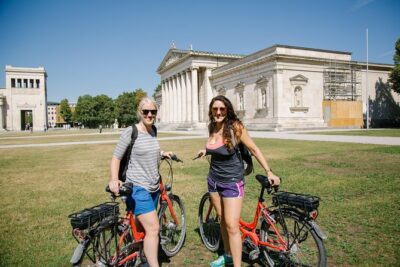
One of the first major stops is Königsplatz, a broad square known as a center of Munich’s cultural life. Its monumental architecture gives the tour an immediate sense of scale.
This is a good place to hear how Munich presents itself as a city of museums, arts, and classical design. The square is not just a pretty backdrop. Its buildings and open space reflect the ambitions of Bavaria’s rulers and the changing political uses of public architecture.
Königsplatz also helps explain Munich’s darker modern history. The guide gives you a primer on the city’s role in the rise of Hitler and National Socialism, including the nearby Führerbau, or Hitler’s former headquarters.
That part of the tour deserves attention. Munich is often sold through beer halls, handsome squares, and royal traditions, but its 20th-century story cannot be separated from the city center. Seeing these locations in person gives the historical discussion a clear physical setting.
The treatment is an introduction rather than an extended memorial tour. If you want a detailed study of Nazi history, you will need a separate visit to Munich’s museums and documentation centers. Still, this stop gives you useful background and prevents the sightseeing from becoming only a parade of attractive buildings.
The Führerbau and Munich’s Difficult Memory
The Führerbau is one of the more serious points on the route. The building is tied to Hitler’s regime and the political history that made Munich a key city in National Socialism.
A guide can add something that a passing glance cannot: context about why the building matters and how Munich’s public spaces were used during that era. You will not spend the whole tour on this subject, but you should expect it to be handled as part of the city’s story, not brushed aside.
This is one reason I would choose a guided ride instead of simply renting a bicycle. Munich’s major buildings do not always explain themselves. Without context, you may photograph a facade and miss why it matters.
Keep your expectations measured. The stop is part of a broad city overview, so the explanation will not replace a dedicated history tour. Its value is in placing the subject alongside Munich’s royal, cultural, and civic landmarks.
Odeonsplatz and the Munich Residenz
Odeonsplatz brings you into another side of Munich. The square is linked to the city’s royal and architectural identity, and the nearby Munich Residenz was the former palace of Bavaria’s royal family.
The Residenz is one of the route’s strongest sightseeing points because it connects political power, court life, and the long history of Bavaria. You may even have the chance to wave to members of the local royal family, according to the tour description, though this is clearly not something to count on.
The ride gives you an exterior introduction rather than a full palace visit. That distinction matters. If you want ornate rooms, collections, and detailed palace displays, set aside separate time to go inside the Residenz.
Even so, seeing the palace as part of the city helps you understand Munich’s layout. Royal buildings are not isolated attractions here. They sit within the same central district as cultural institutions, public squares, shops, and government buildings.
The guide’s stories are likely to make this stop more memorable than a quick photograph. Past feedback repeatedly praised guides for their humor, patience, and ability to explain Munich through stories rather than a string of dates. Rob received especially warm praise for making the information lively, while Dan was singled out for his history explanations and patient manner.
Guide assignments can change, so treat those names as examples rather than a promise. The important point is that the experience depends heavily on the person leading it. A good guide can turn a short stop into a useful lesson.
Same roads, a different day in the saddle:
- Munich: Guided City Tour by Bike with Beer Garden Stop
★ 4.7 · 604 reviews - Munich Small-Group Bike Tour
★ 4.5 · 510 reviews - Munich by Bike: Half-Day Tour with Local Guide
★ 4.7 · 417 reviews - Munich: Bike Tour with Beer Garden Break
★ 4.9 · 391 reviews
The Bavarian National Theatre
The Bavarian National Theatre adds another piece to Munich’s cultural identity. Its location near the Residenz makes it a natural part of the central route, and its grand appearance fits the city’s royal and artistic character.
You will likely see it as part of the outdoor sightseeing portion rather than attend a performance. That keeps the tour moving, but it also means you should not expect an interior visit or theater program to be included.
I like this kind of stop on a first-day route. It broadens your picture of Munich beyond churches and beer halls. The city’s public identity is tied to music, theater, museums, and court culture, and the National Theatre makes that visible.
The English Garden and the Eisbach Wave
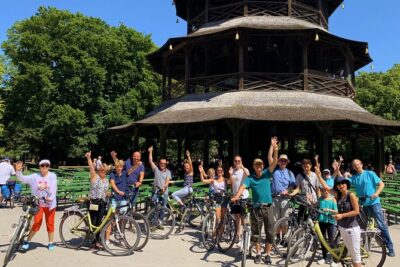
The English Garden gives the tour a change of mood. After the formal squares and imposing buildings, you reach one of Munich’s best-known green spaces.
The highlight here is the Eisbach Wave, where river surfers ride a standing wave in the middle of the city. It is an odd and memorable sight: serious surfing technique in a setting far from the coast.
You will have time to watch the surfers and take in the scene. The stop is short enough to keep the tour on schedule, but it provides a welcome break from architectural history. It also shows you how Munich residents use their city in ordinary life.
The Eisbach Wave can draw a crowd, and the water is powerful. Follow the guide’s instructions and keep a safe distance from the edge. This is a viewing stop, not an invitation to enter the river or try the wave yourself.
The English Garden portion also gives you a sense of how much open space Munich contains near its central districts. You will not explore the entire park in 150 minutes, but the route offers a useful first taste and helps you decide if you want to return on foot later.
The Guide Makes the Difference
The strongest pattern in the feedback is praise for the guides. Rob was described as engaging and highly informed, with one group rating the outing among its best guided city experiences. Dan was praised for his history knowledge and patience, while Achim was remembered for mixing sharp historical detail with humor.
Other comments point to useful practical qualities. One guide adjusted the route and pace for different abilities. Another helped participants who were unsure at first, and the tour was extended after some guests had trouble finding the meeting point.
Those details matter because a bicycle group is rarely perfectly even. Some people cycle every day. Others need a few minutes to feel comfortable starting, stopping, and keeping position in a group.
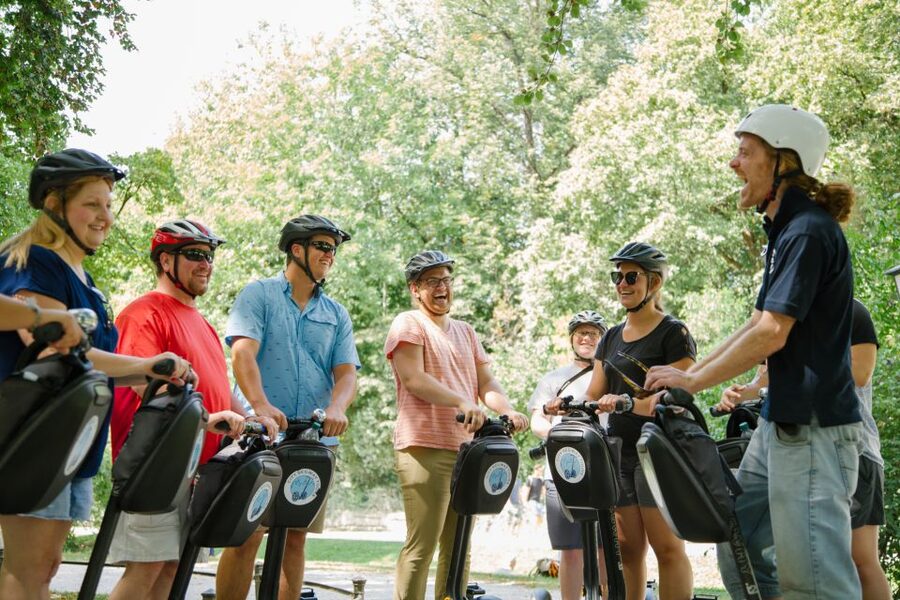
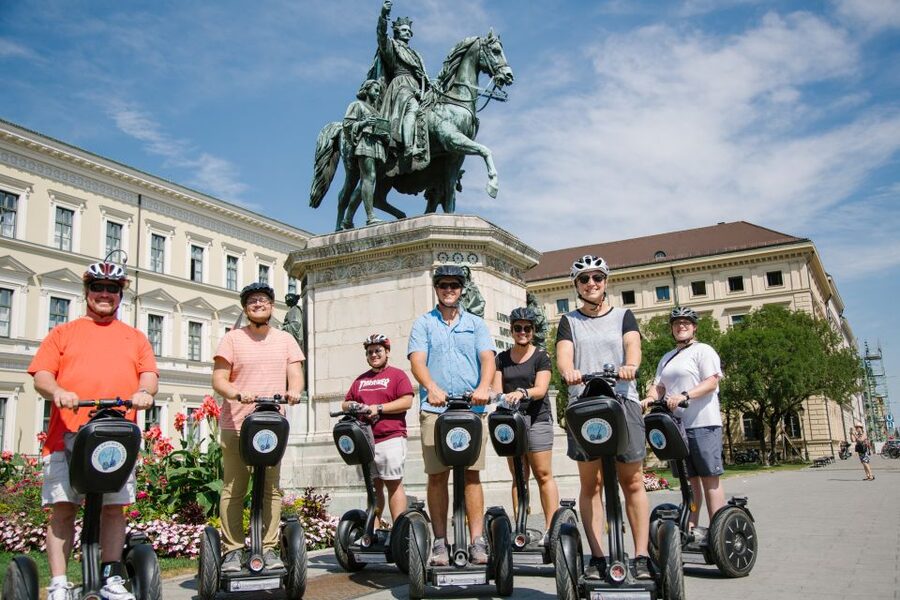
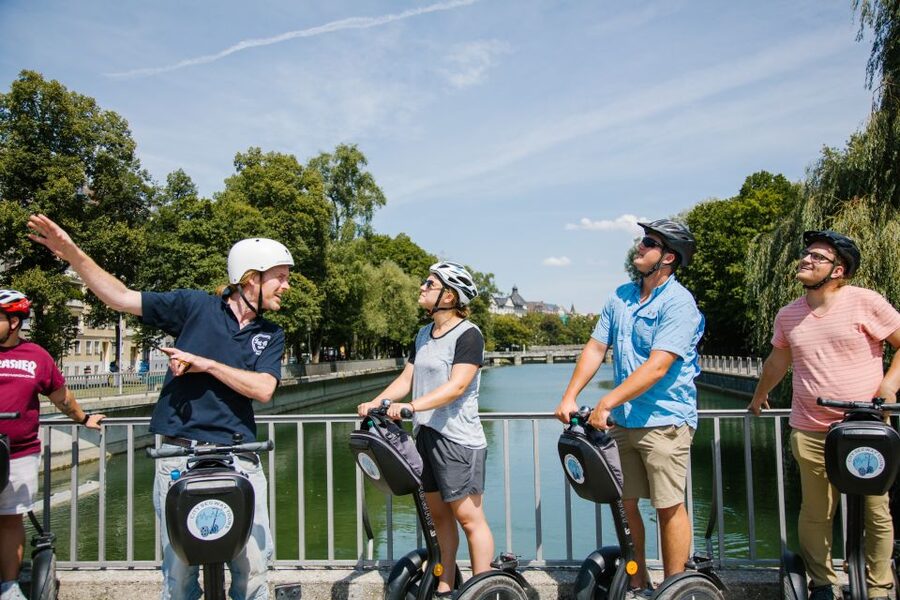
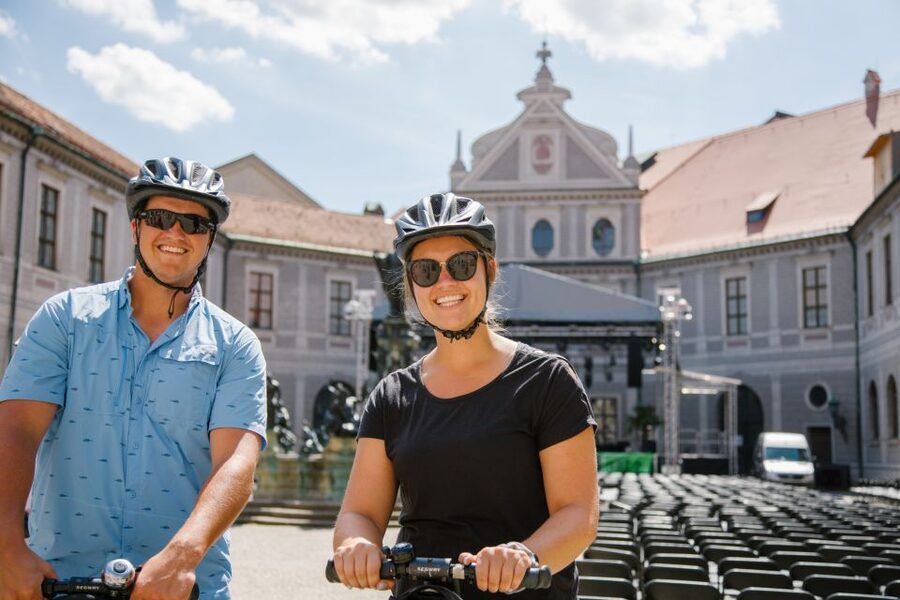
Several past comments actually describe a Segway rather than a bicycle. Since the current experience information specifies bicycles, you should confirm the vehicle when booking if that distinction matters to you. The praise for patient instruction and careful pacing is still useful, but do not assume that Segway equipment is part of this bicycle tour.
The tour is offered in English with a live guide. If you enjoy asking questions, listen closely during the stops and use the moving sections to notice how the neighborhoods change.
Pace, Comfort, and Practical Limits
The tour lasts 150 minutes, including riding and sightseeing stops. That makes it a strong choice for a first morning or afternoon in Munich, especially if your schedule also includes museums, a palace visit, or a day trip.
The pace will be quicker than a walking tour. You should be comfortable riding a bicycle and paying attention to the group around you. The tour is not described as suitable for unaccompanied minors, and anyone under 18 must be with an adult.
There is no food stop included. Eat beforehand if you tend to get hungry during active outings, or plan a meal afterward. The tour is short enough that this is not a major problem, but you should not expect a snack break along the way.
Bad weather does not normally stop the ride. Bring layers and rain protection rather than assuming the tour will be rescheduled for a light shower. Closed shoes are required, and open-toed footwear is not allowed.
Free cancellation is available up to 24 hours before departure for a full refund. You can also reserve now and pay later, which helps if your Munich plans are still shifting.
Who Will Get the Most From This Tour
I would recommend this ride to first-time visitors who want a clear introduction without spending half a day on foot. It is also useful for anyone staying near the central station or Karlsplatz, since the meeting point is simple to reach.
Families with older children and teenagers may enjoy the combination of movement, history, royal buildings, and the Eisbach surfers. Minors must have an adult with them, and everyone should be comfortable following group instructions.
The tour also suits repeat visitors who want a quick look at parts of Munich they missed before. One past participant who already lived in Munich still found unfamiliar sights along the route. That is a good sign for the route’s variety.
I would choose something else if you want long museum visits, a slow photographic outing, or a detailed examination of Nazi-era sites. You may also prefer a walking tour if cycling in traffic makes you nervous.
Should You Book the Munich Essentials Bike Tour?
Book it if you want to get your bearings quickly, see Munich’s major central sights, and hear the stories that connect them. The mix of Königsplatz, the Führerbau, Odeonsplatz, the Residenz, the National Theatre, and the Eisbach Wave gives you more variety than the modest price suggests.
The main tradeoff is limited time at each stop. Think of this as a guided overview that helps you choose what to revisit, not a substitute for entering every major building.
At $37, the tour offers solid value for busy visitors, active families, and anyone who prefers seeing a city in motion. Check the vehicle details if you have seen references to Segways, dress for the forecast, arrive early at Karlsplatz, and book it early in your stay so the guide can help shape the rest of your Munich plans.
FAQ
How long is the Munich Essentials Bike Tour?
The tour lasts 150 minutes, or two and a half hours.
What is included in the price?
The price includes a professional local guide, a bicycle, and a helmet. An eBike upgrade is available.
Where does the tour meet?
It meets at Karlsplatz, also called Stachus, at the shop at Karlsplatz 4. From the fountain, keep your back to Karlstor and the pedestrian zone, turn right onto Sonnenstraße, and walk about 50 meters.
What language is the tour offered in?
The live guided tour is offered in English.
Does the tour run in the rain?
Yes. The tour runs rain or shine except in extremely inclement weather. Dress appropriately for the forecast.
Can children join the tour alone?
No. Unaccompanied minors are not allowed. Anyone under 18 must be accompanied by an adult.
Just added around Munich
- Munich: Street Art Bike Tour★ 4.6 · 66 reviews
- Munich: Mini Classic Bike Tour with Beer Garden Stop at 4 PM★ 4.8 · 28 reviews
- Munich: Neuschwanstein Castle by Bus with Alpine Bike Ride★ 4.9 · 217 reviews
- Best of Munich Electric Bike Tour★ 4.7 · 23 reviews
- Best of Munich Electric Bike Tour★ 5.0 · 38 reviews
- Munich City Bike Tour + Beer Garden Lunch Stop★ 5.0 · 283 reviews
- Munich: Bike Tour with Beer Garden Break★ 4.9 · 391 reviews
- Munich by Bike: Half-Day Tour with Local Guide★ 4.7 · 417 reviews
Munich Cycling Tours, compared.
Classic Mike’s Bike Tour daily @ 11.30 incl Beer Garden & Surfers
Read our review →
Neuschwanstein Castle by Bus Incl. Bike Ride or Hohenschwangau
Read our review →
Browse the lists this tour appears in