
REVIEW · ITALY
Rome: Monuments and Belvederes Bike Tour
Rome rewards those who keep moving. This three-hour bike tour links ancient ruins, grand piazzas, hilltop views, and famous fountains without asking you to cross the city on foot. I like the way it covers both headline sights and less obvious corners, especially Trastevere and Aventine Hill. I also like the live storytelling, with guides such as Lorenzo, Mario, and Maurizio praised for useful anecdotes and friendly help.
The main catch is simple: you need to be comfortable riding a bike. Rome is not flat, and the route includes hills, narrow streets, and a packed run of sights. At $71 per person, the price is fair if you want a broad orientation with a guide, bike, helmet, and child seat, but it is not the right pick if you prefer slow visits inside museums or monuments.
Key things to know before you pedal off
- Aventine Hill gives you an early city view, helping you see Rome from above before the route reaches its busiest sights.
- The Colosseum and Circus Maximus are viewed from outside, so this is a sightseeing tour, not an interior visit.
- The route moves from ancient Rome to Baroque Rome, taking in Trevi Fountain, the Spanish Steps, Piazza Navona, and Bernini’s Fountain of the Four Rivers.
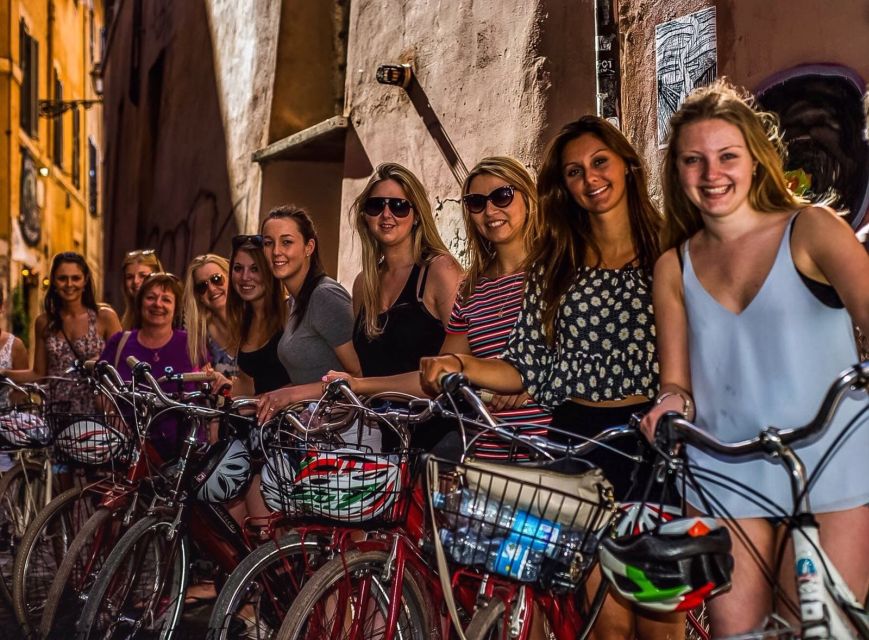
- Trastevere is both the starting point and part of the experience, with narrow medieval streets and a more local feel than the grand avenues.
- The final stretch reaches Castel Sant’Angelo and Saint Peter’s Basilica, giving you a strong Vatican-area finish.
- English, French, Spanish, and Italian tours are available, and cancellation is free up to 24 hours before departure.
Why this bike tour works for a first look at Rome
Rome can feel like three cities piled on top of one another. Ancient imperial ruins sit beside Renaissance churches, Baroque fountains, and ordinary neighborhood streets. A bike helps you connect those pieces quickly.
This tour begins at Via di S. Calisto, 9, in Trastevere, and returns to the same place. That round trip matters. You are not left at the far end of town trying to find your way back to your hotel or figure out Rome’s transport system after three hours on a saddle.
I like the route’s broad sweep. In one outing, you see the Colosseum, Roman Forum views, Trevi Fountain, Spanish Steps, Piazza Navona, and Saint Peter’s Basilica. You also get several elevated viewpoints, including Aventine Hill, Capitoline Hill, and the Pincio balcony.
The tradeoff is pace. You get photo stops and guided sightseeing, but not long visits at each monument. Think of this as a smart city introduction, not a substitute for entering the Colosseum, Vatican Museums, or other major sites.
A few more days on two wheels around Italy worth a look
- Rome EBike Tour: Appian Way, Catacombs & Roman Aqueducts
★ 5.0 · 1,766 reviews - Rome: Top Highlights & Hidden Gems Tour by Cannondale E-Bike
★ 4.9 · 1,760 reviews - Rome: Appian Way & Aqueducts E-Bike Tour (Catacombs & Food)
★ 4.9 · 1,498 reviews
Starting in Trastevere at Via di S. Calisto, 9
The meeting point is in Trastevere, one of Rome’s most atmospheric districts. The tour begins and ends at Via di S. Calisto, 9, so arrive 15 minutes early. That gives you time to meet the guide, get your bike, and sort out the helmet or child seat before the group starts rolling.
Trastevere is known here for its narrow streets and medieval character. This opening section gives the tour a pleasant contrast with the monumental Rome ahead. Instead of beginning beside a huge ruin or crowded square, you start among smaller lanes and neighborhood buildings.
I would wear clothes that allow easy movement and shoes suited to pedaling. Bring a passport or identity card, or a copy, since that is listed among the required items. Food and drinks are not included, so carry water if you need it during the three-hour ride.
Aventine Hill and the first panoramic view
The route heads to Aventine Hill, where one of Rome’s finest views opens across the city. This is one of the strongest parts of the tour because the view gives context to everything that follows.
Rome can be hard to understand from street level. From a hill, the domes, rooftops, ruins, and distant landmarks begin to form a single picture. Your guide also uses this stop to explain the city’s past and point out details you could miss on your own.
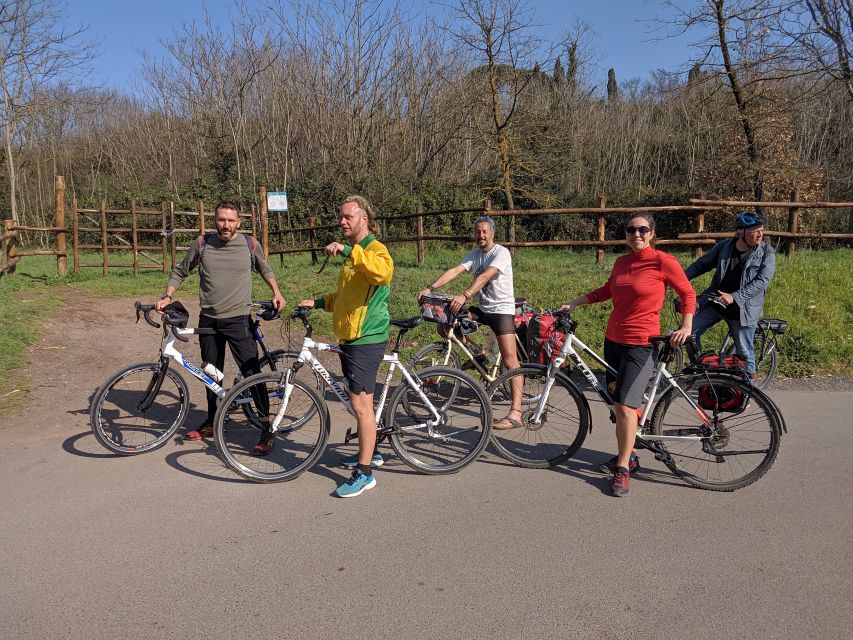
The hill is not just a photo stop. It sets the rhythm of the tour: pedal, pause, listen, and take in the view. Still, you should expect some uphill riding. If you are not a regular cyclist, this is worth considering before booking.
Circus Maximus and the Colosseum
From Aventine Hill, the ride reaches Circus Maximus and then the Colosseum. These are two of the clearest links to imperial Rome.
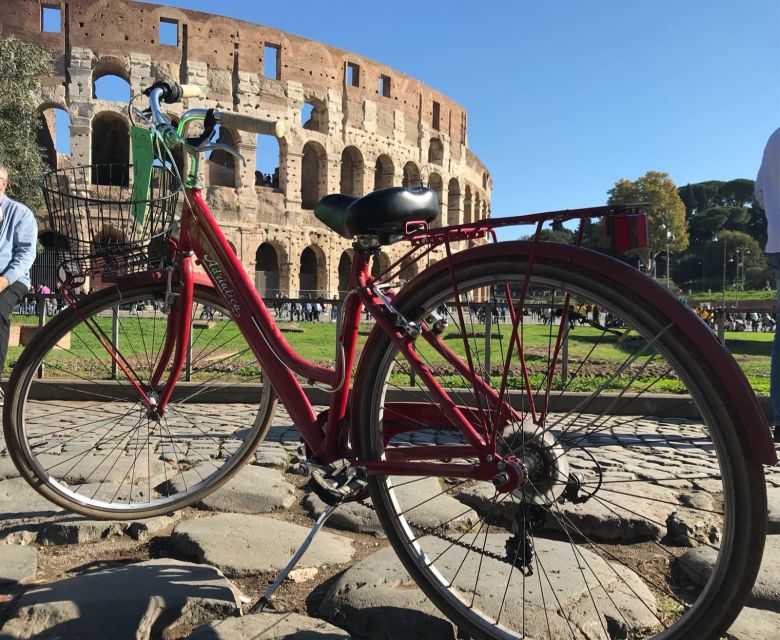
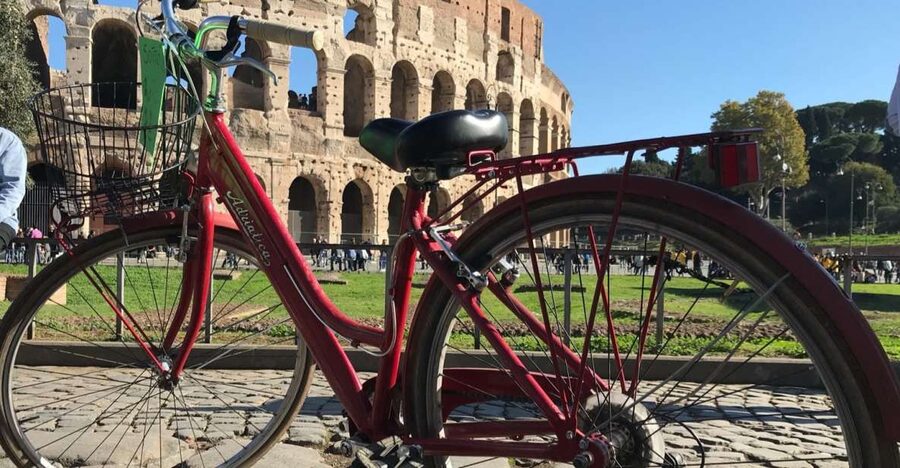
Circus Maximus was once a vast racing ground, while the Colosseum remains Rome’s great symbol of imperial power. Seeing both in sequence helps you understand the scale of the ancient city. The Colosseum is not treated as an isolated photo backdrop. It appears as part of a larger Roman setting, connected to the hills and ruins around it.
The tour includes sightseeing and photo stops, but it does not include entry into the Colosseum. That distinction is important. If you want to walk through the amphitheater, inspect its underground levels, or spend time with an archaeological guide inside, you will need a separate ticket and visit.
I like this outdoor approach for a first day in Rome. You get the famous view without using several hours of your schedule. Later, you can return to the Colosseum with a timed admission if you decide the interior deserves more attention.
Same roads, a different day in the saddle:
- Rome: Appian Way, Catacombs, & Roman Aqueducts E-bike Tour
★ 4.9 · 1,421 reviews - Rome City Small Group Bike Tour with quality Cannondale EBike
★ 5.0 · 1,380 reviews - Milan: Hidden Gems Guided Bike Tour
★ 4.8 · 1,334 reviews - Tuscany Bike Tours Through the Chianti Hills with Wine Tasting
★ 5.0 · 1,300 reviews
Capitoline Hill and views over the Roman Forum
Capitoline Hill brings the ancient story into sharper focus. From here, you can look toward the Roman Forum, where temples, basilicas, and civic buildings once formed the center of Roman public life.
The viewpoint is valuable because the Forum is easier to grasp from above. At ground level, the ruins can feel like a maze of columns and broken walls. From Capitoline Hill, the remains spread out in a more readable pattern.
Your guide explains the secrets and stories of ancient Rome along the way. Past feedback gives special weight to the storytelling. Lorenzo was praised for adding anecdotes and even suggesting restaurant addresses at the end, while other guides, including Mario and Maurizio, received warm praise for giving a broad overview in a small group.
The tour does not promise admission to the Forum. You are seeing the area from the outside and from a lookout. That keeps the ride moving, but it also means history fans may want a separate archaeological visit.
Trevi Fountain and the Spanish Steps
After imperial Rome, the route shifts to the city of fountains, palaces, churches, and grand stairways. Trevi Fountain is one of the tour’s central photo stops.
The fountain is famous for its theatrical design and busy atmosphere. You will have time to see it and hear about its place in Rome, but do not expect a quiet, private encounter. This is one of the city’s most popular sights, and the stop works best if you treat it as a quick look rather than a long pause.
The Spanish Steps follow, with Trinità dei Monti church above them. This part of the route shows another side of Rome: elegant, highly designed, and built for urban drama. The steps and fountain below are easy to recognize, but the guide’s context can help tie the scene to the wider history of the city.
Because you are on bicycles, you will not linger as long as you might on a walking tour. That is a limitation, but it is also the reason this outing fits so many sights into three hours.
The Pincio balcony and Piazza del Popolo
The Pincio balcony adds another high viewpoint. From here, the city opens toward Piazza del Popolo and the surrounding rooftops.
I value this stop because the tour is not only about ticking off famous monuments. The elevated views break up the street riding and give you time to look at Rome as a whole. You also get a better sense of how the historic center is arranged.
Piazza del Popolo is another broad, formal space in contrast to the tight lanes of Trastevere. The route gives you a chance to photograph the square and take in its scale before returning to the older lanes of the city center.
The sequence of Aventine Hill, Capitoline Hill, and Pincio works especially well. Each view has a different angle, so the three stops do not feel like repeats.
Piazza Navona and Bernini’s fountain
The route eventually reaches Piazza Navona, one of Rome’s most impressive urban spaces. The square follows the outline of an ancient stadium, and its long shape makes it feel different from the more compact Trevi area.
The main artistic focus is Bernini’s Fountain of the Four Rivers. Its figures, rocks, and central obelisk create the kind of theatrical Baroque scene Rome does so well. Your guide can help you read the fountain instead of simply photographing it and moving on.
Piazza Navona is also a good place to notice how Rome mixes daily life with grand decoration. It is a functioning city square, not a museum room. You may find people sitting, walking, eating, or stopping for photos around the same fountain that draws art fans from around the world.
The route also passes through Rione IV Campo Marzio, a historic district that adds more street-level character to the ride. This section helps connect the major piazzas rather than treating each one as a separate postcard.
Castel Sant’Angelo and Saint Peter’s Basilica
The closing section brings you toward Castel Sant’Angelo and Saint Peter’s Basilica. The contrast here is striking: a former fortress beside one of Christianity’s most famous churches, with the river and central Rome tying the view together.
The tour ends with sightseeing rather than a visit inside Saint Peter’s Basilica. That is useful to know if you are planning a full Vatican day. You will see the exterior and get a strong orientation to the area, but you will not have time for the basilica’s interior, the Vatican Museums, or the Sistine Chapel on this tour.
As an ending, it works well. After ancient ruins, fountains, steps, and hilltop views, the Vatican area gives you one last major landmark before the ride returns to Trastevere.
The guides and the value of the storytelling
The guide can make or break a city bike tour. Here, the strongest praise centers on friendly service, clear explanations, and stories that add life to the monuments.
Lorenzo is specifically remembered for unusual anecdotes, church visits, and restaurant suggestions. Mario and Maurizio are also associated with different routes in Rome, including a less usual option that still gave a solid three-hour overview. The available tours are offered in English, French, Spanish, and Italian.
I would ask at booking which language is scheduled for your chosen departure. A live guide in a language you follow comfortably makes a big difference, especially when the route moves quickly and the city noise rises around you.
The bike, helmet, and child seat are included. A child seat can make the tour workable for some families, but the person riding the bike must be able to do so. The experience is not suitable for anyone who cannot ride.
Is $71 a fair price for three hours?
At $71 per person, this is not the cheapest way to see Rome. You can walk around many of these areas for free, and public transport costs far less. But a bike tour gives you a guide, equipment, a planned route, and the ability to connect distant areas in one morning or afternoon.
The value is strongest if you have limited time in Rome or want help getting your bearings fast. It is also useful early in a stay, since you can return later to the Colosseum, Forum, Trevi Fountain, or Vatican area with a better sense of where everything fits.
The value is weaker if you want long museum visits, detailed archaeological study, or a slow food-centered outing. You are paying for coverage and interpretation, not entry tickets or meals.
Free cancellation up to 24 hours before departure and the option to reserve now and pay later add useful flexibility. Starting times vary, so check availability before setting your day around the ride.
Who should book this Rome bike tour?
I would recommend it to first-time Rome visitors who want to see the city’s major sights in a compact outing. It suits active couples, families who can manage the cycling, and anyone who prefers moving through a city rather than spending a full day at one monument.
It is also a good choice for visitors who want more than the usual center-city route. Trastevere, Aventine Hill, the Pincio balcony, and the Capitoline viewpoint give the tour a wider range than a simple Colosseum and Trevi circuit.
I would skip it if cycling makes you nervous, if hills are a serious problem, or if you want to enter every major attraction. Rome’s traffic, narrow streets, and busy public spaces require attention. You should feel comfortable riding in an active city setting.
My verdict on the three-hour route
I like this tour because it gives Rome a clear shape. You move from Trastevere to imperial ruins, from hilltop viewpoints to Baroque fountains, then toward Saint Peter’s Basilica before returning to the starting point.
The best features are the broad route, the repeated city views, and the guides’ story-based approach. The main limitation is that nearly everything is seen from outside. Book it for orientation, local context, and efficient sightseeing. Skip it if your priority is indoor access or a slow, detailed visit at one site.
FAQ
How long is the Rome bike tour?
The tour lasts three hours.
How much does the tour cost?
The listed price is $71 per person.
Where does the tour start?
The starting point is Via di S. Calisto, 9, in Rome.
Does the tour return to the starting point?
Yes. The ride returns to Via di S. Calisto, 9.
Which landmarks are included?
The route includes Trastevere, Aventine Hill, Circus Maximus, the Colosseum, Capitoline Hill, Trevi Fountain, the Spanish Steps, the Pincio balcony, Piazza del Popolo, Piazza Navona, Castel Sant’Angelo, and views of Saint Peter’s Basilica.
Does the tour enter the Colosseum or Saint Peter’s Basilica?
No interior admission is listed. The tour provides sightseeing and photo stops at these landmarks.
Which languages are available?
Live guided tours are available in English, French, Spanish, and Italian.
Is a bike and helmet provided?
Yes. The bike and helmet are included, and a child seat is also available.
Can I cancel the booking?
Yes. You can cancel up to 24 hours before the activity for a full refund. You can also reserve now and pay later.
Just added around Italy
- Discovering Chianti, e-bike tour – daily experience★ 5.0 · 20 reviews
- Mountain bike tour of the Madonie from Cefalù★ 5.0 · 38 reviews
- Cagliari E-Bike Tour: Gulf, Canals & Flamingos at Molentargius★ 5.0 · 79 reviews
- Private Bike Tour with Olive Oil Tasting★ 4.5 · 15 reviews
- E-bike tour in Ostuni. Oil mill, Dolmen and huge olive trees★ 5.0 · 13 reviews
- E-Bike tour and Wine tasting from Desenzano Inland★ 5.0 · 24 reviews
- Desenzano e-bike tour★ 5.0 · 17 reviews
- Bologna Panoramic Bike Tour★ 4.0 · 14 reviews
Italy Cycling Tours, compared.
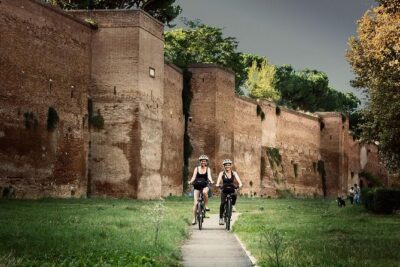
Rome EBike Tour: Appian Way, Catacombs & Roman Aqueducts
Read our review →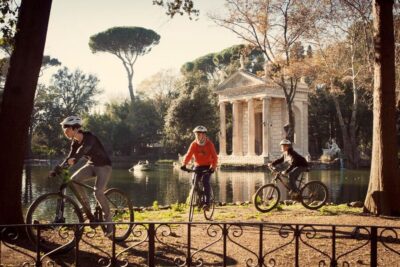
Top Highlights & Hidden Gems Tour by Cannondale E-Bike
Read our review →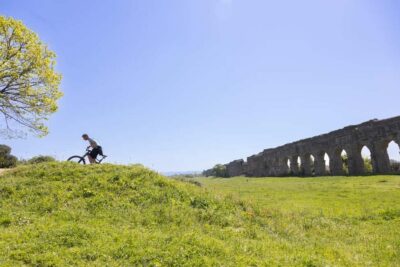
Appian Way & Aqueducts E-Bike Tour (Catacombs & Food)
Read our review →
Appian Way, Catacombs, & Roman Aqueducts E-bike Tour
Read our review →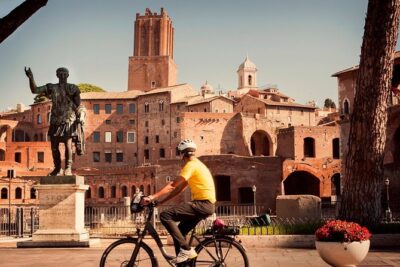
Rome City Small Group Bike Tour with quality Cannondale EBike
Read our review →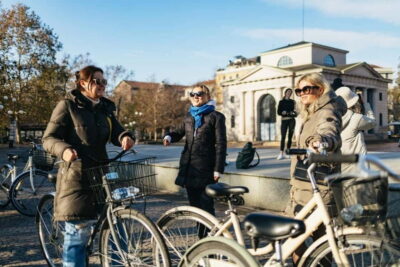
Tuscany Bike Tours Through the Chianti Hills with Wine Tasting
Read our review →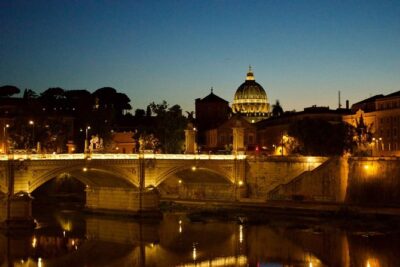
Rome by Night – Ebike Small Group Tour – Food and Wine (Option)
Read our review →Browse the lists this tour appears in