
REVIEW · ROME
Appian Way, Catacombs and Aqueducts Park Tour with Top E-Bike
Ancient Rome feels bigger on two wheels. This tour links the Appian Way, catacombs, imperial ruins, and aqueducts in one long ride, using an electric-assist bike to cover ground that is awkward by foot. I especially like the small groups of up to 10 and the way the route gets you beyond Rome’s usual center. The main catch is that this is not a beginner’s bike outing: about 40 percent takes place on city streets, and some park paths are rough or tight.
I also like the choice between a four-hour and six-hour route. The longer version adds a proper catacomb visit, Villa dei Quintili, and the Baths of Caracalla, making it the better buy if you have the time. Still, Sunday crowds, narrow paths, traffic, and bumpy ground can make the ride more demanding than the electric motor suggests.
Key points to know before you book
- 27 kilometers of Rome beyond the usual sights: The route connects the Appian Way Park with the Aqueducts Park, covering about 17 miles.
- The six-hour tour offers the fuller experience: It includes a 45-minute guided catacomb visit, Villa dei Quintili, and the Baths of Caracalla.
- Electric assist helps, but does not replace bike skills: You still need to control the bike on rough surfaces, narrow paths, and city streets.
- A small group makes a real difference: The maximum is 10 people, so guides can keep an eye on the group and answer questions.
- The route is partly urban and partly rural: About 60 percent is off-road, while the city sections require attention around traffic.
- Weekday timing is worth considering: Sundays can bring many walkers and cyclists to the parks, making the ride feel crowded.
Why this is one of Rome’s best outdoor history tours
Rome is easy to experience as a parade of famous monuments. The Colosseum, Pantheon, and Vatican fit neatly into a city itinerary. The Appian Way does not. Its ancient road, open fields, catacombs, aqueducts, and scattered ruins stretch across a large area south of the center.
That distance is the reason this e-bike tour makes sense. Walking gives you only a small taste of the Appian Way before fatigue and transportation problems take over. A taxi can get you there, but it will not give you the same connection to the road, parks, and old structures.
The e-bike solves much of the distance problem. You still pedal, but the motor takes the sting out of longer stretches and helps you keep moving for four to six hours. Several guides receive especially strong praise for combining safety with good storytelling, including Arina, Bita, Claudia, David, Fabio, Francesca, Han, Khalid, Lorenzo, Stefan, and Zac.
The ride is not effortless sightseeing. You need to be comfortable balancing, braking, turning, and riding in a group. The electric motor helps on the physical side, but it cannot steer around a pedestrian or keep you upright on a rough patch.
More E-Bike Tours in Italy
- Rome EBike Tour: Appian Way, Catacombs & Roman Aqueducts
★ 5.0 · 1,766 reviews - Rome: Top Highlights & Hidden Gems Tour by Cannondale E-Bike
★ 4.9 · 1,760 reviews - Rome: Appian Way & Aqueducts E-Bike Tour (Catacombs & Food)
★ 4.9 · 1,498 reviews
Starting at Porta San Sebastiano and the Aurelian Walls
The tour begins at Via Labicana 49, within reach of public transportation. After fitting a helmet and getting familiar with the bike, the group heads toward Porta San Sebastiano.
This large gate belongs to the third-century Aurelian Walls, the defensive ring that once enclosed Rome. It is a fitting opening because the tour quickly moves from the familiar city into an older, quieter part of Rome.
The first section includes city riding. The route is planned to limit traffic, but traffic is not absent. You should expect some narrow bike paths and city streets where you need to stay alert and follow the guide closely.
This part can feel slow to riders used to cycling alone. The group rides together, and one less confident cyclist can affect the pace. That caution is useful for safety, but it also explains why the tour may feel restrained at times.
Riding the Ancient Appian Way
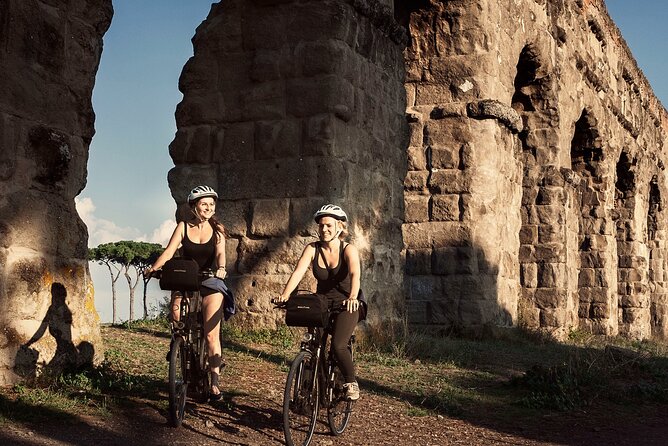
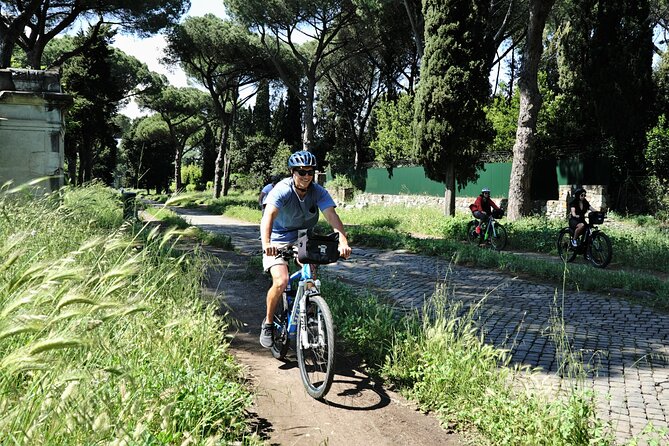
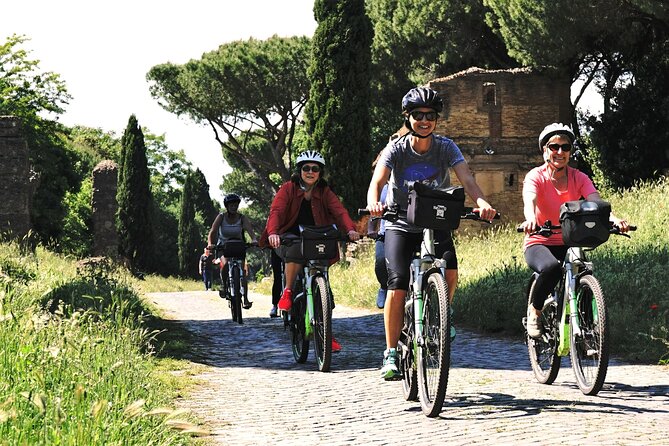
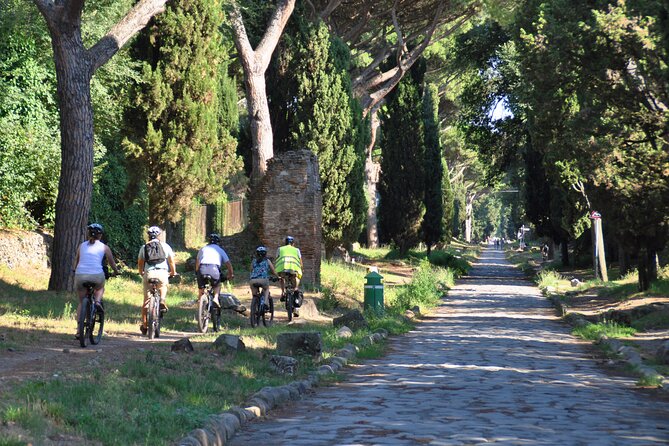
The Via Appia Antica begins as a road that can seem almost ordinary. Then the setting changes. Modern Rome falls away, and the old route takes on a rural character, with ancient stones, open ground, hills, valleys, and sheep grazing in the distance.
The Appian Way is valuable because it does not present Rome as a polished museum. The road is uneven, and the ruins are spread out rather than arranged in a tidy row. You see how ancient routes connected the city with the wider Roman world while also experiencing the countryside that now surrounds the capital.
The electric bikes are especially useful here. They let you spend more energy looking around instead of worrying about every rise in the road. Still, the paving and trails can be bumpy. Anyone with back or neck trouble should think carefully before booking, since the rough surface can become uncomfortable over several hours.
You will also want to resist the temptation to stare at every ruin while riding. Photo stops are limited, and the safest approach is to wait for the guide to pause rather than trying to take pictures in motion.
The catacombs: a short stop or a full visit
The catacombs are handled differently depending on your chosen duration. On the four-hour tour, you get a short pause near the Catacombs of San Callixtus. The site represents a huge underground burial area associated with roughly half a million people, giving you a sense of the scale even without a full visit.
The six-hour tour includes a 45-minute guided visit inside the catacombs. This is the stronger option if underground Christian burial sites are a major reason you want to take the tour. You get more context and time to understand the structure, purpose, and mystery of these second-century spaces.
On Wednesdays, the route changes. The four-hour tour does not include the San Callixtus stop, while the six-hour tour visits the Catacombs of San Sebastiano instead. The route can also run about 30 minutes longer on Wednesdays.
The catacombs are not for everyone. Underground spaces can feel confined, and one account described a large queue and a crowded visit as uncomfortable. If you dislike tight spaces, the shorter option may be a better fit, though it offers less time inside.
More E-Bike Tours in Rome
- Rome: Appian Way, Catacombs, & Roman Aqueducts E-bike Tour
★ 4.9 · 1,421 reviews - Rome City Small Group Bike Tour with quality Cannondale EBike
★ 5.0 · 1,380 reviews - Rome by Night – Ebike Small Group Tour – Food and Wine (Option)
★ 5.0 · 1,275 reviews - Rome by Night: E-bike Small Group Tour -Food & Wine (Option)
★ 4.9 · 1,233 reviews
Circus of Maxentius and Cecilia Metella
The next section brings you to the remains of the Circus of Maxentius, part of a fourth-century imperial complex. The complex included a villa, a mausoleum, and a circus used for chariot racing.
You may spend only a few minutes here, but the stop helps you picture the scale of imperial Rome. The remains are not presented as a long archaeological visit. Instead, the guide uses the site as one piece of a larger ride, explaining what you are seeing before the group continues.
Nearby, the Mausoleum of Cecilia Metella is one of the best-preserved structures on the Appian Way. This first-century funerary monument was built for a young woman from a patrician family. Its size tells you something about status in ancient Rome: a private tomb could be built with the presence of a fortress.
The short stops are a strength and a limitation. You cover many important places, but you will not receive the same amount of time you would on a dedicated archaeological tour. I see this experience as a broad look at the Appian Way, not a substitute for studying each ruin in detail.
What the six-hour route adds at Villa dei Quintili
The six-hour version continues to Villa dei Quintili and Santa Maria Nova. This sprawling second-century private villa once belonged to two very wealthy brothers connected with the Roman imperial world.
The site adds a different side of ancient Rome. The Appian Way gives you roads, tombs, and public infrastructure. Villa dei Quintili shows how powerful Romans lived in large private complexes outside the city center.
The stop itself is brief in the stated itinerary, but riding through this wider archaeological area gives the six-hour route more range. You see not just the road, but the estates and institutions that grew around it.
If you are choosing between the two durations, this is one reason to select six hours. The longer tour is not simply a slower version of the shorter ride. It reaches more of the archaeological park and adds places that the four-hour schedule cannot fit.
Aqueducts Park and Rome’s open countryside
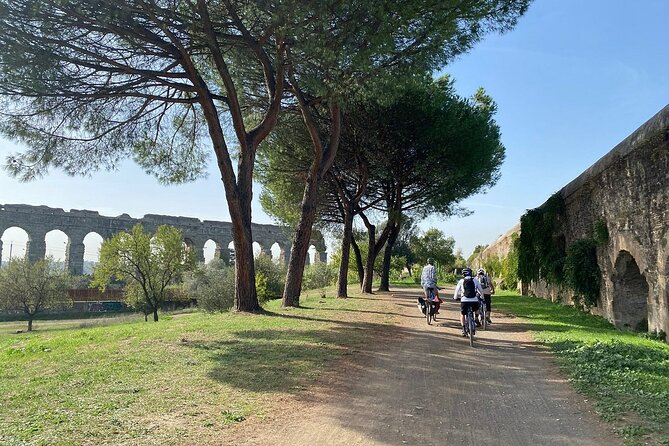
The Aqueducts Park is the visual high point for many people. Huge arches cross the open ground, marking the remains of Rome’s ancient water system.
Your guide explains how water reached the city through underground channels and elevated aqueducts. The structures are impressive on their own, but the setting makes them more striking. Instead of being hemmed in by modern buildings, they stretch across open fields and broad skies.
This is also where the tour feels furthest from central Rome. The parks offer green valleys and hills, with large sheep herds grazing nearby. The scenery gives you a welcome break from stone streets and crowded squares.
You may have a chance to buy food or drinks along the route, but nothing is included. Bring water and consider carrying a small snack, especially on the six-hour outing. A picnic-style break among the aqueducts can be memorable, but you should not count on a full meal being part of the tour.
The Aqueducts Park can become crowded on Sundays with local walkers and cyclists. That makes weekday departures preferable if your schedule allows. The same paths that feel peaceful on a quieter day can require constant attention when filled with other park users.
The Baths of Caracalla on the six-hour route
The six-hour tour finishes its main sightseeing with a view of the Baths of Caracalla. These enormous public baths were central to Roman social life, not just places for washing.
The ruins help explain how Roman public life operated. Baths offered space for exercise, conversation, relaxation, and social contact. Even a short stop gives the guide a chance to connect the building with the daily routines of ancient residents.
The Baths of Caracalla are seen from a useful vantage point rather than treated as a long indoor visit. That keeps the tour moving, but it also means you should not book this ride expecting extended time at every monument.
Bikes, safety, and the actual riding effort
The tour supplies a quality e-bike with anti-puncture tires, a helmet, a front bag, and a biodegradable water bottle. Helmets are required for everyone.
The bikes make the route manageable for many people who do not cycle regularly. One couple in their sixties found the ride comfortable with the electric assist, while families with teenagers often appreciated getting away from the walking demands of central Rome.
That does not mean the tour suits every casual cyclist. The stated difficulty is intermediate, and it becomes difficult with a child seat or child extension. Children aged five to eight can use a child streamliner, while children aged nine and older can ride an appropriately sized e-bike independently.
The provider describes the route as safe, with carefully planned streets and traffic-free park sections. A more precise reading is useful: the park riding is generally calmer, but 40 percent still takes place in the city. You should be confident enough to ride near traffic and manage narrow spaces.
The group pace can also divide opinion. Some people appreciate the careful speed and close supervision. Others may find the group too slow, especially when the e-bike has plenty of battery left. You are joining a guided group, not renting a fast bike for independent exploration.
The equipment has a 300-pound, or 136-kilogram, weight limit. The tour is not recommended if you lack confidence on a bicycle.
Price, group size, and the four-hour versus six-hour choice
At $102.79 per person, this is not the cheapest way to see the Appian Way. The value comes from combining bike rental, guide service, equipment, city connections, and distant archaeological sites in one outing.
For the four-hour version, you pay for a broad route with a short catacomb stop. It works well if your Rome schedule is tight or if you want a taste of the Appian Way and aqueducts without giving up an entire day.
The six-hour version is the better value for most people who have room in their itinerary. You receive a 45-minute guided catacomb visit, Villa dei Quintili, and the Baths of Caracalla. The extra time also makes the 27-kilometer route feel less rushed.
The maximum group size is 10. That is small enough for direct contact with the guide, and it matters when crossing streets or keeping together on rough paths. The tour requires at least four participants, so a cancellation is possible if too few people book, with an alternative or full refund offered.
Free cancellation is available up to 24 hours before the start time. Food and drinks are not included, and gratuities are optional.
Who will enjoy this ride most
I would choose this tour for someone who wants ancient Rome with fresh air, movement, and open space. It is especially good for families with older children, couples who have already seen the central monuments, and anyone who finds a full day of walking tiring.
Teenagers often fit the experience well because the route keeps changing. You move from city walls to ancient roads, underground burial sites, villas, aqueducts, and open parks instead of standing in one crowded archaeological area for hours.
I would not recommend it to a nervous cyclist, someone with serious back or neck concerns, or anyone who wants a quiet, fully off-road ride. You will encounter traffic, narrow routes, pedestrians, other cyclists, and rough surfaces.
For the best chance of a relaxed ride, pick a weekday and the six-hour version. Wednesday requires special attention because the route changes and lasts longer. Also note that the catacombs are closed on Easter Sunday, April 5, 2026, so the six-hour tour will not operate that day.
Should you book the Appian Way e-bike tour?
Book it if you want to see a wider side of Rome than the central monuments allow. The combination of Appian Way ruins, catacombs, aqueducts, sheep-filled parks, and electric bikes creates a memorable day with real variety.
Choose four hours if you want the main scenery and a manageable schedule. Choose six hours if you care about the catacombs and want Villa dei Quintili and the Baths of Caracalla included.
My practical advice is simple: be honest about your cycling ability, avoid Sunday if you can, bring a snack, and allow extra time on Wednesday. For a confident cyclist, this is one of the most efficient and enjoyable ways to reach ancient Rome beyond the city center.
FAQ
Where does the tour start and finish?
It starts at Via Labicana 49, 00184 Rome, Italy, and finishes back at the same meeting point.
How long does the e-bike tour last?
You can choose a tour lasting approximately four or six hours. Wednesday routes may take about 30 minutes longer.
How far do you ride?
The route covers approximately 17 miles, or 27 kilometers.
How much of the route is off-road?
About 60 percent of the route takes place off-road in parks. The remaining 40 percent uses city streets.
Is the catacomb visit included?
The six-hour tour includes a 45-minute guided catacomb visit. The four-hour tour includes only a short pause near the catacombs, and that stop is not included on Wednesdays.
Which catacombs are visited on Wednesdays?
The six-hour Wednesday tour visits the Catacombs of San Sebastiano instead of the Catacombs of San Callixtus.
Are helmets provided?
Yes. Helmets are provided free of charge and are required during the tour.
Can children join the tour?
Children aged five to eight can use a child extension called a child streamliner. Children aged nine and older can ride an appropriately sized e-bike independently.
Is food included?
No. Food and drinks are not included, although the route offers some opportunities to buy them during a suitable break.
Just added around Rome
- Rome: Guided eBike Evening Tour with italian Aperitif★ 5.0 · 16 reviews
- Rome: Villa Borghese, Villa Ada, and Coppedè E-Bike Tour★ 4.8 · 78 reviews
- Sunrise in Rome: Small Group E-Bike Tour & Italian breakfast★ 4.9 · 177 reviews
- Rome: Top 10 Highlights Guided Tour by Bike or E-Bike★ 4.4 · 15 reviews
- Rome: Appian Way, Aqueducts, & Catacombs E-Bike Guided Tour★ 4.9 · 54 reviews
- Rome: Villa Borghese E-Bike Tour (Small Group or Private)★ 4.9 · 92 reviews
- Rome: Panoramic Off-the-beaten-track Cannondale E-Bike tour★ 5.0 · 71 reviews
- Rome: Taste of Rome by quality Cannondale E-Bike★ 5.0 · 12 reviews
E-Bike Tours, compared.
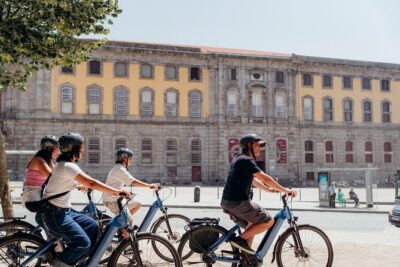
3-Hour Porto Highlights on a Electric Bike Guided Tour
Read our review →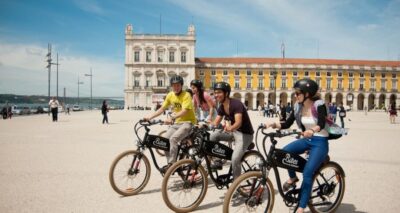
Hills, Alfama, and Mouraria Tour by Electric Bike
Read our review →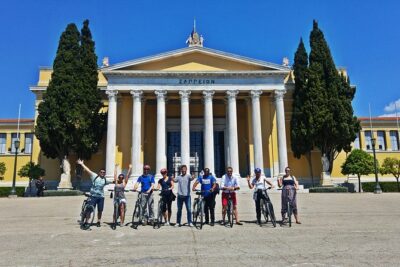
Athens Scenic Electric Bike Tour with optional Acropolis visit
Read our review →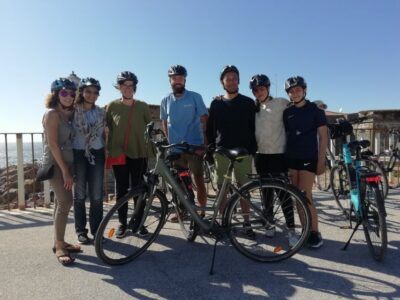
City Highlights 3-Hour Guided Electric Bike Tour
Read our review →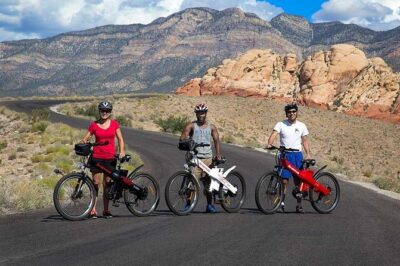
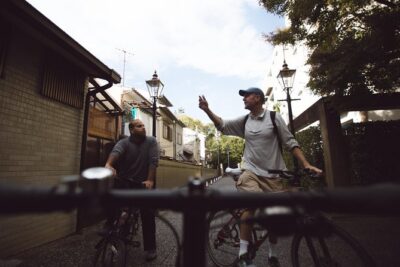
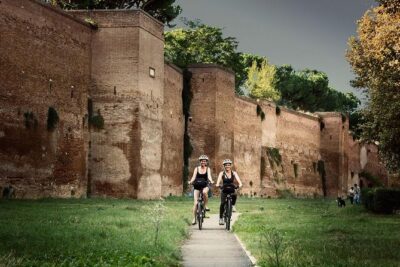
Rome EBike Tour: Appian Way, Catacombs & Roman Aqueducts
Read our review →
Top Highlights & Hidden Gems Tour by Cannondale E-Bike
Read our review →Browse the lists this tour appears in