
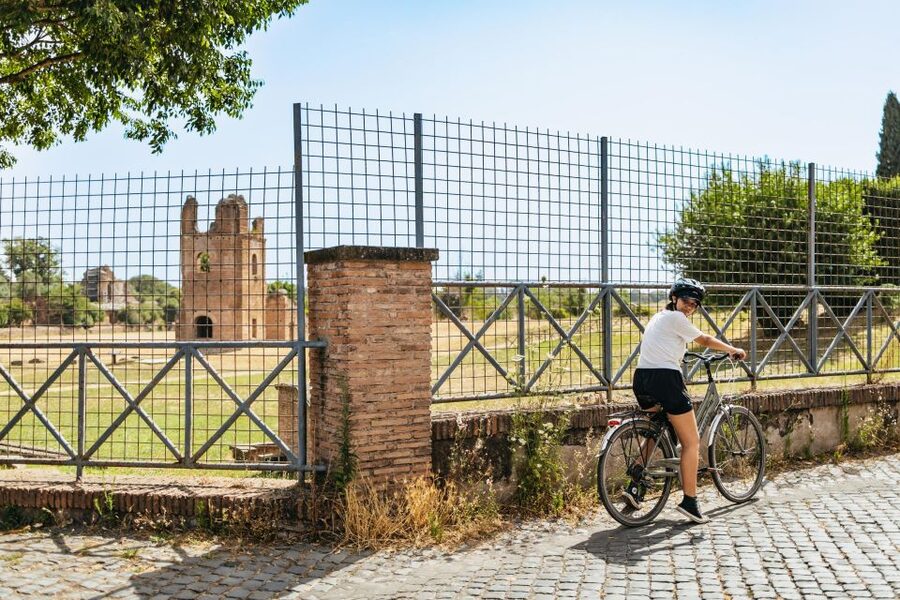
REVIEW · ROME
Appia Antica & Aqueducts e-Bike Tour – Official Provider
Ancient Rome feels different from a bike seat. This 3.5-hour ride leaves the crowded center behind for the Appian Way, where wagon marks still cut into stones laid about 2,000 years ago. I like the mix of Roman ruins and open countryside, and I like that an electric bike makes the long route manageable without turning it into an athletic contest. The main caution is simple: parts of the ride use public streets, and a few less-confident cyclists can slow the group.
The route also covers the Caffarella Valley and Aqueducts Park, giving you a wider view of Rome than the usual Colosseum and Trevi Fountain circuit. The guides receive especially strong praise for their stories and care at road crossings, with Federico, Sara, and Alex all singled out for making the ride engaging.
Key things to know before you book
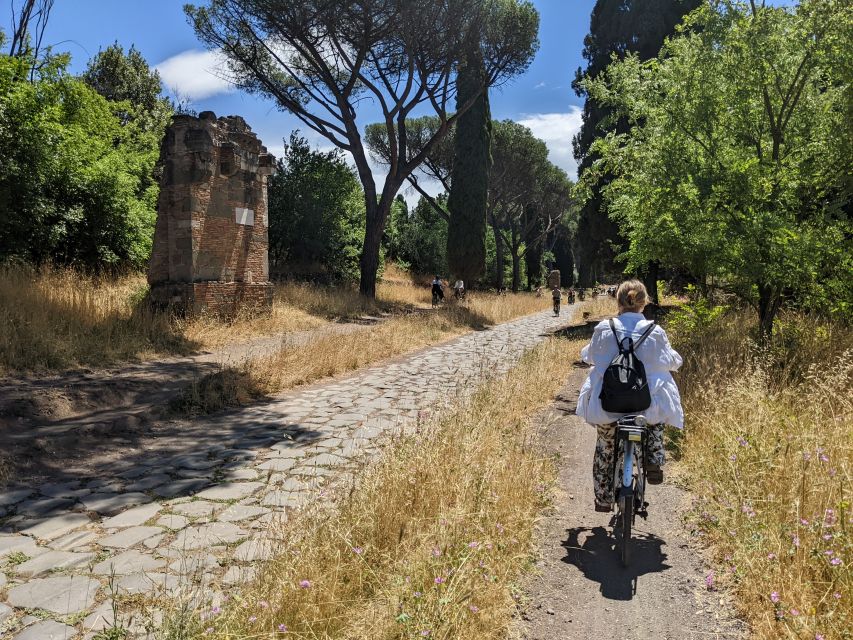
- You ride from Domine Quo Vadis to the Aqueducts Park, covering the most scenic stretch of the ancient road.
- The route is mostly away from city traffic, though one recent rider described it as roughly 70 percent off-road and 30 percent on streets.
- The Circus of Maxentius is an included stop, with free entry to its circus, villa, and mausoleum complex.
- Catacombs are optional, with Saint Sebastian and Saint Callixtus available for an additional €10 each, paid on site.
- The e-bike is essential for this full route, especially for the distance and mixed surfaces.
- The tour runs rain or shine, so bring suitable clothing and expect exposed conditions.
Why this Roman road is worth your morning
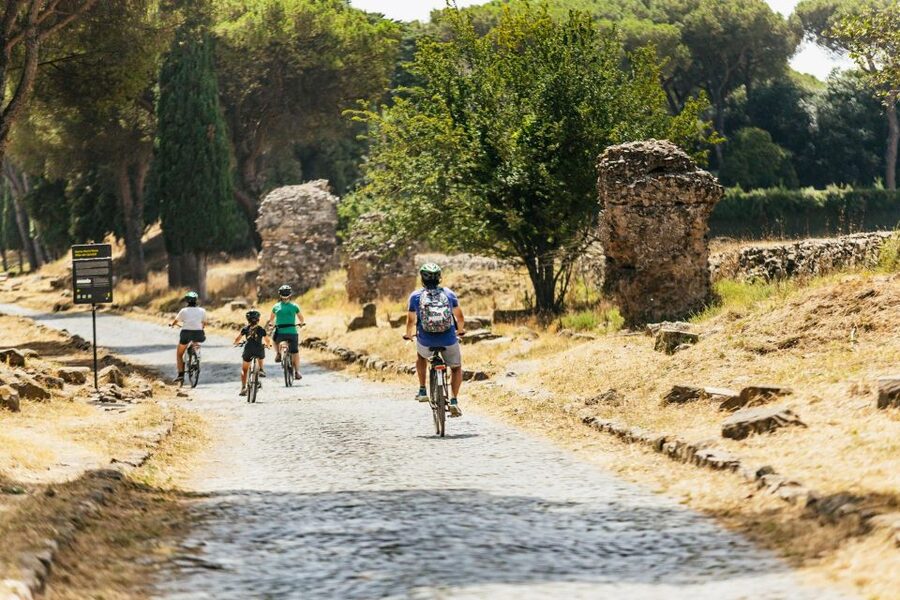
The Appian Way was Rome’s great southern road, known to the Roman poet Statius as the Queen of Roads. It began as a military route and later carried merchants, pilgrims, scholars, and other long-distance visitors. Today, the road offers something the central monuments cannot: a sense of Rome spreading outward into fields, ruins, old churches, and wide skies.
I like that the tour does not treat the Appian Way as one isolated monument. You move through several connected sites, then continue to the massive arches of the Roman aqueducts. That variety keeps the ride moving. You are not stopping every five minutes for another broken wall, yet you still get a steady run of tombs, villas, churches, and engineering works.
The protected Appian Way Regional Park covers about 4,500 hectares. You will not see all of it in one outing, of course, but the route gives you a strong sample of its main archaeological areas. It is a useful choice if you have already covered the central sights and want Rome to feel less polished and more open.
More E-Bike Tours in Italy
- Rome EBike Tour: Appian Way, Catacombs & Roman Aqueducts
★ 5.0 · 1,766 reviews - Rome: Top Highlights & Hidden Gems Tour by Cannondale E-Bike
★ 4.9 · 1,760 reviews - Rome: Appian Way & Aqueducts E-Bike Tour (Catacombs & Food)
★ 4.9 · 1,498 reviews
Starting at EcoBike near the Appian Way
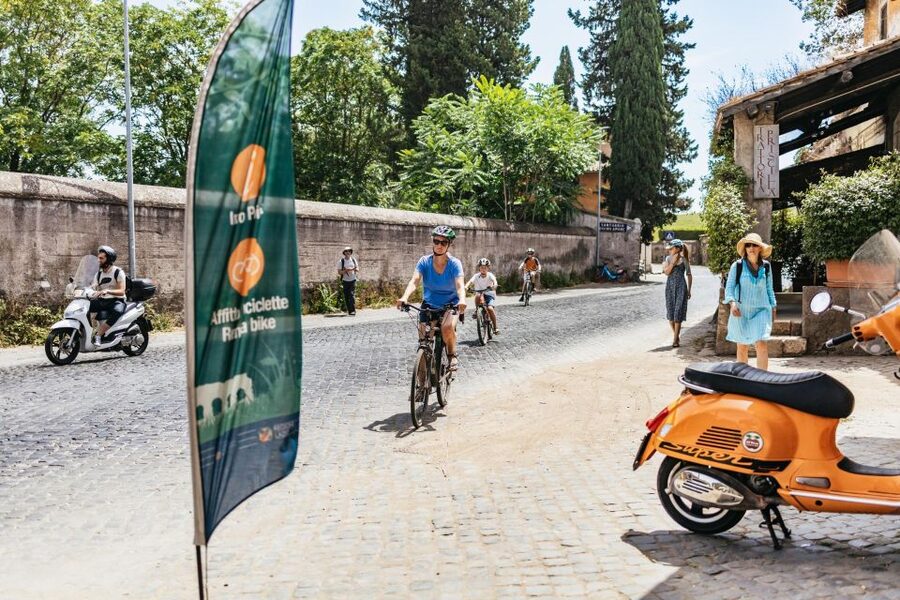
The tour begins at Centro Servizi Appia Antica, EcoBike, at Via Appia Antica 60. The guide first explains how to use the electric bike and gives you an orientation to the area. That short briefing matters, especially if you have little experience with assisted bicycles.
The included equipment is practical: a high-quality e-bike, helmet, lock, map, and half a liter of mineral water. Child seats are available on request for children up to 20 kilograms, but the activity itself is listed as unsuitable for children under 13. E-bikes are available from age nine for riders at least 135 centimeters tall, so families should confirm which age rule applies to each participant before booking.
The bikes are approved for adults up to 90 kilograms. Bring an identity document or a copy. Alcoholic drinks are not allowed in the vehicle, and bare feet are not permitted.
Domine Quo Vadis and the first Appian Way views
The first landmark is the Church of Domine Quo Vadis. According to Christian tradition, the Apostle Peter met Jesus here while fleeing Nero’s persecution. Jesus then disappeared, leaving footprints on the paving stones.
You should treat the story as tradition rather than a documented event, but it adds a human layer to the road. This was not only a route for soldiers and carts. For centuries, people passed along it for faith, trade, work, and travel.
From here, the ride follows the Appian Way through a setting shaped by both nature and archaeology. The old paving is the star. The stones are uneven, and the grooves left by ancient wagon wheels help you picture the road in use. This is not a smooth cycle path, so the electric assistance helps, but you still need to steer carefully and keep your eyes on the surface.
The road also carries modern traffic in places. The guide manages crossings and keeps the group together, but you should not expect a completely traffic-free ride. If you are nervous on a bicycle, tell the guide early.
Catacombs of Saint Sebastian or Saint Callixtus
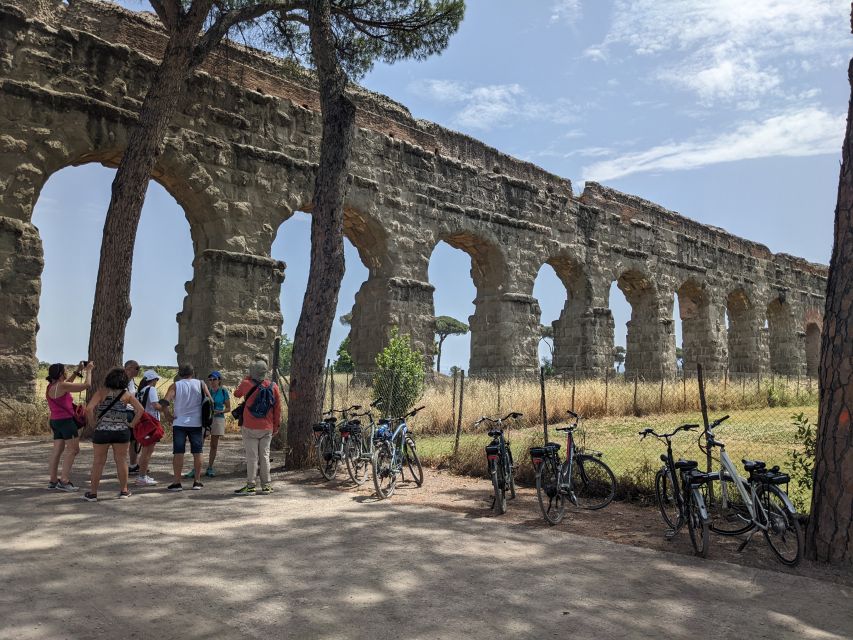
The route gives you the option to visit the catacombs of Saint Sebastian or Saint Callixtus. This is not included in the base price. You can choose one independently and pay €10 on site.
The catacombs add an underground side trip to a day otherwise spent outdoors. They help explain how early Christian communities buried and commemorated their dead beneath the countryside around Rome. Since the extra visit affects timing, ask the guide how it fits into the group schedule before deciding.
I would choose the catacombs if underground Christian history is a priority for you. If you prefer to keep the ride moving and spend more time in the parks, skip them and enjoy the main route. The tour remains worthwhile without the add-on.
More E-Bike Tours in Rome
- Rome: Appian Way, Catacombs, & Roman Aqueducts E-bike Tour
★ 4.9 · 1,421 reviews - Rome City Small Group Bike Tour with quality Cannondale EBike
★ 5.0 · 1,380 reviews - Rome by Night – Ebike Small Group Tour – Food and Wine (Option)
★ 5.0 · 1,275 reviews - Rome by Night: E-bike Small Group Tour -Food & Wine (Option)
★ 4.9 · 1,233 reviews
Circus of Maxentius and the Ben-Hur connection
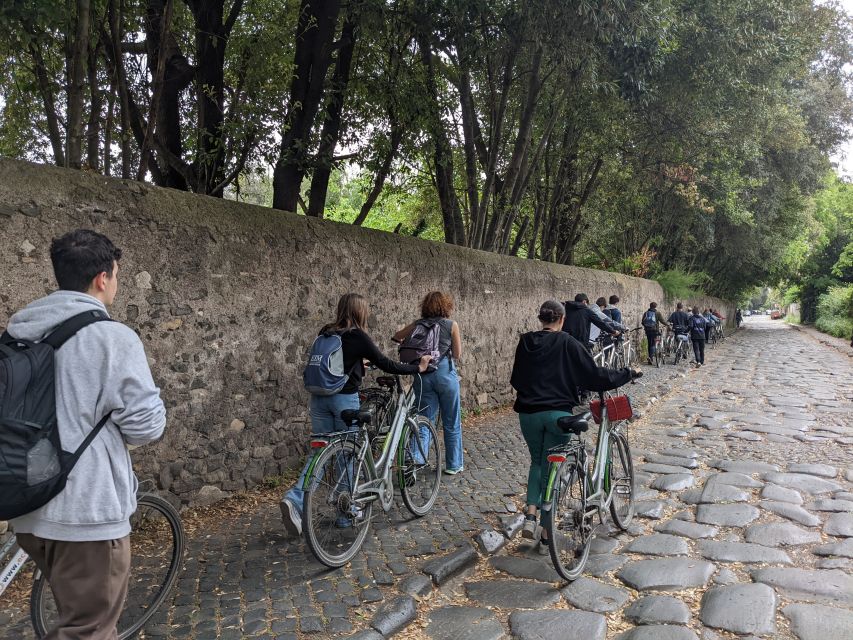
One of the strongest stops is the Circus of Maxentius, described as the best-preserved Roman circus in the world. The complex includes the circus, the villa, and the mausoleum of Valerius Romulus, the emperor’s son. Entry to this complex is free as part of the route.
The circus gives you a better sense of Roman entertainment than a quick glance at a ruin. Its scale and surviving structure help you imagine chariots racing around the track. The site also has a film connection: the chariot-race scene in Ben-Hur was shot here.
That fact is fun, but the place does not depend on Hollywood. The archaeological remains carry the visit. I especially like this stop because it combines a readable story with a substantial ruin, rather than asking you to admire a few scattered stones.
Tomb of Cecilia Metella and the medieval fortress
The Tomb of Cecilia Metella is passed on the way, rather than presented as a full interior visit. Its large round form rises above the Appian Way and is one of the road’s most recognizable markers.
Very little is known about Cecilia Metella herself beyond her family background, yet her tomb became important for another reason. During the Middle Ages, several families used the strategic site as a fortress. The Caetani family later controlled the area, built a fortified settlement, and charged people a duty to pass through.
That history changes how you see the monument. It was not simply an ancient grave surviving by accident. Its position gave it value long after the Roman period ended. You also get a reminder that the Appian Way was a working route across many centuries, not a frozen archaeological display.
Because the tour passes the tomb rather than listing a full entry, this stop is best for exterior views and a guide’s explanation. If you want an extensive look at the tomb itself, check the day’s plan before departure.
Passing the Villa dei Quintili and its nymphaeum
The ride continues past the Villa dei Quintili, a large aristocratic Roman residence connected with wealthy owners and imperial power. The itinerary also refers to the Quintili Nymphaeum, linking the villa area with the wider archaeological route.
Here, the value is the setting as much as any single ruin. Sepulchers, thermal baths, villas, and old road surfaces appear in sequence. You get a sense of how Roman suburban life extended beyond the city walls, with elite residences and public infrastructure spread along the same route used by ordinary traffic.
The tour passes this area rather than promising a long interior exploration. That keeps the route moving toward the aqueducts, but it also means you should not book this ride expecting a detailed villa excavation visit.
Aqueducts Park and Rome’s engineering scale
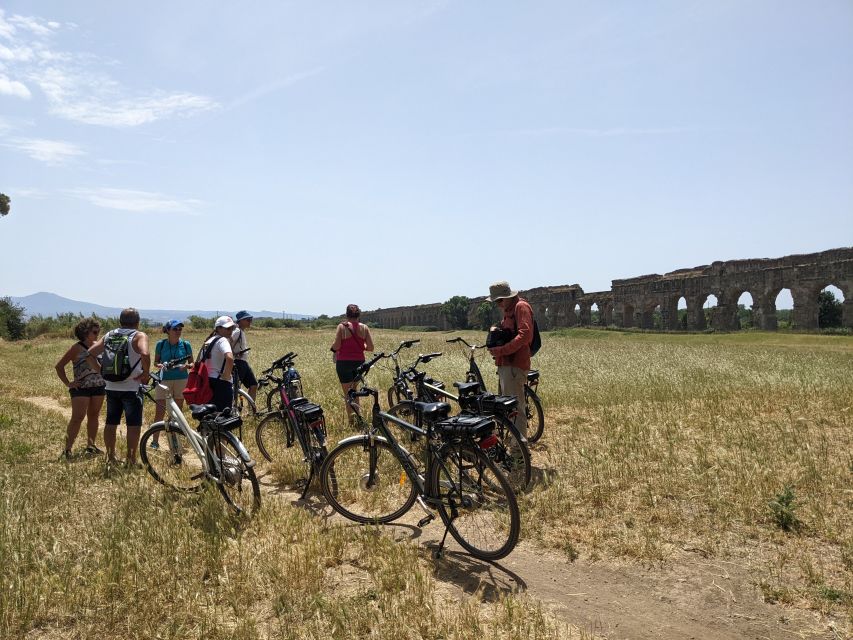
The Aqueducts Park is the visual payoff. The enormous arches cross open ground in long lines, showing how Rome moved water across great distances with careful grades and durable construction.
The site feels different from the Appian Way. The road gives you close views of ancient paving and tombs. The aqueducts give you space and scale. From a bicycle, you can cover more ground and see how the structures sit within the surrounding park.
The guide explains the engineering and helps connect the aqueducts to the rest of the route. This is where the tour’s full itinerary earns its price. You are not merely visiting one landmark and returning. You are linking roads, burial sites, villas, water systems, and imperial projects into one continuous story.
Bring a hat and sun protection if the weather is bright. The tour takes place rain or shine, and much of the route is outdoors. The provided water is useful, but half a liter may not be enough for every person on a warm day, so consider bringing additional water if allowed by the operator.
Caffarella Valley and the ride back
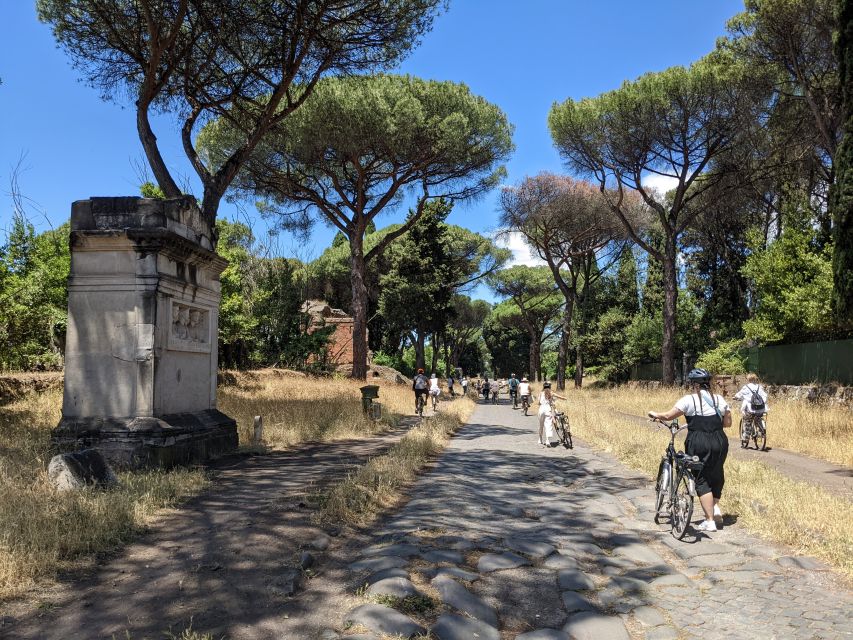
The Caffarella Valley adds a softer, greener section to the outing. After the stone road and monumental aqueducts, the valley gives you a more open view of Rome’s countryside.
The guide leads you through the park and then back toward EcoBike. One of the tour’s strengths is the way these sections fit together. You see the Appian Way as an archaeological route, the aqueducts as an engineering corridor, and Caffarella as protected open land close to the city.
The return route may include more mixed riding and road crossings. A recent rider praised the guide’s attention to safety at crossings but also noted that inexperienced cyclists slowed the group. That is useful advice. You should be comfortable starting, stopping, steering, and riding near traffic before choosing this guided route.
What the e-bike changes
The e-bike is not just a pleasant extra. It makes this particular itinerary practical. The tour covers a long section of road, park paths, archaeological stops, and some public streets within three and a half hours.
You still pedal, but the motor reduces the effort needed on the route. That lets you focus on the guide’s stories and the scenery instead of worrying about keeping up. It also helps a mixed group stay together, although the motor cannot solve every problem caused by poor bike handling.
The rough Roman paving can be bumpy. The route is not suited to bare feet, and people with back problems, pregnant women, and children under 13 are specifically advised not to take part. If you have concerns about balance or riding on uneven ground, a standard sightseeing visit may suit you better.
The guides make a real difference
The strongest praise goes to the guides. Federico is described as highly informed and careful with a family group. Sara is praised for making the outing feel perfect, while Alex is noted for combining strong explanations with entertaining stories.
Those details point to what you should expect from a good guide on this route. The Appian Way is spread out, and individual ruins can be hard to understand without context. A guide helps you notice why a tomb was placed there, how a circus functioned, and why the aqueducts mattered.
The guide also has a practical job: managing the group on uneven paths and at road crossings. This is not a hop-on, hop-off sightseeing ride. Your experience depends partly on the pace and confidence of the people riding with you.
Is $59 a fair price?
At $59 per person, the tour offers solid value if you want transport, equipment, and interpretation in one package. You get three and a half hours, an e-bike, helmet, lock, map, water, a professional English-speaking guide, the Appian Way, the Circus of Maxentius, Aqueducts Park, and Caffarella Valley.
The price does not include lunch or the optional catacomb admission. It also does not turn every stop into a full guided interior visit. You are paying mainly for the route design, bike, guide, and access to a large area that would be difficult to cover efficiently on foot.
A self-guided rental could give you more control over your pace. That may suit confident cyclists who want to stop often or avoid waiting for a group. The guided option is better if you want the route explained, need help navigating, or would rather not plan the connections between the separate parks.
Free cancellation up to 24 hours before departure and the reserve-now, pay-later option add useful flexibility. The exact departure time depends on availability.
Who should book this ride?
I would choose this tour if you have already seen Rome’s central sights and want a half-day outside the usual circuit. It suits adults and older teens who can handle uneven surfaces, short stretches of traffic, and a group riding pace.
It is also a strong choice for families with confident cyclists. The child-seat information may help with younger children, but the stated age restrictions need careful checking before booking.
You may want another option if you dislike bicycles, have back problems, are pregnant, or want a slow archaeological visit with long indoor stops. The tour is active and outdoors in all weather.
Final call: book it for Rome beyond the center
Book this e-bike tour if you want Roman history spread across roads, tombs, villas, countryside, and aqueducts rather than packed into a single museum. The Appian Way stones, Circus of Maxentius, and Aqueducts Park give you three very different looks at ancient Rome, while the electric bike keeps the route within reach for many riders.
Skip it if you need a fully traffic-free ride or dislike uneven paving. Also think twice if your group contains inexperienced cyclists who may struggle with the pace. For a confident rider who wants a guided route into Rome’s archaeological outskirts, $59 is a sensible price for the amount of ground covered.
FAQ
How long does the Appia Antica and Aqueducts e-bike tour last?
The tour lasts 3.5 hours, including the guided route through the Appian Way, Caffarella Valley, and Aqueducts Park.
Where does the tour start and finish?
It starts and finishes at Centro Servizi Appia Antica, EcoBike, at Via Appia Antica 60.
What language is the tour offered in?
The live guided tour is offered in English.
Are the catacombs included in the price?
No. You can optionally visit the catacombs of Saint Sebastian or Saint Callixtus by paying €10 per person for each one on site.
Is lunch included?
No. Lunch is not included.
What equipment is provided?
The tour provides a high-quality e-bike, helmet, lock, map, and half a liter of mineral water. Child seats are available on request for children up to 20 kilograms.
Can children join the tour?
The activity is listed as unsuitable for children under 13. E-bikes are available from age nine for riders at least 135 centimeters tall, so confirm the age requirements before booking.
Does the tour run in bad weather?
Yes. The tour takes place rain or shine.
Who should not take this tour?
The activity is not suitable for pregnant women, people with back problems, or children under 13. Adults using the e-bikes must be within the stated maximum weight of 90 kilograms.
Just added around Rome
- Rome: Guided eBike Evening Tour with italian Aperitif★ 5.0 · 16 reviews
- Rome: Villa Borghese, Villa Ada, and Coppedè E-Bike Tour★ 4.8 · 78 reviews
- Sunrise in Rome: Small Group E-Bike Tour & Italian breakfast★ 4.9 · 177 reviews
- Rome: Top 10 Highlights Guided Tour by Bike or E-Bike★ 4.4 · 15 reviews
- Rome: Appian Way, Aqueducts, & Catacombs E-Bike Guided Tour★ 4.9 · 54 reviews
- Rome: Villa Borghese E-Bike Tour (Small Group or Private)★ 4.9 · 92 reviews
- Rome: Panoramic Off-the-beaten-track Cannondale E-Bike tour★ 5.0 · 71 reviews
- Rome: Taste of Rome by quality Cannondale E-Bike★ 5.0 · 12 reviews
E-Bike Tours, compared.
3-Hour Porto Highlights on a Electric Bike Guided Tour
Read our review →
Hills, Alfama, and Mouraria Tour by Electric Bike
Read our review →
Athens Scenic Electric Bike Tour with optional Acropolis visit
Read our review →
City Highlights 3-Hour Guided Electric Bike Tour
Read our review →
Rome EBike Tour: Appian Way, Catacombs & Roman Aqueducts
Read our review →
Top Highlights & Hidden Gems Tour by Cannondale E-Bike
Read our review →Browse the lists this tour appears in