
REVIEW · PARIS
Paris Guided Bike Tour
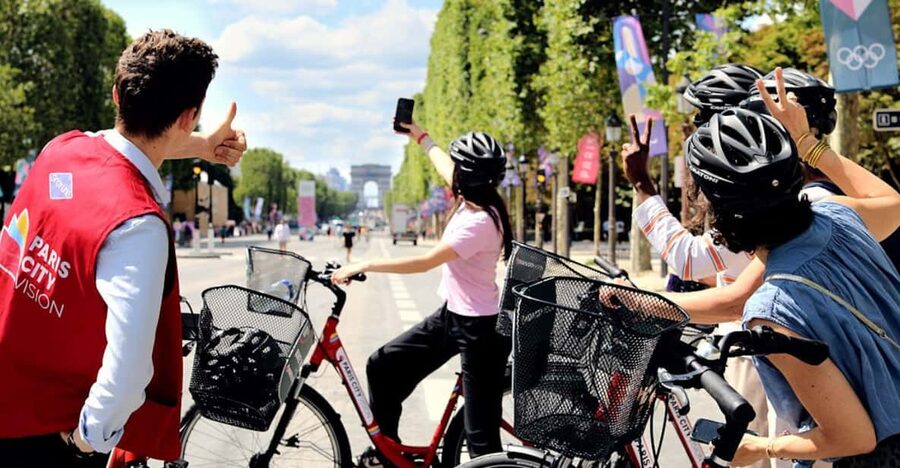
Paris rewards two wheels. This three-hour guided bike tour links the Louvre, Notre-Dame, the Latin Quarter, the Eiffel Tower, and the Champs-Elysées while also slipping into quieter Parisian streets. I like the expert-led route and the chance to cover far more ground than you could on foot.
I also like the small group size, capped at 12, and the guide’s focus on stories rather than a nonstop list of dates. Guides such as Andrea and Hugo have earned praise for mixing useful facts with fun local tales. The main consideration is simple: you need a reasonable level of cycling ability, and the tour does not include monument entry or food tastings.
The route is ambitious for three hours, so you will mostly pass by major sights rather than stop for long visits. That is a fair trade if you want a lively first look at central Paris, but less useful if you want detailed time inside the Louvre, Notre-Dame, or the Musée d’Orsay.
Key points to know before you ride
- A dozen riders or fewer: The small group makes it easier to hear the guide, ask questions, and adjust the pace.
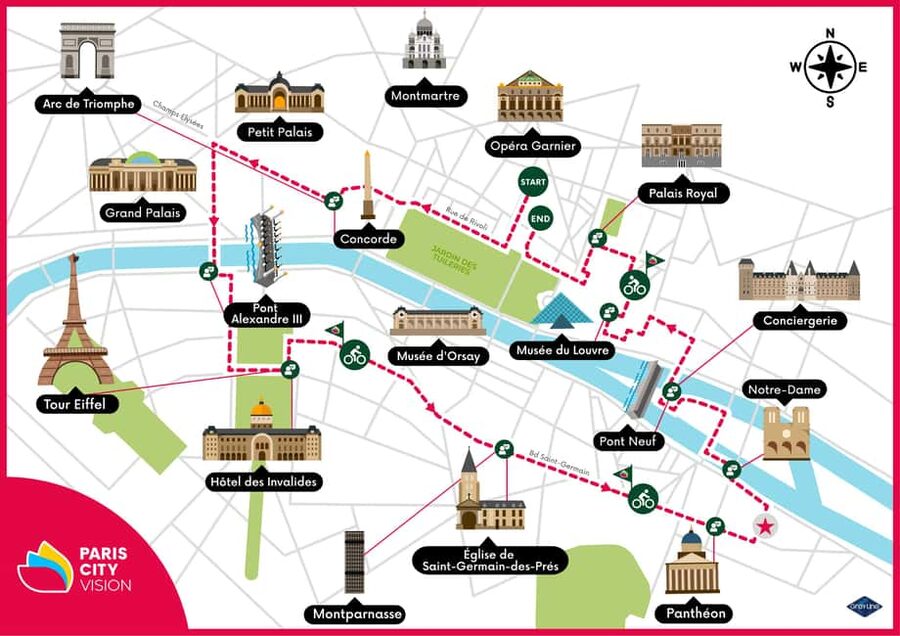
- A broad central Paris route: You pass the Louvre, Pont Neuf, Notre-Dame, the Latin Quarter, Invalides, the Eiffel Tower, the Arc de Triomphe, and Place de la Concorde.
- Quiet streets alongside famous monuments: The route aims to show both postcard Paris and more local-looking lanes.
- Guides with personality: Andrea is praised for clear, interesting explanations, while Hugo is noted for combining facts with amusing stories about Paris past and present.
- Pastry advice, but no included tasting: You may get recommendations for croissants, ice cream, and other specialties, but you pay for anything you sample.
- A good orientation ride: At $43 per person, the tour can be strong value if you want to learn the city’s layout before exploring on your own.
Why a bicycle works so well in central Paris
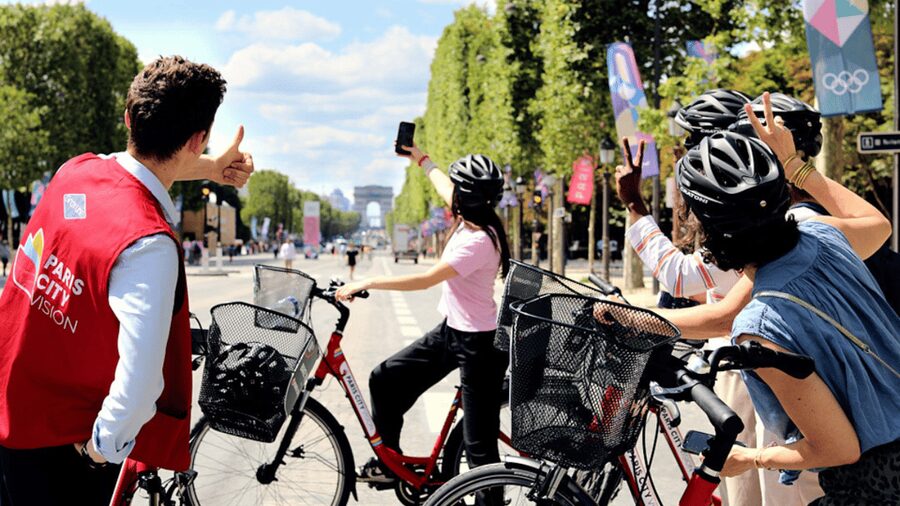
Paris is compact at street level but spread out enough that walking between its major sights can consume much of your day. A bicycle gives you a useful middle ground. You see the city close up, unlike from a bus, but you cover enough distance to connect the Louvre with the Eiffel Tower and the Arc de Triomphe in one outing.
I like this format for a first or second day in Paris. You get a quick sense of how the Seine, grand boulevards, historic quarters, and major monuments fit together. Later, you can return to the places that caught your attention.
The ride is not built around racing. The guide leads the group, allows time for photographs, and adjusts how often the group stops. That matters in Paris, where a good view may appear around one corner and a crowded crossing may require patience around the next.
You should still take the cycling requirement seriously. The tour is open to people with different levels of experience, but you must be able to ride confidently enough to keep with a group in a busy capital. The minimum age is 13. Children’s bikes are intended for ages 13 to 17, or for riders about 130 centimeters, or 4 feet 2 inches, tall, with suitable cycling ability.
More Guided Rides in Paris:
- Paris Local Districts and Stories Off the Beaten Track Guided Bike Tour
★ 5.0 · 1,264 reviews - Highlights of Paris Bike Tour w/ a Local Guide (English or Dutch)
★ 4.5 · 1,176 reviews - Versailles Bike Tour with Market, Gardens & Guided Palace Tour
★ 5.0 · 1,121 reviews
Starting near the Louvre at Place des Pyramides
Meet at the ParisCityVision agency at 3 Place des Pyramides, 75001 Paris, and arrive 15 minutes early. This location puts you in the middle of the city from the start, close to the Louvre and the Palais-Royal.
The opening stretch through the Palais-Royal area is a useful introduction to Parisian scale. You are near grand architecture, formal public spaces, and some of the city’s best-known cultural addresses before the ride has really gathered speed.
You will pass the Louvre rather than enter it. That distinction is important. Three hours is enough to see the museum from outside and understand its place in the city, but not enough to combine a guided ride with a proper museum visit.
I would schedule the Louvre for another part of your day. Treat this opening stop as an orientation point and photo opportunity, not as a substitute for museum admission.
From Pont Neuf to Île de la Cité
The route then moves toward Pont Neuf, Place Dauphine, and Île de la Cité. This is one of the most satisfying sections because the river helps you understand Paris as a city shaped by water and bridges.
Pont Neuf is the oldest standing bridge across the Seine, and its position gives the group an excellent connection between the historic center and the riverbanks. Place Dauphine is quieter and more intimate than the large squares nearby, which fits the tour’s promise of pairing famous sights with less obvious corners.
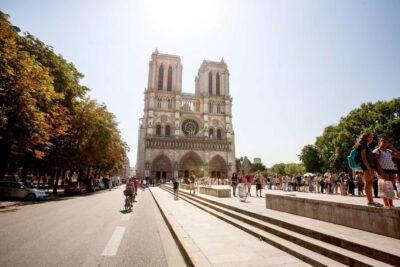
Notre-Dame follows. You pass the cathedral and the island rather than go inside. Even from the bicycle, this part gives you a strong sense of the old city center, especially when the guide explains how the island connects Paris’s earliest core with the neighborhoods on either bank.
Do not expect a long cathedral stop. The value here comes from seeing several linked places in a short span and hearing the guide explain how they relate.
The Latin Quarter and Fontaine Saint-Michel
The ride continues into the Latin Quarter, passing the Sorbonne and the Fontaine Saint-Michel. This neighborhood has a different feel from the formal space around the Louvre. Its streets are associated with student life, cafés, bookshops, and long layers of Parisian culture.
The guide’s role matters most here. A list of buildings is easy to forget, but stories about Parisian habits, film locations, local food, and daily life can give the streets more meaning. Andrea, one of the named guides, is praised for keeping his explanations focused while still adding anecdotes. That is exactly the right approach on a moving tour.
The stop at the Fontaine Saint-Michel is also a reminder that this is a sightseeing ride, not a food tour. The guide may point you toward a good croissant or an artisan ice cream shop, but tastings are not included. Bring money if you want to follow a recommendation during or after the ride.
A few more days on two wheels around Paris worth a look
- Versailles Palace Bike Tour with Market & Marie-Antoinette hamlet
★ 5.0 · 2,680 reviews - Paris: Charming Nooks and Crannies Bike Tour
★ 4.8 · 2,585 reviews - From Paris: Versailles Bike Tour w/ Palace, Gardens, & Picnic
★ 5.0 · 2,150 reviews - Paris: City Highlights Bike Tour
★ 4.7 · 1,835 reviews
Along the Seine toward Invalides and the Eiffel Tower
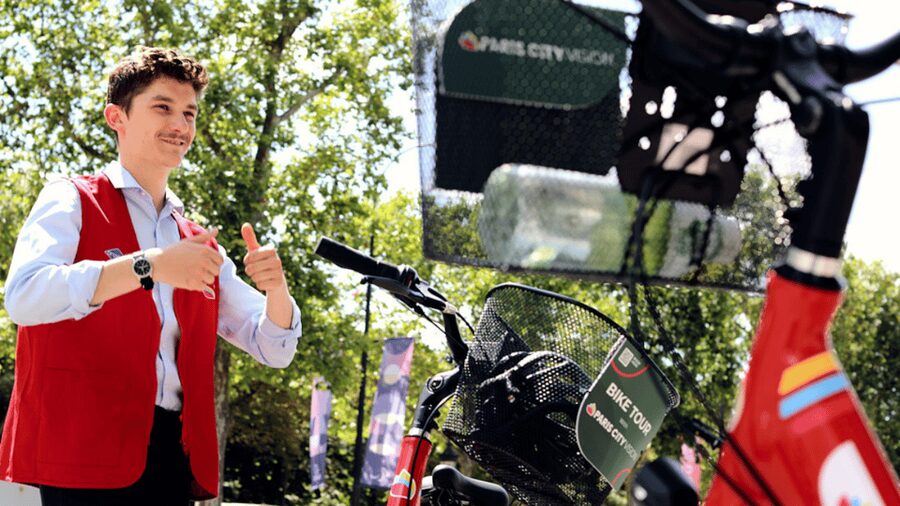
After the Latin Quarter, the route heads toward Les Invalides and the Seine quays. Riding along the river gives you one of the clearest ways to connect the city’s major landmarks.
Les Invalides is easy to recognize by its grand scale and dome. You pass by rather than enter, so the guide can give you context without turning the ride into a museum visit. The same applies to the Musée d’Orsay, which appears in the wider route of central Paris. If you want to see its collection, plan a separate visit.
The Eiffel Tower is another major pass-by point. You will see it as part of the moving route and have a chance to take photos, but tower access is not part of the tour. This keeps the schedule moving, though it means you should not book the ride expecting a reserved entrance or a long pause beneath the monument.
I appreciate that the guide can help with photographs. A short stop with someone who knows the city can be more useful than simply pulling over at the first open space and hoping for a good background.
The grand westward sweep to the Arc de Triomphe
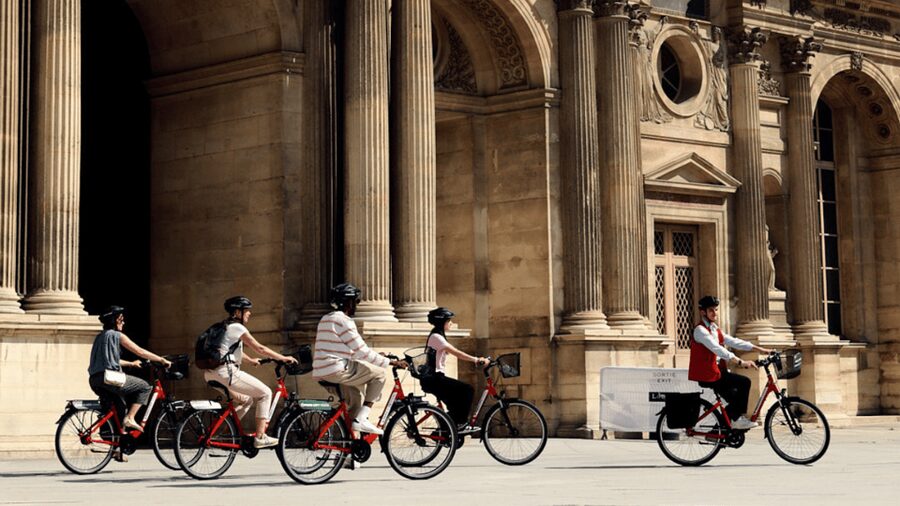
The tour then reaches the Arc de Triomphe and the Champs-Elysées. This section gives you Paris at its grandest: broad avenues, monumental planning, and a scale that is hard to appreciate from a narrow sidewalk.
The Arc de Triomphe is seen from outside, and you do not climb to its terrace. That is a limitation, but it is also why the bicycle works here. You can take in the monument, avenue, and surrounding city plan without spending the time required for an interior visit.
The Champs-Elysées can feel more commercial than intimate. If your idea of Paris is small streets and neighborhood cafés, this may be the least personal part of the route. Still, it belongs in a first overview because it shows a very different side of the capital.
Traffic and crossings may affect the pace. The group has to stay together, and the guide’s promise of flexible stops does not mean you can linger as long as you wish at every landmark.
Grand Palais, Petit Palais, and Place de la Concorde
The Grand Palais and Petit Palais follow, giving you another look at Parisian civic and exhibition architecture. Both are passed from the outside, so the ride provides visual context rather than an art visit.
Place de la Concorde is a strong final landmark on the main circuit. It connects the Champs-Elysées with the Tuileries and the Seine, and its large open space makes the city’s grand design easy to read.
This is where the tour’s broad route pays off. In one morning or afternoon, you have moved from the medieval center around Île de la Cité to the monumental west, with museums, palaces, bridges, avenues, and river views along the way.
The final portion includes Saint-Germain-des-Prés and the Comédie-Française before finishing at the Musée du Louvre. These places add a more literary and theatrical note to the ride and bring you back toward the city center.
What the guide adds to the ride
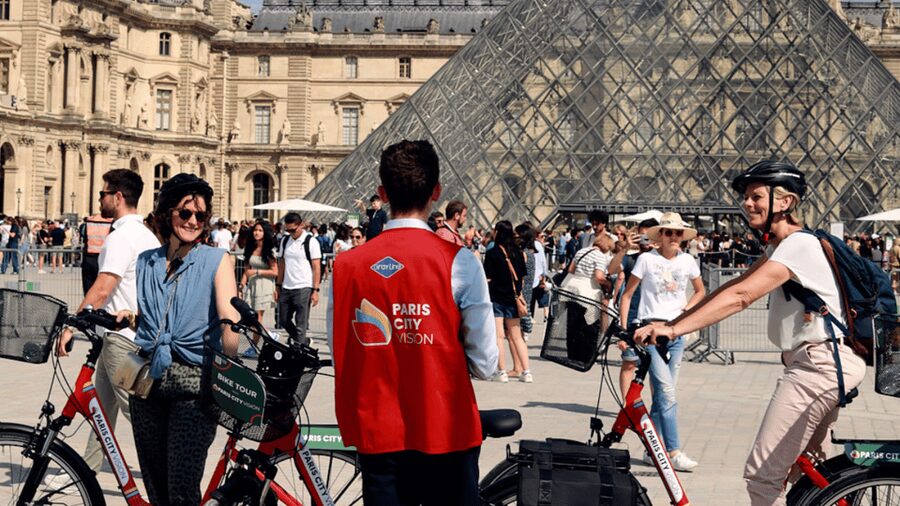
The guide is not just there to point toward monuments. The experience is built around commentary, questions, and small observations that are easy to miss when you explore alone.
You can expect information about historical events, Parisian customs, filming locations, and local food. The strongest praise has gone to guides who balance those subjects well. Hugo, for example, is noted for combining facts with entertaining stories and for showing affection for both old and modern Paris.
Andrea has also received particularly warm praise for showing a more village-like side of the city through authentic lanes and for explaining major sights from a fresh angle. That is the difference between a standard monument circuit and a tour with a local voice.
The guide speaks English, French, or Spanish. Ask questions as you go. The format is especially useful if you want help deciding where to eat, which neighborhood to revisit, or how to fit a museum into the rest of your stay.
Is $43 a fair price?
At $43 per person, the tour is priced sensibly for a three-hour guided activity in central Paris. You are paying for the bicycle outing, the guide, and the planning behind a route that links many major sights without requiring you to organize the sequence yourself.
The value is strongest if you are short on time, new to Paris, or want an active way to get oriented. You can see more than you would on foot and receive practical suggestions for the rest of your visit.
The value is weaker if you measure a tour by the number of interiors included. There is no entry to the Louvre, Notre-Dame, the Musée d’Orsay, the Eiffel Tower, or other monuments. Food is also extra, despite the guide’s pastry and ice cream recommendations.
I would think of the $43 as paying for access to a well-planned city overview, not a collection of admissions. For many visitors, that is a good deal. For museum-focused sightseeing, spend the money on separate tickets and explore those places properly.
Who should book this bike tour?
I would recommend it to confident cyclists, first-time Paris visitors, couples, families with teenagers, and anyone who likes a little movement in a sightseeing day. A small group of up to 12 helps keep the ride personal without making it private or expensive.
It also suits people who want more than the standard postcard route. The promise of quieter lanes, local habits, food advice, and filming locations gives the ride extra character.
You may want to skip it if cycling is uncomfortable for you, if you use a wheelchair, or if you want long, quiet visits inside monuments. The tour is not suitable for wheelchair users, and the pace of a three-hour city ride will not allow extended stops at every major sight.
Check the weather before you go and dress for riding. Paris can be delightful by bicycle in good conditions, but a poorly chosen outfit can make even a fine route feel long.
Final verdict: book it for orientation and local color
I would book this tour if I wanted to understand Paris quickly and see the city from street level. The route covers an impressive number of major places, yet the smaller streets and guide-led stories keep it from becoming a simple parade of monuments.
The best reason to choose it is the combination of distance and personality. Andrea and Hugo represent the kind of guide this format needs: clear, friendly, and able to connect history with ordinary Parisian life.
Book it if you can ride comfortably and accept that the sights are viewed from outside. Skip it if you want museum time, included tastings, or a slow walking tour. For $43, a three-hour ride with a small group and an adaptable guide is a useful, good-value introduction to central Paris.
FAQ
Where does the Paris bike tour begin?
It begins at the ParisCityVision agency at 3 Place des Pyramides, 75001 Paris, near the Louvre.
Where does the tour finish?
The tour finishes at the Musée du Louvre.
How long does the bike tour last?
The tour lasts three hours.
How much does the tour cost?
The listed price is $43 per person.
What languages does the guide speak?
The tour is available with a live guide in English, French, or Spanish.
How large is the group?
The group is limited to a maximum of 12 people.
Does the price include food tastings?
No. Croissants, ice cream, and other food recommendations may be offered, but tastings are not included.
Can I enter the Louvre or other monuments during the tour?
No. The tour passes by the monuments, but entrance tickets are not included.
What cycling ability is required?
You need a certain level of cycling ability and must be able to ride comfortably with the group.
Is there a minimum age?
Yes. The minimum age is 13. Children’s bikes are suitable for ages 13 to 17, or for riders around 130 centimeters, or 4 feet 2 inches, tall, with suitable cycling ability.
Just added around Paris
- The Best of Paris: Small Group Bike Tour like a Local★ 4.7 · 12 reviews
- The Best of Paris by Bike with a Local★ 4.8 · 15 reviews
- Paris: Afternoon E-Bike Guided Small Group Tour★ 4.8 · 152 reviews
- Private Highlights of Paris Bike Tour★ 4.9 · 12 reviews
- Paris: Guided Private E-bike Sightseeing Tour★ 4.4 · 19 reviews
- Paris: Versailles Palace and Queen Hamlet E-Bike Tour★ 5.0 · 126 reviews
- Paris : Private guided tour in Rickshaw bike – Napoléon★ 4.5 · 23 reviews
- Paris: Street Art Open-Air Museum Bike Tour★ 4.8 · 51 reviews
Paris Cycling Tours, compared.
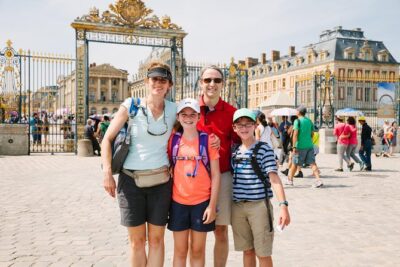
Versailles Bike Tour w/ Palace, Gardens, & Picnic
Read our review →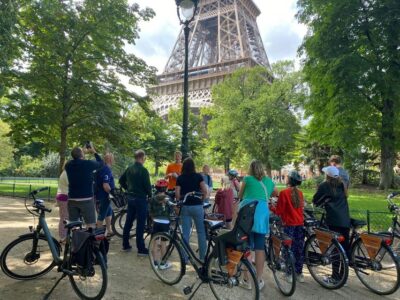
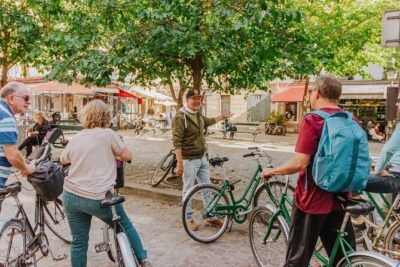
Paris Local Districts and Stories Off the Beaten Track Guided Bike Tour
Read our review →
Highlights of Paris Bike Tour w/ a Local Guide (English or Dutch)
Read our review →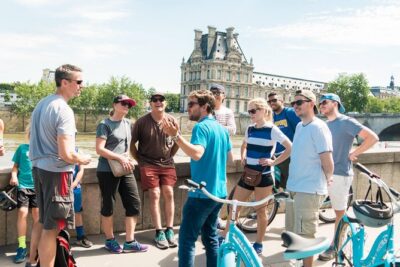
Paris Highlights Bike Tour: Eiffel Tower, Louvre and Notre-Dame
Read our review →Browse the lists this tour appears in