
REVIEW · ROME
Rome: E-Bike Tour of Appia Antica, Aqueducts, and Caffarella
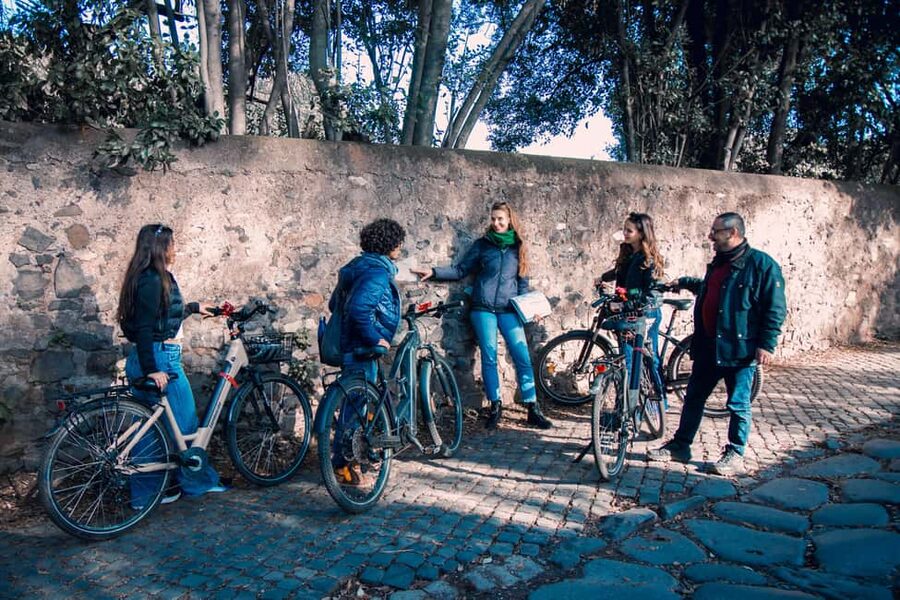
Rome’s best escape is just beyond the center. This four-hour e-bike ride follows the ancient Appian Way, passes Roman ruins and aqueducts, and reaches the peaceful fields of Caffarella Valley. I especially like the mix of archaeology and countryside and the way electric assistance makes the rough Roman road manageable. The small groups, limited to eight people, also give guides room to watch the traffic and answer questions.
The main caution is simple: this is still a real bike ride, not a sightseeing bus with pedals. Some sections are bumpy, parts use public roads, and you need to ride confidently. The tour runs rain or shine, so wear clothes that can handle dust or splashes, plus closed-toe shoes.
Key points to know before you book
- The route begins near Circus Maximus: You avoid starting in Rome’s most chaotic traffic and quickly reach the Baths of Caracalla and the Aurelian Walls.
- The Appian Way is the star: Ancient paving stones, tombs, villas, and catacombs appear along the first miles of the road.
- Electric power matters: The e-bikes help with hills, uneven stones, and the long ride to the aqueducts.
- Caffarella adds a rural surprise: Horses, sheep, goats, and pigs can appear close to the city center, along with the Nymphaeum of Egeria.
- Guides make the difference: Monica, Adriana, Frederick, Martin, and Alannah have all received strong praise for history, safety, and personal attention.
- A coffee stop breaks up the ride: A 20-minute pause at a local bar gives you time to rest before the parks and aqueducts.
Why the Appian Way deserves half a day
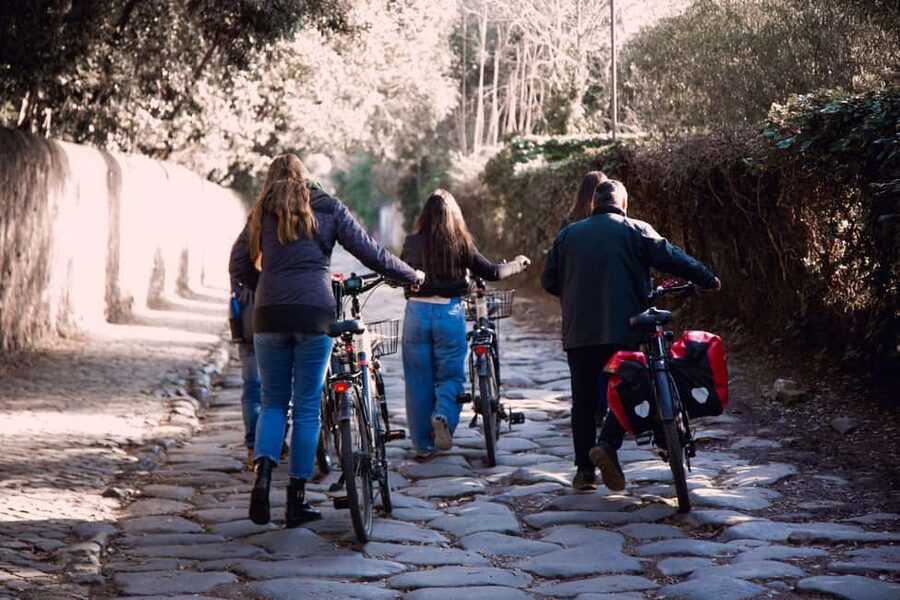
The Via Appia Antica was begun in 312 BC under the Roman censor Appius Claudius Caecus. It ran from Rome toward Brindisi, linking the capital with southern Italy. The Romans called it the Regina Viarum, or Queen of Roads, and the name still feels justified when you ride between ancient stones, fields, walls, and monuments.
I like this tour because it lets you see the road at human speed. On foot, covering the Appian Way, the aqueducts, and Caffarella Valley in four hours would be difficult. By bus, you would miss the quiet lanes and the texture of the old road. The e-bike gives you enough range to connect the major sights without turning the day into an athletic event.
The route also tells an important modern story. Rome’s expanding housing industry threatened much of the countryside around the historic center during the economic boom of the 1950s. Archaeologist, urban planner, journalist, and politician Antonio Cederna fought to protect the Appian Way from uncontrolled development. The archaeological park exists in large part because of that campaign.
That context adds weight to the ride. You are not only looking at Roman remains. You are also seeing a stretch of land that survived modern construction because people fought to keep it open.
More E-Bike Tours in Italy
- Rome EBike Tour: Appian Way, Catacombs & Roman Aqueducts
★ 5.0 · 1,766 reviews - Rome: Top Highlights & Hidden Gems Tour by Cannondale E-Bike
★ 4.9 · 1,760 reviews - Rome: Appian Way & Aqueducts E-Bike Tour (Catacombs & Food)
★ 4.9 · 1,498 reviews
From Circus Maximus to the Baths of Caracalla
The meeting point is at Rome in a Day Tours, near Circus Maximus. Arrive 15 minutes early to get familiar with the bike and complete the required paperwork. The staff fits you to the e-bike and explains its controls before the group sets off.
Circus Maximus was Rome’s enormous chariot-racing stadium, capable of holding about 300,000 spectators. Today, the broad open space is a useful starting point because it gives the guide room to explain the route before you move into busier streets.
The first major stop is the Garden of Oranges and the nearby Knights of Malta Square. The itinerary gives you a short look at these modern-era Rome sights before turning toward the ancient road. You then pass the Baths of Caracalla, where the guide introduces the Roman water system.
The baths are more than a quick photo opportunity. Their scale helps you understand how much water Rome consumed and why aqueduct engineering mattered. The full water story comes later at the Aqueducts Park, but the Baths of Caracalla provide a strong opening chapter.
Porta San Sebastiano and the city walls
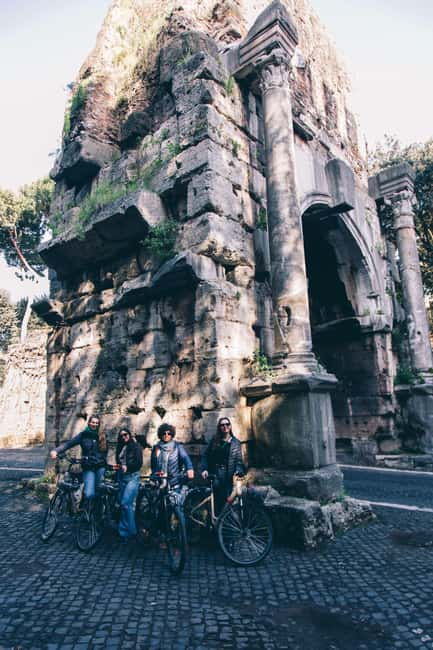
Porta San Sebastiano marks your approach to the Appian Way. The gate formed part of the Aurelian Walls, Rome’s great defensive circuit. You stop here for about 20 minutes, long enough for an explanation and photographs.
This is one of the route’s useful transitions. Inside the center, Rome can feel like one grand monument after another. At Porta San Sebastiano, the city begins to loosen its grip. The walls, quieter roads, and open spaces point you toward the countryside beyond the ancient gate.
The group still rides on roads at times, so you must pay attention. One reason this starting point works well for families is that it avoids beginning in the heaviest central traffic. Adriana received particular praise for stopping the group carefully at busy crossings, while other guides were credited with keeping riders on quieter streets when possible.
Church of Domine Quo Vadis and the catacombs
The Church of Domine Quo Vadis is a 20-minute visit along the Appian Way. Its name refers to the Christian tradition that the apostle Peter encountered Jesus here while fleeing Rome. The church gives the route a religious layer after the earlier focus on engineering and military roads.
You then pass the Catacombs of Rome, including the Catacombs of Saint Callistus. This part of the tour is mainly an exterior pass-by rather than a full underground catacomb visit. That distinction matters if you are hoping to explore burial chambers in detail. The value here is seeing how many major sites are concentrated along the opening miles of the ancient road.
Your guide explains the monuments as you go, and the small group helps keep the stops conversational. Guides named Monica, Monika, Adriana, Frederick, Martin, and Alannah have been praised for strong command of Roman history and for explaining it in an accessible way. Frederick, a college history major, was especially appreciated for taking time with questions.
More E-Bike Tours in Rome
- Rome: Appian Way, Catacombs, & Roman Aqueducts E-bike Tour
★ 4.9 · 1,421 reviews - Rome City Small Group Bike Tour with quality Cannondale EBike
★ 5.0 · 1,380 reviews - Rome by Night – Ebike Small Group Tour – Food and Wine (Option)
★ 5.0 · 1,275 reviews - Rome by Night: E-bike Small Group Tour -Food & Wine (Option)
★ 4.9 · 1,233 reviews
Villa of Maxentius and the Tomb of Cecilia Metella
The Villa of Maxentius is one of the route’s major archaeological stops. The complex is associated with Emperor Maxentius and includes the remains of a large imperial residence. You stop for photographs and interpretation rather than spending a long period inside every site.
Next comes the Tomb of Cecilia Metella, one of the most recognizable monuments on the Appian Way. This large cylindrical tomb shows how Roman burial monuments were designed to announce status beside one of the empire’s most important roads.
You also pass the Tumulus of the Curiazi and Villa dei Quintili. The first connects the route with Rome’s early legendary past, while the second recalls the wealth of an elite Roman family. The sites arrive in quick succession, which is one of the ride’s strengths and one of its limits. You see a remarkable amount in a short time, but you will not get the same detailed interior visit you would receive from a dedicated archaeological tour.
The old paving stones can be uneven. Several riders found that the e-bike made the rough sections easier, but you should still expect jolts and occasional challenging patches. The bumpy surface is part of the appeal, though. You are not simply looking at the Appian Way from a distance. You are moving across the road itself.
The coffee break and the value of the e-bike
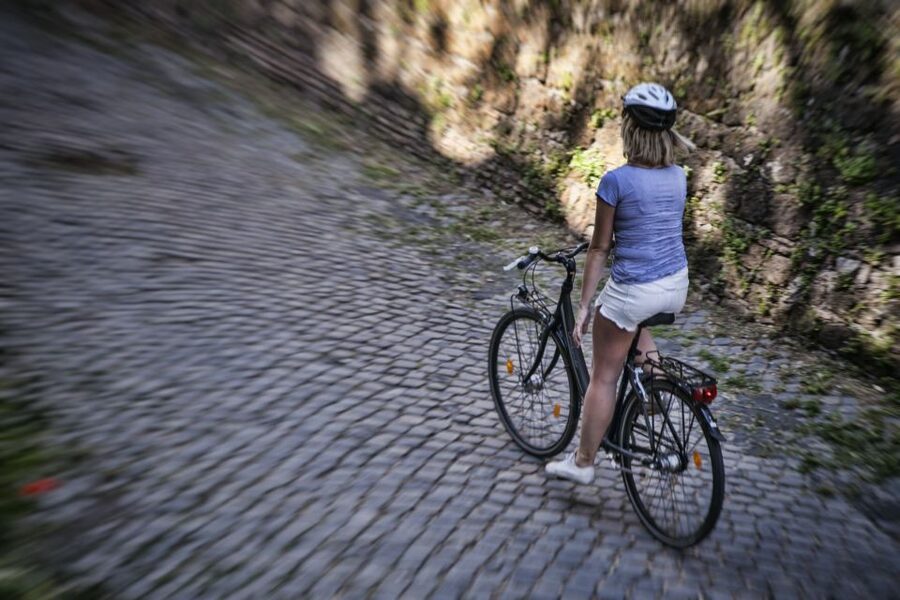
A 20-minute stop at a local bar provides a sensible pause. You can get a coffee or a snack, settle your legs, and prepare for the next stretch. In hot weather, this break becomes even more useful.
The e-bike is central to the experience, not a minor extra. The route covers ancient roads, parks, hills, and open paths. Electric assistance reduces the effort needed to keep pace, especially on uneven sections and during warmer months.
At the same time, an e-bike does not remove all physical demands. You still need to balance, steer, brake, and handle rough ground. You also need enough cycling skill to ride near roads and manage crossings. The tour is not suitable for anyone who cannot ride a bicycle, people with mobility impairments, pregnant women, or children under 12.
The company fleet has been praised for being well maintained, fully charged, and made up of high-quality bikes. One rider with a smaller frame found the fit less than ideal, so tell the staff immediately if the bike does not feel right. The opening adjustment is the best time to fix saddle height or choose a better size.
Aqueducts Park, Rome’s open-air engineering museum
The Parco degli Acquedotti is the visual high point of the tour for many people. The park preserves the remains of Rome’s aqueduct system, which carried huge volumes of water into the city from distant sources.
The setting is unusually open. Instead of seeing aqueduct arches squeezed between buildings, you ride beside them across broad grassland. The contrast between monumental Roman construction and the quiet park makes the stop memorable.
The planned visit lasts about 30 minutes. That gives the guide time to explain how the aqueducts supplied baths, fountains, and homes, while you take photographs and walk around the main viewpoints. If you have seen Roman ruins only in the crowded center, this change of pace is refreshing.
The park also demonstrates the tour’s environmental appeal. You reach a major historical area by bike rather than by adding another vehicle to Rome’s streets. The electric motor helps you cover distance without the noise or fuel use of a motorized sightseeing tour.
Caffarella Valley and the Nymphaeum of Egeria
From the aqueducts, the route follows the Almone River into Caffarella Valley. This is where Rome can suddenly feel far away. Horses, sheep, goats, and pigs may be grazing close to the city, an odd and wonderful contrast to the ruins you saw earlier.
The valley is not an isolated wilderness. Its appeal comes from the way nature, farms, waterways, and ancient remains occupy the same space. You get a better sense of Rome’s former edge, before modern buildings covered so much of the surrounding countryside.
The final notable sight is the Nymphaeum of Egeria, linked by tradition to the villa of Herodes Atticus. The graceful structure and the nearby water give the stop a calmer mood than the imposing tombs and walls earlier in the ride.
Caffarella is also a good reason to choose this tour instead of a standard monument circuit. You are not spending the entire half-day in front of famous facades. You are seeing animals, paths, fields, and water within a short ride of the historic center.
Safety, group size, and guide quality
The group limit is eight participants. That is small enough for a guide to keep an eye on riders, adjust the pace, and stop when someone needs help. It also makes questions practical rather than ceremonial.
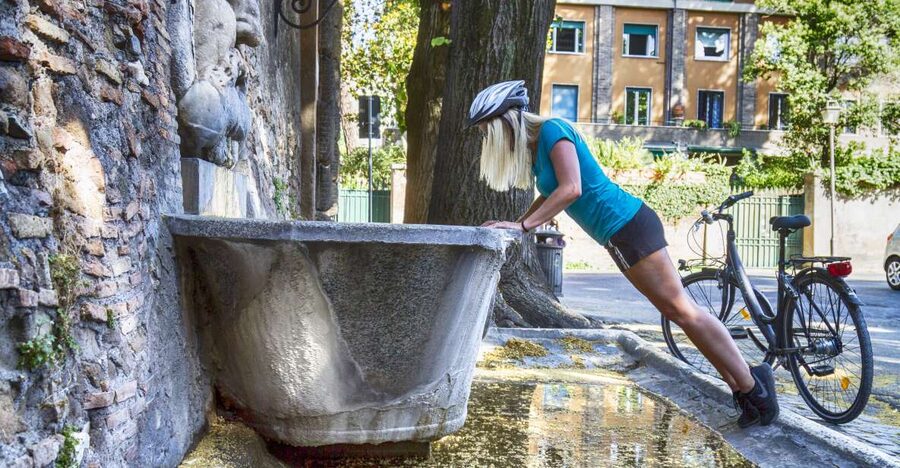
Safety depends partly on the guide and partly on your own cycling ability. Monica was praised for keeping the group comfortable in hot weather and stopping near shade and fountains. Adriana earned strong marks for careful road crossings and for adapting the ride to a capable family group. Alannah was remembered for both kindness and strong explanations.
The guides speak English and Dutch. Their style may differ, but the strongest pattern is clear: this tour benefits from a guide who can connect the ruins, roads, water system, and countryside into one story.
You should wear comfortable clothing that can get dirty. Closed-toe shoes are required, and loose or delicate clothing is a poor choice for dusty paths and old stone. The tour operates in rain or shine, so check the forecast and dress with the weather in mind.
Is $88 a fair price?
At $88 per person, this is not the cheapest way to see Rome. You are paying for four hours, a quality e-bike, a guide, bike fitting, and a route that links several areas difficult to combine on foot.
I think the price makes sense if you value access and time. The Appian Way, Aqueducts Park, and Caffarella Valley are spread out. Reaching them independently requires planning and multiple transport decisions, while this tour connects them in one continuous outing.
The value is strongest for first-time visitors who have already spent time around the Colosseum, Pantheon, and Trevi Fountain and want something less central. It is also useful for families with confident cyclists, couples, and active adults who would rather ride through open space than queue for another indoor sight.
The value is weaker if you want long interior visits at each monument or if you dislike uneven roads. You are paying for breadth, movement, and interpretation, not a slow archaeological excavation tour.
Who should book this ride?
Book it if you can ride a bicycle confidently and want a change from Rome’s dense center. You will get ancient roads, imperial ruins, Christian sites, Roman water engineering, open parks, and farm animals in a single half-day.
It suits families with children 12 and older who are comfortable around traffic. One family with 14 and 16-year-old children found the quiet-road approach reassuring, even though the children were used to rural cycling rather than city traffic.
It also works well for visitors who want a guide with strong historical knowledge. Monica, Monika, Adriana, Frederick, Martin, and Alannah have all been praised for clear explanations, patience, and personal care.
Skip it if you cannot cycle, are pregnant, need step-free mobility support, or want a fully protected route away from cars. You should also think twice if rain, mud, or rough paving would spoil your day.
With free cancellation up to 24 hours before departure and the option to reserve now and pay later, the booking terms are flexible. More important, the tour gives you a side of Rome that many standard city routes miss: an ancient highway leading into open country.
FAQ
How long does the Rome e-bike tour last?
The tour lasts four hours, including the stops at the Appian Way, archaeological sites, Aqueducts Park, Caffarella Valley, and a local bar.
Where does the tour begin?
It begins at Rome in a Day Tours, near Circus Maximus. You should arrive 15 minutes before departure to get familiar with the bike and complete the paperwork.
What languages are available?
The live tour guide is available in English and Dutch.
Is the e-bike included in the price?
Yes. The price includes the e-bike and an experienced tour guide.
Do I need to know how to ride a bicycle?
Yes. You need to be able to ride a bicycle to join the tour. The route includes uneven ancient paving and some roads.
Is the tour suitable for children?
Children under 12 cannot join. Children aged 12 or older may be suitable if they can ride confidently and handle the route and traffic conditions.
What should I wear?
Wear comfortable clothes that can get dirty and closed-toe shoes. The tour operates rain or shine, so dress for the weather.
Just added around Rome
- Rome: Guided eBike Evening Tour with italian Aperitif★ 5.0 · 16 reviews
- Rome: Villa Borghese, Villa Ada, and Coppedè E-Bike Tour★ 4.8 · 78 reviews
- Sunrise in Rome: Small Group E-Bike Tour & Italian breakfast★ 4.9 · 177 reviews
- Rome: Top 10 Highlights Guided Tour by Bike or E-Bike★ 4.4 · 15 reviews
- Rome: Appian Way, Aqueducts, & Catacombs E-Bike Guided Tour★ 4.9 · 54 reviews
- Rome: Villa Borghese E-Bike Tour (Small Group or Private)★ 4.9 · 92 reviews
- Rome: Panoramic Off-the-beaten-track Cannondale E-Bike tour★ 5.0 · 71 reviews
- Rome: Taste of Rome by quality Cannondale E-Bike★ 5.0 · 12 reviews
E-Bike Tours, compared.
3-Hour Porto Highlights on a Electric Bike Guided Tour
Read our review →
Hills, Alfama, and Mouraria Tour by Electric Bike
Read our review →
Athens Scenic Electric Bike Tour with optional Acropolis visit
Read our review →
City Highlights 3-Hour Guided Electric Bike Tour
Read our review →
Rome EBike Tour: Appian Way, Catacombs & Roman Aqueducts
Read our review →
Top Highlights & Hidden Gems Tour by Cannondale E-Bike
Read our review →Browse the lists this tour appears in