
REVIEW · ROME
Rome: Standard or E-Bike Highlights Guided Tour
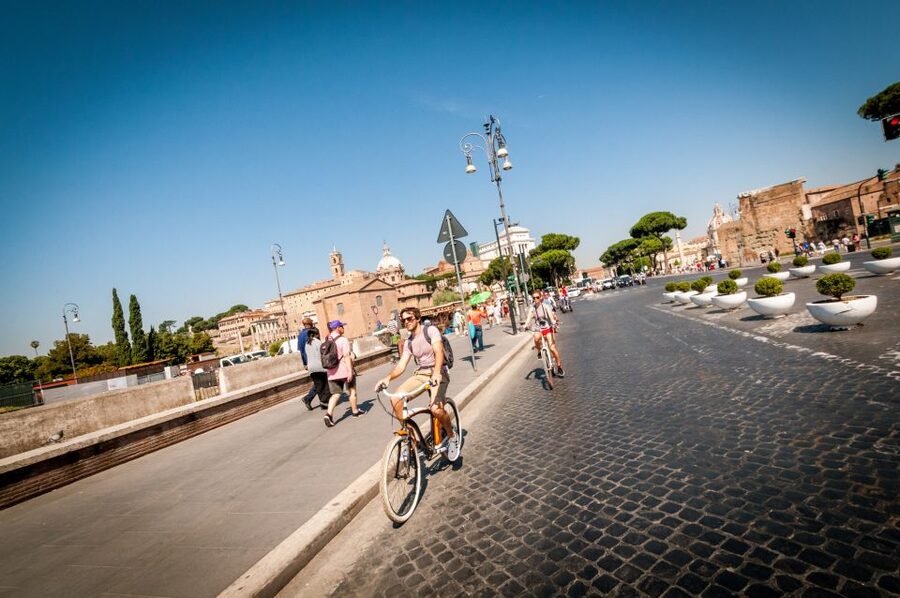
Rome rewards a little momentum. This three-hour bike tour links ancient ruins, grand piazzas, fountains, and narrow historic streets in one lively ride. I especially like the chance to cover far more ground than you could on foot, and the headset means you can keep listening while rolling between stops. The main drawback is traffic: parts of Rome feel tricky on a bicycle, especially if you are not comfortable riding near cars, pedestrians, and uneven cobblestones.
I also like the relaxed cruiser bikes, frequent photo stops, and guides who mix stories with practical care. Guides including Stefano, Matt, Sara, Alessandro, and Marco have been praised for keeping groups together and helping riders feel safe. This is an overview tour, not a museum tour, so you will see the monuments from outside and need separate tickets if you want to enter them.
Key points to know before booking
- The route covers major sights quickly: You pedal past the Pantheon, Trevi Fountain, Roman Forum area, Colosseum, and Circus Maximus in three hours.
- The riding is generally manageable: Several riders describe the route as mostly flat, though cobblestones, crowds, and busy roads still require confidence.
- The headset is genuinely useful: You can hear the guide while riding, even if you fall toward the back of the group.
- E-bikes help more with distance than hills: The route is not known for long climbs, but electric assistance can make a hot afternoon or full three-hour ride easier.
- Rome traffic is the chief concern: Guides work hard to keep the group safe, but this is still city cycling, not a protected bike path.
- The tour is best for an introduction: You get a broad sense of central Rome, then can return later to explore favorite sights inside.
What this Rome bike tour is really like
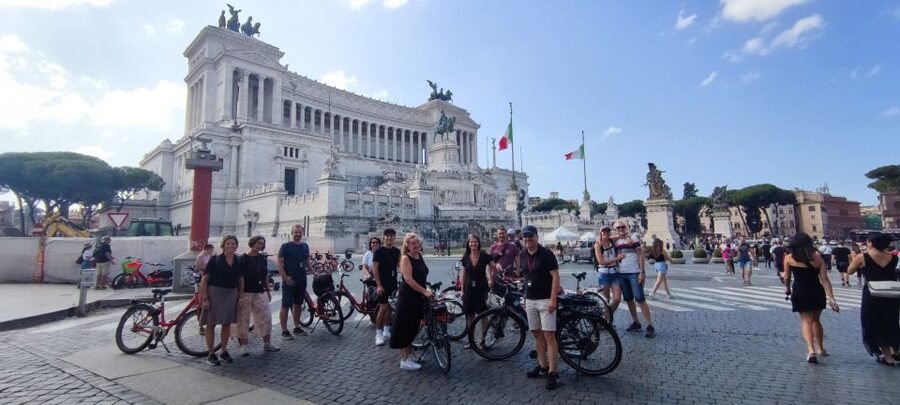
The tour begins at the Fat Tire Tours office on Via dei Delfini, close to Piazza Venezia. Arrive 15 minutes early so you have time for check-in, bike fitting, and any questions about the route. The office is about a five-minute walk from Piazza Venezia and roughly 15 minutes on foot from the Colosseum.
You receive a cruiser bike, a headset, and a local English-speaking guide. A helmet is available but optional. The bikes have several gears, and the relaxed upright position suits sightseeing better than racing around town. If you choose the e-bike option, you will get extra help when the route feels tiring, though several riders found the standard route fairly flat.
The headset changes the experience for the better. You do not need to crowd around the guide at every monument or strain to hear a speech over traffic. You can listen while riding, then stop for photographs and a closer look.
The pace is active but not a workout for most reasonably confident cyclists. You will ride, stop, listen, and ride again. The group format means you need to follow instructions and stay alert, especially when crossing streets or moving through crowded areas.
More City Highlights Bike Tours in Italy
- Rome: Top Highlights & Hidden Gems Tour by Cannondale E-Bike
★ 4.9 · 1,760 reviews - Rome: City Highlights E-Bicycle Tour
★ 4.9 · 740 reviews - Rome Highlights by E-Bicycle Small group
★ 5.0 · 486 reviews
Jewish Ghetto and Campo de’ Fiori
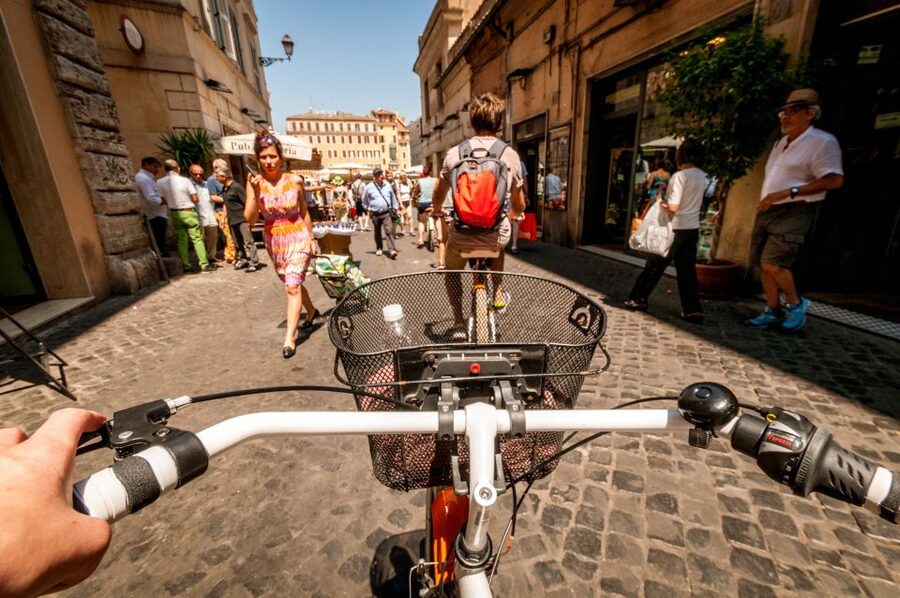
The first ride takes you toward Rome’s Jewish Ghetto, one of the city’s oldest neighborhoods. This opening section gives you a taste of the central streets before the famous monuments begin. It is also a useful warm-up because you can get used to the bike, headset, and rhythm of following a guide.
Next comes Campo de’ Fiori. The square is known for its market atmosphere and central location, though the exact feel can vary by time of day. You will not spend long here, so treat it as a quick orientation stop rather than a full market visit.
This early part of the route is valuable because it shows Rome as a working city, not just a chain of famous ruins. You pedal through streets where daily life and ancient history sit very close together. That contrast is one of the pleasures of seeing Rome by bike.
Pantheon, Piazza Navona, and Sant’Ignazio
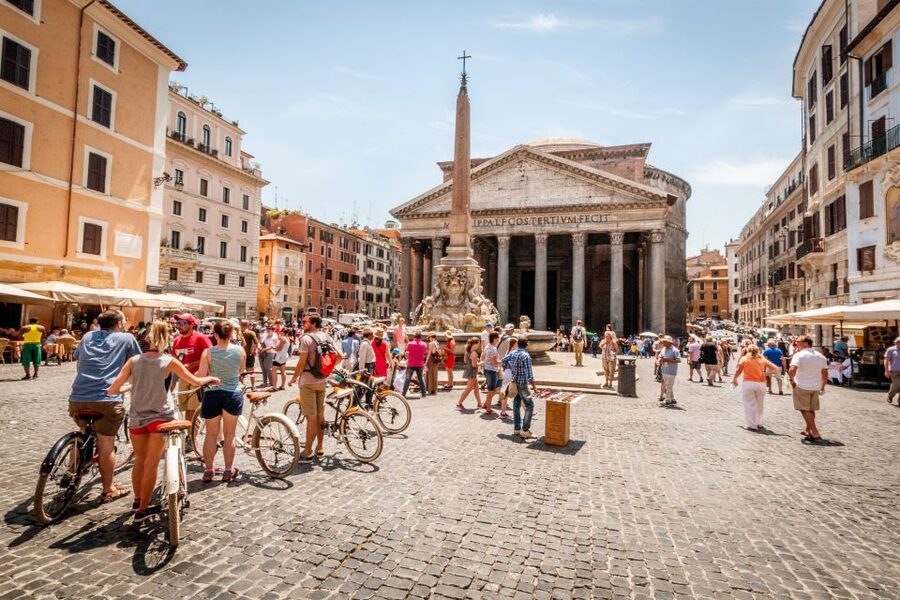
The Pantheon is one of the strongest stops on the tour. Its Corinthian columns and huge concrete dome make it one of the clearest examples of Roman engineering still visible in the city. The building began as a temple dedicated to all the gods of Ancient Rome and was later used as a church.
The tour views the Pantheon from outside. That is enough to appreciate the scale, but you should know that the itinerary does not include an interior visit. If the dome and interior light are high on your list, plan a separate visit at another time.
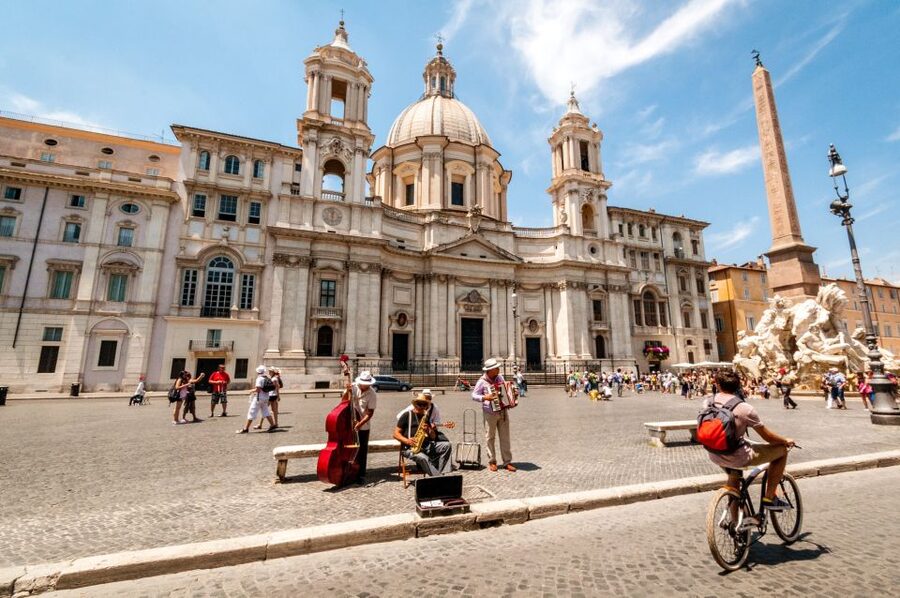
Piazza Navona follows. Its long shape reflects its ancient use as a Roman stadium, though today it is one of the city’s grandest public squares. The stop gives you time to take in the fountains, façades, and open space before the group moves on.
You then pass the Church of Sant’Ignazio di Loyola. Its interior is famous for painted architectural effects, but this bike tour does not include a museum-style visit inside. The value here is the quick look at another layer of Rome, where Baroque illusion and ancient Roman planning share the same compact center.
The Temple of Hadrian and Trevi Fountain
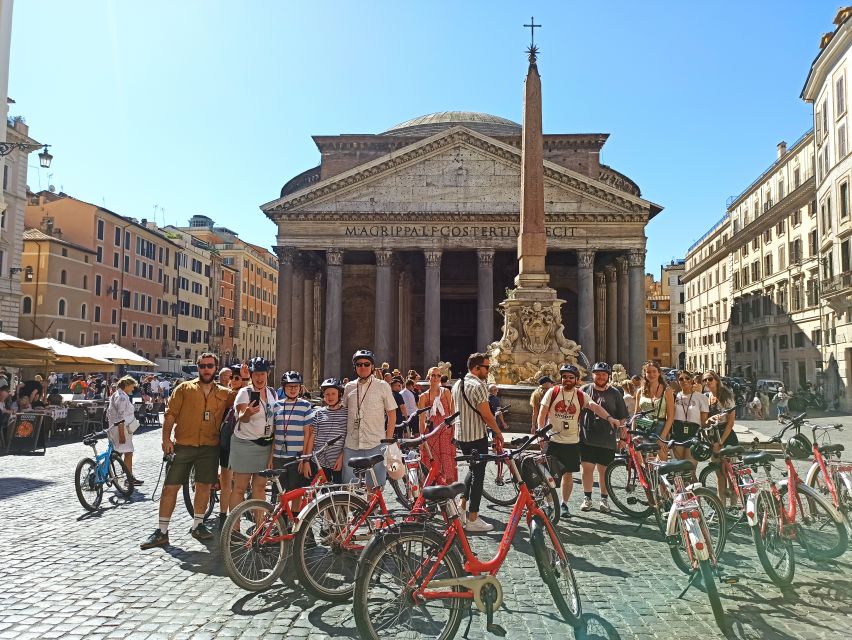
The Temple of Hadrian is a short stop, but it helps connect the modern streets to imperial Rome. The surviving columns are built into a later setting, which is typical of the city. Rome often gives you a fragment of antiquity beside cafés, offices, and traffic.
The Trevi Fountain receives a longer visit, with about 20 minutes listed for the stop and surrounding ride. This is a good place for photographs, though it is also one of the busiest points on the route. Keep your belongings close and follow the guide’s instructions when the crowd thickens.
The fountain is Rome’s largest Baroque fountain, filled with movement, carved figures, and elaborate stonework. You can admire the craftsmanship without needing a long explanation, but the guide’s historical comments add useful context. This is also a practical point to refill your water if needed, since August heat can be intense.
The tour does not give you a private or quiet view of the fountain. You are seeing it as part of the city’s public rush. That is less peaceful than arriving early alone, but the bike tour lets you reach it without spending much of your day walking across Rome.
More City Highlights Bike Tours in Rome
- Rome: City Highlights Electric Bike Tour
★ 4.9 · 343 reviews - Highlights & Hidden Gems Tour with Top E-bike
★ 5.0 · 300 reviews - Rome’s Best by E-bike: Guided City Tour (Small Group or Private)
★ 5.0 · 207 reviews - Rome: Panoramic Off-the-beaten-track Cannondale E-Bike tour
★ 5.0 · 71 reviews
Trajan’s Column and Piazza Venezia
After Trevi, the route continues toward Trajan’s Column. Its carved spiral relief tells the story of Emperor Trajan’s military campaigns. You will see it as an outdoor monument, not as a site you enter.
Piazza Venezia is close to the starting office and acts as an important crossroads in the historic center. The square can feel hectic, with traffic and large buildings competing for attention. From a bicycle, you get a quick but useful sense of how Rome’s major roads connect its ancient and modern districts.
This section also shows why the headset matters. You may be moving, stopping, and watching the road at the same time. Being able to hear the guide without forming a tight circle around the speaker makes the sightseeing more practical.
The Colosseum and Arch of Constantine
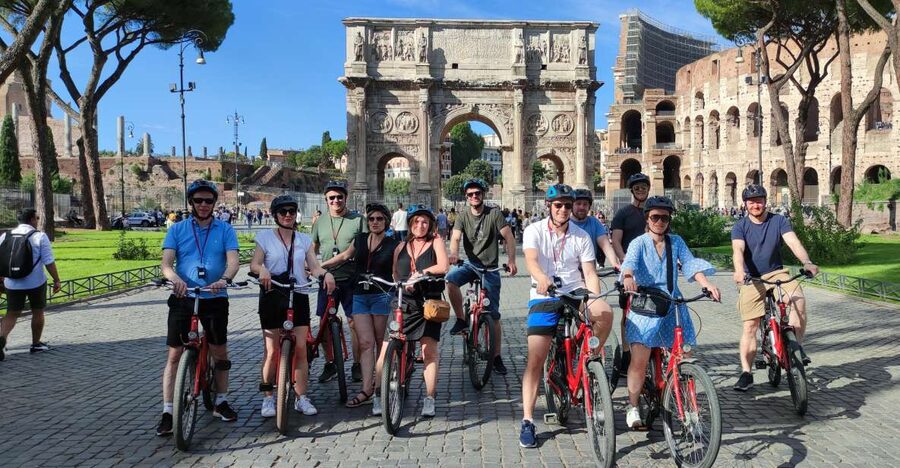
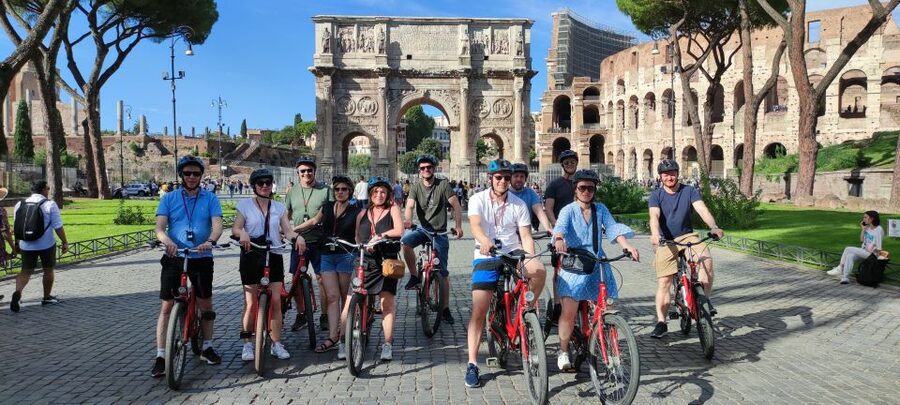
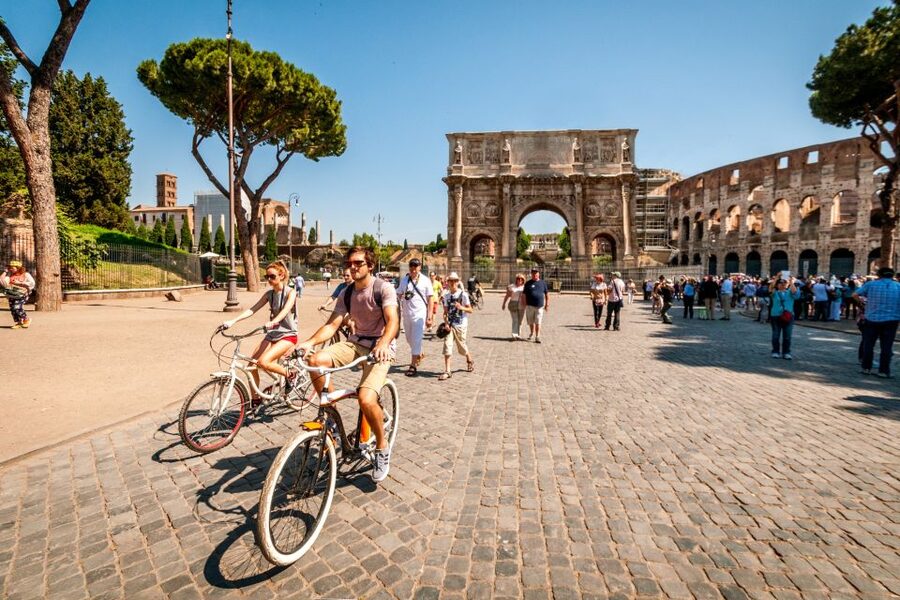
The Arch of Constantine marks the approach to the Colosseum. Its carved decoration and monumental scale prepare you for the larger arena nearby. You will have a chance to stop for photographs and hear the guide explain the setting.
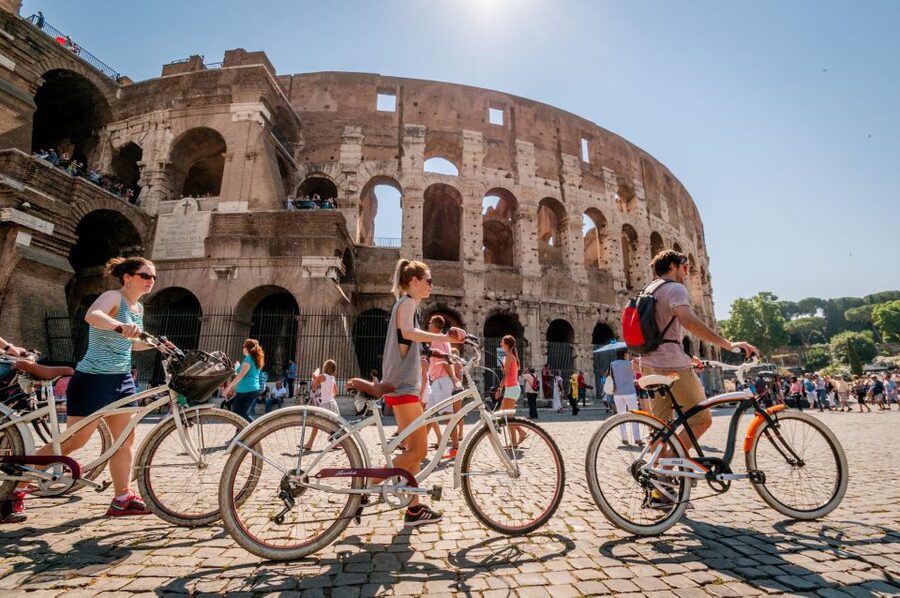
The Colosseum is the visual high point for many people. Built beginning in AD 72 during the reign of Emperor Vespasian, it once hosted public spectacles and remains Rome’s most recognizable ancient monument. Seeing it by bicycle gives you a strong sense of its position within the city rather than only the ticketed interior.
The tour does not include entry to the Colosseum. That is an important limitation if you have never been inside. Still, the exterior view is worthwhile, and the bike route helps you connect the arena with the Arch of Constantine, Roman Forum area, and nearby ancient roads.
The 25-minute portion around the Colosseum is among the longer sections of the route. That gives the guide room to explain more and gives you time for photographs. Groups can become separated here because the area attracts crowds, so stay close and listen for instructions.
Circus Maximus and the ride back
The route continues to Circus Maximus, the former site of chariot races. The enormous open space is less visually intact than the Colosseum, but its size helps you understand how large Roman public entertainment could be.
This is also one of the more comfortable parts of the ride. Several people found the route mostly flat and easy to manage, and the longer 20-minute section at Circus Maximus allows time to pause. You may appreciate this open area after tighter streets and crowded monument zones.
The group then returns to the Fat Tire Tours office. You finish with a broad map of central Rome in your head, even if you have not entered any monuments. I see this as a strong first-day activity because it helps you decide where you want to spend more time later.
Does the tour really include Vatican City?
The experience description refers to Vatican City and St. Peter’s Basilica, but the detailed stop sequence provided for this tour runs through the Jewish Ghetto, Campo de’ Fiori, the Pantheon, Trevi Fountain, Piazza Venezia, the Colosseum, and Circus Maximus. It does not list a Vatican stop.
I would not book this tour specifically to see Vatican City. Treat the listed central Rome route as the reliable guide to what you will cover. If the Vatican is a priority, arrange a separate visit and allow time for its museums, St. Peter’s Basilica, and security procedures.
That distinction matters because three hours is not enough for a full Rome sightseeing program. The tour gives you a strong sampler of ancient and Baroque Rome, but it cannot replace dedicated visits to the Colosseum, Pantheon, Roman Forum, or Vatican.
Standard bike or e-bike?
The standard cruiser is a sensible choice if you are comfortable cycling and want the simplest option. The route has been described as largely flat, and the bikes are easy to ride. Several people also liked the three-speed setup.
I would choose the e-bike if you are worried about heat, stamina, or keeping up with the group. It may not be necessary for hills, but Rome’s cobbles, traffic, stops, and three hours in the saddle can still wear you down. An e-bike also gives you more control when the group accelerates after a stop.
The electric option will not remove the need for balance or road awareness. You still need to steer around people, parked vehicles, and uneven surfaces. It is assistance, not a substitute for confident riding.
Safety, cobblestones, and summer heat
The strongest theme in the feedback is the care taken by guides. Stefano, Mattia, Alessandro, Marco, Sergio, and others have been praised for clear instructions, humor, and keeping the group together. One guide stopped during torrential rain when slippery roads became unsafe, while another adapted an afternoon tour to intense summer heat by using shade and avoiding major roads where possible.
That does not mean every street feels easy. Several riders found traffic and crowded roads challenging, and one person described parts of the route as dicey. You should be comfortable riding in an urban setting before booking.
Rome’s cobblestones also matter. They can make the ride bumpy, particularly for anyone unused to cycling. The tour is not recommended for pregnant women or children who are uneasy on a bike.
Wear comfortable, closed-toe shoes. Open-toed footwear is not allowed. The tour runs in rain or shine, and ponchos are available during wet weather. If heavy rain makes the roads too slippery, your guide may adjust the pace or stop for shelter.
Who will get the most from this experience?
I think this tour suits you best if you have limited time in Rome and want a fast orientation without committing to a full day of walking. It is also a good fit for families with older children, active adults, and anyone who enjoys learning while moving.
Teenagers can find the bike format more engaging than a long walking lecture. Older riders can also enjoy it if they are steady and comfortable on a bike. The route is not described as strenuous, but fitness is not the only issue. Balance, road confidence, and comfort with cobblestones matter just as much.
Children under 18 must be with an adult. For children younger than 10, the operator requires excellent cycling ability and solo riding on their own bike, and staff can decline participation if the child is not suitable. Give the operator each child’s age and height so the right bike can be prepared.
I would skip this tour if you dislike city cycling, have difficulty on uneven ground, or want quiet time inside Rome’s monuments. I would also avoid it if your main goal is the Vatican, since the detailed route does not include a Vatican stop.
Is $53 good value for three hours?
At $53 per person, I consider the price fair if you value both transportation and guiding. You get a bike, a local guide, a headset, and a route that links many major sights without paying separate admission fees.
The value is strongest when you are new to Rome. A guide helps you understand how the Pantheon, Roman temples, Baroque squares, imperial monuments, and Colosseum fit together. You also save your feet and cover distances that would take much longer on foot.
The price is less compelling if you only want photographs from outside. You could walk between some of the central sights for less money, though you would spend more time navigating and miss the guide’s stories.
Free cancellation up to 24 hours before departure and the option to reserve now and pay later make the booking less rigid. Starting times vary, so check availability before planning the rest of your day.
Should you book this Rome bike tour?
I would book it early in a Rome visit, especially if you have only a few days. It gives you a useful first look at the city, highlights the places worth returning to, and adds context without turning the day into a lecture.
Choose the standard bike if you regularly cycle and are comfortable with a mostly flat route. Choose the e-bike if heat, distance, or stamina might distract you from the sights. In either case, wear closed shoes, arrive early, and expect some traffic and cobblestones.
Book this tour if you want an active overview with strong guide support. Skip it if you need interior access, a Vatican visit, or a protected cycling route. For the right rider, it is a practical and enjoyable way to get Rome into focus quickly.
FAQ
How long is the Rome bike tour?
The tour lasts three hours, with multiple sightseeing stops and riding sections through central Rome.
What sights does the route include?
The route includes the Jewish Ghetto, Campo de’ Fiori, Pantheon, Piazza Navona, Church of Sant’Ignazio di Loyola, Temple of Hadrian, Trevi Fountain, Trajan’s Column, Piazza Venezia, Arch of Constantine, Colosseum, and Circus Maximus.
Does the tour go inside the Colosseum or other monuments?
No. The tour does not visit inside monuments or museums. You see the sights from outside and hear explanations from the guide.
Is Vatican City included?
The experience description refers to Vatican City, but the detailed route provided does not list a Vatican stop. Plan a separate visit if seeing Vatican City is important to you.
Are e-bikes available?
Yes. You can choose between a standard bike and an e-bike option. The route is generally described as fairly flat, but an e-bike can make the ride easier in hot weather or over the full three hours.
Can children join the tour?
Children under 18 must be accompanied by an adult. Children under 10 must be excellent cyclists and able to ride their own bike, and the operator may decline participation if the child is not suitable. Provide children’s ages and heights in advance for bike preparation.
What should I wear and bring?
Wear comfortable clothing and closed-toe shoes. Open-toed shoes are not allowed. The tour runs in rain or shine, and rain ponchos are available when needed.
More E-Bike Tours in Rome
- Rome by Night – Ebike Small Group Tour – Food and Wine (Option)
★ 5.0 · 1,275 reviews - Rome by Night: E-bike Small Group Tour -Food & Wine (Option)
★ 4.9 · 1,233 reviews - Appian Way, Catacombs and Aqueducts Park Tour with Top E-Bike
★ 5.0 · 735 reviews - Rome: Appian Way E-Bike Tour Catacombs, Aqueducts & Picnic
★ 4.6 · 727 reviews
More E-Bike Tours in Italy
- Rome EBike Tour: Appian Way, Catacombs & Roman Aqueducts
★ 5.0 · 1,766 reviews - Rome: Appian Way & Aqueducts E-Bike Tour (Catacombs & Food)
★ 4.9 · 1,498 reviews - Rome: Appian Way, Catacombs, & Roman Aqueducts E-bike Tour
★ 4.9 · 1,421 reviews - Rome City Small Group Bike Tour with quality Cannondale EBike
★ 5.0 · 1,380 reviews
Just added around Rome
- Rome: Guided eBike Evening Tour with italian Aperitif★ 5.0 · 16 reviews
- Rome: Villa Borghese, Villa Ada, and Coppedè E-Bike Tour★ 4.8 · 78 reviews
- Sunrise in Rome: Small Group E-Bike Tour & Italian breakfast★ 4.9 · 177 reviews
- Rome: Top 10 Highlights Guided Tour by Bike or E-Bike★ 4.4 · 15 reviews
- Rome: Appian Way, Aqueducts, & Catacombs E-Bike Guided Tour★ 4.9 · 54 reviews
- Rome: Villa Borghese E-Bike Tour (Small Group or Private)★ 4.9 · 92 reviews
- Rome: Panoramic Off-the-beaten-track Cannondale E-Bike tour★ 5.0 · 71 reviews
- Rome: Taste of Rome by quality Cannondale E-Bike★ 5.0 · 12 reviews
City Highlights Bike Tours, compared.
3-Hour Porto Highlights on a Electric Bike Guided Tour
Read our review →
City Highlights 3-Hour Guided Electric Bike Tour
Read our review →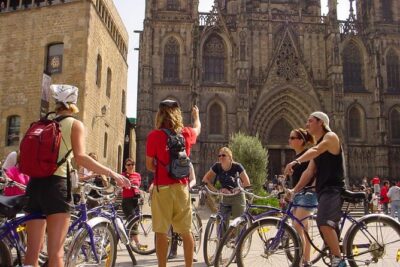
Highlights & Hidden Spots of Barcelona Bike Tour w/ Local Guide
Read our review →
Sights and Highlights Bike Tour with a Local Guide
Read our review →
Highlights 3 Hour Bike Tour with a Local Guide
Read our review →
Browse the lists this tour appears in