

REVIEW · ROME
Rome: Appian Way, Catacombs, & Roman Aqueducts E-bike Tour
Rome has a quieter side. This small-group e-bike tour leaves the city crowds behind for the ancient Appian Way, Roman aqueducts, catacombs, and open parkland. I especially like the mix of outdoor riding and Roman history, plus the excellent Cannondale e-mountain bikes. The main caution is simple: 27 kilometers, rough paths, and some city traffic require solid bike handling.
The six-hour version adds a guided visit underground at the Catacombs of St. Callixtus or St. Sebastian, while the four-hour option only pauses at the entrance. Guides such as Arina, Oscar, Agnese, Bita, and Cas have earned praise for keeping groups together and handling traffic carefully. If you rarely ride, practice on an e-bike before choosing this outing.
Key points to know before booking
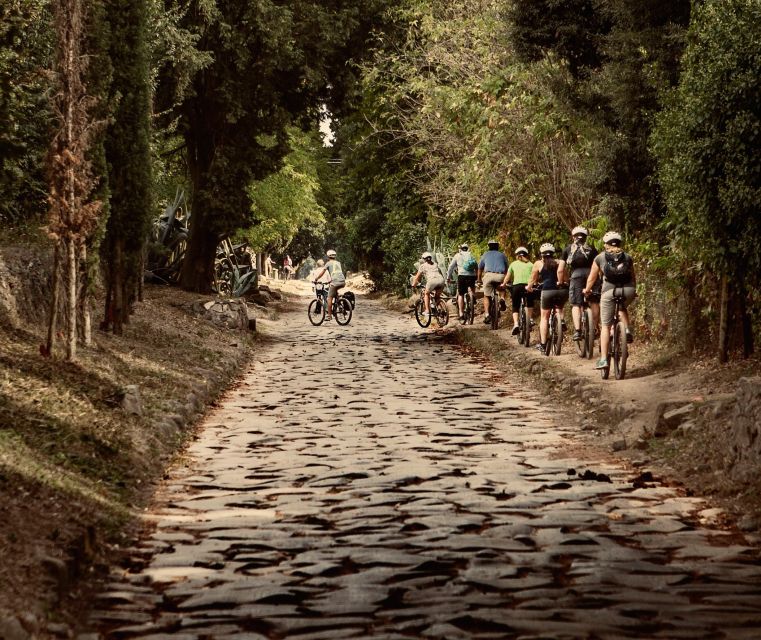
- The route covers 27 kilometers: About 60 percent is off-road, with gravel, uneven surfaces, and park paths.
- The six-hour tour includes the catacombs: The four-hour tour gives you a short explanation outside but does not include the underground visit.
- The Appian Way feels far from central Rome: You pass tombs, villas, mausoleums, and ancient ruins in a peaceful setting.
- The aqueduct section is the visual high point: Huge arches cross the Park of the Aqueducts and offer some of the day’s best views.
- Traffic is part of the deal: Around 40 percent of the route runs through city streets, though guides choose careful connections.
- The $85 price is fair for the full outing: You get a quality e-bike, helmet, guide, water, bag, and, on the longer tour, the catacomb visit.
Why this e-bike ride makes sense in Rome

Rome rewards walking, but its ancient outskirts are too spread out for a comfortable stroll. The Appian Way, the aqueduct parks, the Caffarella Valley, and the Baths of Caracalla sit well beyond the usual Colosseum and Vatican circuit. An e-bike links them in one long outing without asking you to pedal every hill under your own power.
I like the way this tour joins several Roman stories. You see military engineering on the Appian Way, funerary customs in the tombs and mausoleums, early Christian burial sites underground, and the enormous water system that fed ancient Rome. Then you return through green space instead of spending the whole day among buses and stone streets.
The tour costs $85 per person and lasts four to six hours, depending on your choice. That is a reasonable price for a small group capped at 10 people, a Cannondale e-mountain bike, safety equipment, a professional guide, and water. The six-hour version offers particularly good value if the catacombs interest you, since the guided underground visit is included.
Food is not included. Some groups stop at a pizzeria along the route, and you can buy food along the way, but do not count on a full meal unless your guide makes a stop. Bring comfortable shoes and consider carrying a small snack.
More E-Bike Tours in Italy
- Rome EBike Tour: Appian Way, Catacombs & Roman Aqueducts
★ 5.0 · 1,766 reviews - Rome: Top Highlights & Hidden Gems Tour by Cannondale E-Bike
★ 4.9 · 1,760 reviews - Rome: Appian Way & Aqueducts E-Bike Tour (Catacombs & Food)
★ 4.9 · 1,498 reviews
Starting at Via Labicana 49
The meeting point is at Via Labicana 49, within walking distance of two metro stations. From the Colosseum station, allow 10 to 15 minutes. Leave by the main exit, turn left, pass the Colosseum, and continue as the street becomes Via Labicana. Number 49 is on the right after about five minutes on that street.
From Manzoni station, the walk takes about 10 minutes. Follow Viale Manzoni toward the Colosseum, continuing straight as it changes into Via Labicana. Number 49 is on the left.
The start is practical, though you should allow enough time to find the address and arrive ready to ride. At check-in, you receive a helmet, a five-liter handlebar bag, and a biodegradable bottle of water. Helmet use is mandatory, sensibly so given the rough sections and city riding.
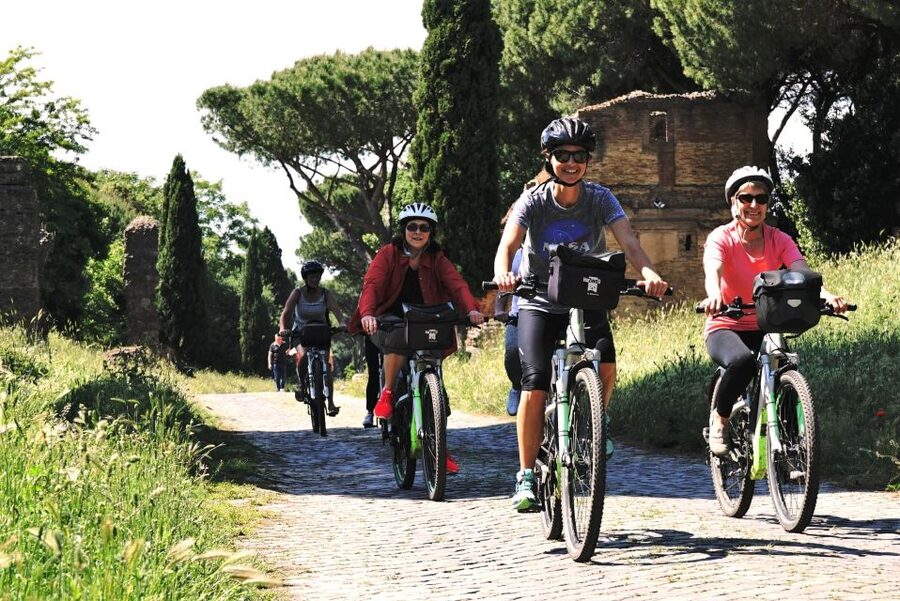
The Cannondale e-mountain bikes use anti-puncture tires and electric assistance. Several people found them easy to operate even on a first e-bike outing. Guides explain the gears and assistance before departure, and the bikes provide enough help for the full distance without making the ride feel like a workout contest.
Through the Aurelian Walls and onto the Appian Way
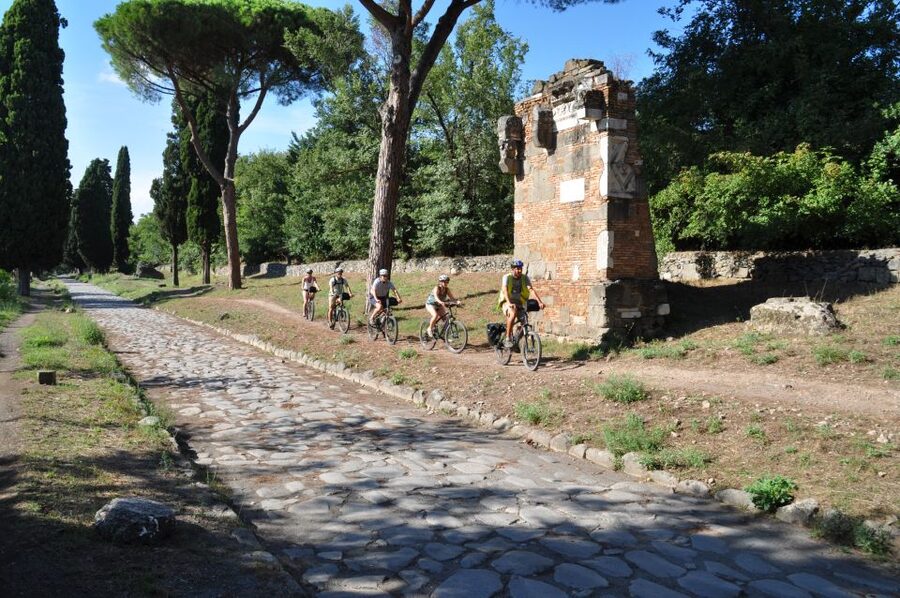
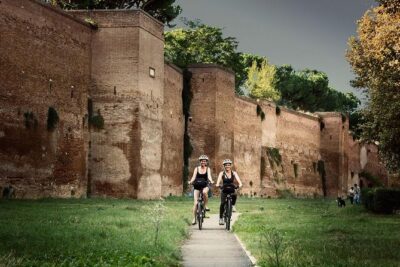
The route begins by passing through St. Sebastian’s Gate in the Aurelian Walls. This is a fitting entrance to the old road, since the walls mark the edge of imperial Rome and the Appian Way leads you into a different kind of city experience.
The Appian Way is about 2,300 years old. It was built as a major route south from Rome, and its surviving stones, roadside tombs, and scattered ruins give you a better sense of Roman expansion than another hour spent staring at a museum model.
You ride past ancient villas, tombstones, mausoleums, and the remains of wealthy estates. The stops are not just quick photo pauses. A good guide gives the ruins a human scale, explaining who used the road, why large tombs lined it, and how the area changed as Rome grew and later declined.
The surface is not perfectly smooth. You will encounter gravel and uneven sections, and the road can be bumpy. The electric motor helps with distance and inclines, but it does not steer the bike for you. You still need to control your speed, keep your balance, and watch the surface ahead.
This is where the intermediate rating matters. A confident cyclist should find the route manageable, especially with the electric assistance. If you have not ridden for years, the distance and rough ground may feel more demanding than the advertised effort suggests.
Maxentius, Cecilia Metella, and the old aristocratic estates
The Circus of Maxentius is one of the major historical stops. It belongs to the complex built by Emperor Maxentius, and its presence helps you picture the scale of Roman construction outside the city center. Seeing it by bike also gives you a better sense of the space around the monument.
The Tomb of Cecilia Metella is another memorable point along the road. Its large, fortified appearance shows how important and visible elite burial monuments could be. You do not simply pass a single ruin and move on. The road is lined with traces of Roman life, so the ride itself becomes part of the sightseeing.
The route also includes Villa dei Quintili, a large suburban estate linked to two wealthy brothers. These properties reveal how Rome’s richest residents used the countryside for leisure and status. The contrast is striking: a road once built for military and commercial movement also became a corridor of villas, gardens, and grand tombs.
Your guide’s pacing makes a big difference here. Arina was praised for keeping the ride measured and safe, while guides including Oscar, Bita, and Agnese received especially warm comments for explaining the sites without overwhelming the group. Several people also appreciated frequent stops for photos and short talks.
More E-Bike Tours in Rome
- Rome City Small Group Bike Tour with quality Cannondale EBike
★ 5.0 · 1,380 reviews - Rome by Night – Ebike Small Group Tour – Food and Wine (Option)
★ 5.0 · 1,275 reviews - Rome by Night: E-bike Small Group Tour -Food & Wine (Option)
★ 4.9 · 1,233 reviews - Rome: Standard or E-Bike Highlights Guided Tour
★ 4.7 · 777 reviews
Choosing the catacombs option
The six-hour tour includes a guided underground visit to the Catacombs of St. Callixtus or St. Sebastian. You descend into crypts and corridors connected with early Christian burial traditions. This changes the mood of the day, moving from open countryside and sunny ruins to a much more enclosed and reflective setting.
The catacombs are a strong reason to choose the longer tour. They add early Christian history to the Roman military, architectural, and engineering stories already covered on the ride. The visit also gives the day a useful rhythm: cycling outdoors, stopping at major ruins, then going below ground before returning to the open parks.
The four-hour tour stops at the catacomb entrance for roughly five minutes. You receive an explanation of the site’s importance but do not take the guided underground visit. This shorter version is sensible if you want the Appian Way and aqueducts but prefer a lighter schedule.
The difference between the two options is not just two hours on a clock. The longer version offers a distinct historical experience. If underground burial sites interest you, spend the extra time and choose six hours. If your priority is cycling and scenery, the four-hour ride may be enough.
The Park of the Aqueducts is the visual payoff
After the Appian Way, the route heads to the Park of the Aqueducts. Here, long lines of colossal arches cross the open ground, creating one of the most striking scenes in Rome. The scale is hard to understand from a city street. Out in the park, you can see how far the structures stretch and how boldly the Romans carried water across open country.
The aqueduct section is also where the tour feels most removed from central Rome. You have room around you, fewer cars, and broad views of the ancient arches. Several people considered this part the highlight of their day, and it is easy to see why.
The route follows the aqueducts back toward modern Rome. This gives you more than a single stop for photographs. You ride alongside the engineering system and watch the setting change as the city gradually returns.
The electric bike is particularly useful here because the distance between sights is substantial. You can keep moving at a good pace without arriving at each stop exhausted. Still, the motor cannot erase heat, sun, or the need to sit on a saddle for several hours. Summer riders should use the water provided and take every chance to refill or purchase more.
Crossing Caffarella Valley and returning through the city
The route continues through Caffarella Park, a green stretch that provides a calm transition back toward the city. This part helps explain why the outing works so well: it is not a string of isolated monuments. You ride through open ground, historic sites, park paths, and city connections in one continuous loop.
The return includes a short city ride and a final stretch toward the Baths of Caracalla before reaching Via Labicana 49. Around 40 percent of the total route takes place in the city, so traffic cannot be avoided entirely. The remaining 60 percent is in parks or on off-road sections with no traffic.
This is the part to take seriously if you are nervous on a bicycle. Guides receive repeated praise for signaling, regrouping, choosing safer streets, and helping riders cross busy areas. Anna was noted for preparing the group for city traffic, while Arina and Bita were praised for keeping riders safe and together.
Even with a careful guide, you remain responsible for controlling your bicycle. The route is not suitable for someone who is uncomfortable riding in traffic or handling gravel. A 12-year-old and 14-year-old can enjoy it with suitable confidence, and children nine and older may ride their own e-bike. Younger children use a child seat or extension, but the tour becomes more difficult with that extra weight and handling challenge.
How hard is 27 kilometers on an e-bike?
The tour is rated intermediate, not beginner. The electric assistance makes the distance much easier, and several first-time e-bike users learned the controls quickly. But pedaling effort is only one part of cycling.
You also need to:
- Ride over uneven ground and gravel
- Handle occasional bumps without swerving
- Follow group instructions in traffic
- Keep a steady pace for four to six hours
- Manage the bike confidently when stopping and starting
The bikes have anti-puncture tires, and the equipment is supplied by the operator. One rider reported that a guide helped fix a flat, but you should still expect normal outdoor-bike conditions rather than a perfectly smooth road ride.
The equipment has a total weight limit of 300 pounds, or 136 kilograms. Infants under one year are not permitted. Children ages one to four can travel free in a child seat up to 49 pounds, or 22 kilograms. Ages five to eight use a child extension, and children nine and older can ride their own e-bike.
Small groups and multilingual guides
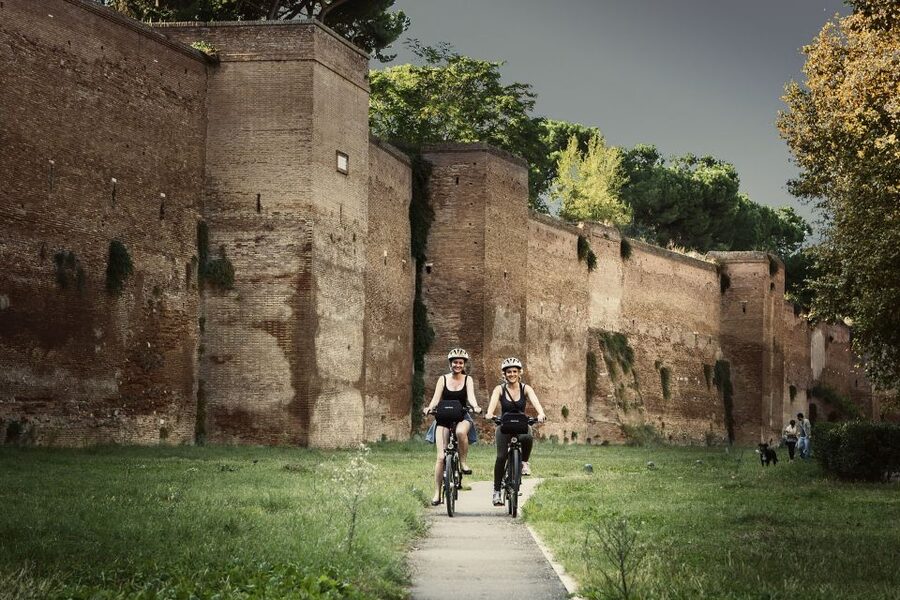
The group limit is 10 people, which is important on a route that includes traffic and frequent stops. A smaller group is easier to keep together, and the guide can respond when someone needs help with gears, pacing, or a bike problem.
Tours are offered with live guides speaking English, Italian, Spanish, French, German, or Dutch. The guide quality appears to be one of the strongest parts of the experience. Oscar, Pablo, Ali, Sina, Zak, Bita, and Agnese were all praised for combining historical detail with patience and practical care.
That combination matters. A guide who only recites dates would miss the point, while a guide who focuses only on safety would make the ride feel flat. The best guides tell stories at the stops, answer questions, watch the road, and adjust the pace when the group needs it.
On Wednesdays, the tour can last 30 minutes longer. The minimum group size is four people. If that number is not reached, an alternative or full refund is offered. You can cancel up to 24 hours ahead for a full refund, and the reserve-now, pay-later option keeps your plans flexible.
Is the $85 price good value?
For $85, you receive a quality Cannondale e-mountain bike, helmet, handlebar bag, water, guide service, and the catacomb visit on the six-hour version. The route links several outlying Roman sights that would otherwise require a mix of buses, taxis, and separate admission plans.
The value is strongest if you want an active day and would use the full six hours. You are paying not only for bicycle rental but also for route planning, traffic management, historical explanations, and access to a carefully connected itinerary.
The price is less appealing if you want a short, gentle ride or have little cycling confidence. You may spend part of the day worrying about surfaces and traffic instead of enjoying the ruins. In that case, the four-hour version reduces the commitment but does not remove the intermediate riding level.
Who should book this Rome bike tour?
I would recommend it to confident cyclists, families with older children, and anyone who has already seen Rome’s central sights and wants a different day. It is especially good for people who enjoy moving through places rather than simply arriving, taking a photo, and leaving.
History fans should choose the six-hour option for the catacombs. Nature lovers will prefer the Appian Way, Aqueducts Park, and Caffarella sections. Teenagers often respond well to the combination of e-bikes, rough tracks, and enormous Roman ruins.
I would be cautious about booking if you have not ridden a bicycle in years, dislike city traffic, or want a polished road surface. The electric motor helps with stamina, not balance. Wear comfortable shoes, listen closely to the guide, and expect some bumps.
Final decision: book the four-hour or six-hour ride?
Book this tour if you want Rome’s ancient world with more space, fresh air, and movement. The aqueducts are spectacular, the Appian Way offers a rare break from central Rome, and the small group format gives guides room to look after you.
Choose six hours if the catacombs matter to you and you are comfortable spending most of a day on a bike. Choose four hours for the main outdoor route without the underground visit. Either way, this is a strong use of a sunny day in Rome, provided you treat the intermediate rating seriously.
FAQ
Where does the tour start and finish?
The tour starts and returns to Via Labicana 49 in Rome.
How far is the route?
The full route is 27 kilometers, or about 17 miles.
How much of the route is off-road?
About 60 percent of the route is off-road, mostly in parks and along the Appian Way.
Does the tour include the catacombs?
The six-hour version includes a guided catacomb visit. The four-hour version stops at the entrance for a short explanation but does not include the underground visit.
Which catacombs might I visit?
The guided visit is at the Catacombs of St. Callixtus or St. Sebastian.
Is the tour suitable for beginners?
The tour is rated intermediate. E-bike beginners can learn the controls, but you should be comfortable riding over gravel, uneven ground, and some city streets.
Are bikes and helmets provided?
Yes. The tour includes a Cannondale e-mountain bike with anti-puncture tires and a helmet. Helmet use is mandatory.
Are food and drinks included?
No. Food and drinks are not included, though you can buy some along the way.
Can children join the tour?
Infants ages one to four can use a child seat up to 49 pounds, or 22 kilograms. Children ages five to eight use a child extension, and children nine and older can ride their own e-bike. Babies under one year cannot join.
What languages are available?
Live guides may conduct the tour in Dutch, Spanish, French, English, German, or Italian.
Just added around Rome
- Rome: Guided eBike Evening Tour with italian Aperitif★ 5.0 · 16 reviews
- Rome: Villa Borghese, Villa Ada, and Coppedè E-Bike Tour★ 4.8 · 78 reviews
- Sunrise in Rome: Small Group E-Bike Tour & Italian breakfast★ 4.9 · 177 reviews
- Rome: Top 10 Highlights Guided Tour by Bike or E-Bike★ 4.4 · 15 reviews
- Rome: Appian Way, Aqueducts, & Catacombs E-Bike Guided Tour★ 4.9 · 54 reviews
- Rome: Villa Borghese E-Bike Tour (Small Group or Private)★ 4.9 · 92 reviews
- Rome: Panoramic Off-the-beaten-track Cannondale E-Bike tour★ 5.0 · 71 reviews
- Rome: Taste of Rome by quality Cannondale E-Bike★ 5.0 · 12 reviews
E-Bike Tours, compared.
3-Hour Porto Highlights on a Electric Bike Guided Tour
Read our review →
Hills, Alfama, and Mouraria Tour by Electric Bike
Read our review →
Athens Scenic Electric Bike Tour with optional Acropolis visit
Read our review →
City Highlights 3-Hour Guided Electric Bike Tour
Read our review →
Rome EBike Tour: Appian Way, Catacombs & Roman Aqueducts
Read our review →
Top Highlights & Hidden Gems Tour by Cannondale E-Bike
Read our review →Browse the lists this tour appears in