
REVIEW · BERLIN
Berlin Wall and Cold War Bike Tour in Small Groups
Berlin’s past is best seen on two wheels. This 3.5-hour bike tour connects the Berlin Wall Memorial, Mauerpark, Brandenburg Gate, Checkpoint Charlie, and other Cold War sites while a local guide explains what happened at each place. I like the small maximum group of 15 and the chance to cover about 20 kilometers without wearing out your feet.
I also like the human side of the tour. Guides such as Giovanni, Peter, George, Monti, and Gilles have been praised for making dates, border politics, escape attempts, and daily life feel understandable. The main drawback is the weather: even with bikes provided, rain or cold can make three and a half hours outside a test of your good humor.
Key Points Before You Book
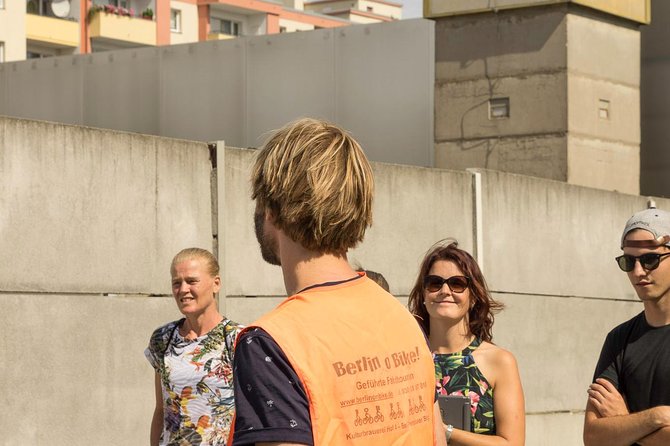
- About 20 kilometers by bicycle: You cover far more ground than on a walking tour, with stops at major Wall sites and lesser-seen Cold War locations.
- Maximum 15 people: The group is small enough for questions and easier cycling through Berlin.
- Strong guide-led storytelling: Peter, also called Liverpool Pete, Giovanni, George, Monti, and Gilles have all been praised for clear, engaging explanations.
- Bikes and helmets included: You do not need to arrange a rental separately.
- Starts and ends at Kulturbrauerei: The meeting point is Berlin on Bike at Knaackstraße 97 in Prenzlauer Berg.
- Plan for changing weather: The tour operates in all weather conditions, but poor weather can lead to cancellation, a new date, or a full refund.
Why a Bike Is a Smart Way to See the Wall
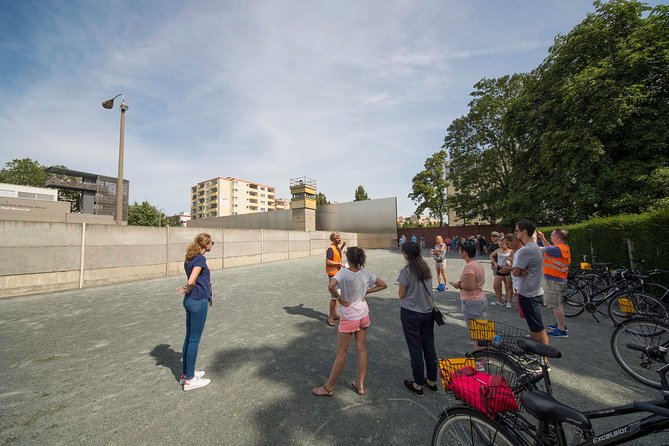
The Berlin Wall was not one single sight. It cut through neighborhoods, parks, railway areas, government districts, and ordinary streets. A memorial plaque or remaining section can be meaningful, but it can also be hard to place on a map. A bicycle helps you connect those fragments.
I like the pace of this outing. You ride between sites, stop for a talk, look around, and continue. You are not trapped on a bus behind glass, and you are not spending the entire day walking from one memorial to the next. The route also gives you a wider sense of how the former East and West met across Berlin.
The tour lasts about three and a half hours and covers roughly 20 kilometers, according to one participant. That is a reasonable distance for anyone comfortable with ordinary city cycling, but it is still exercise. You will want practical clothing, shoes that work on pedals, and protection from rain or sun.
The group limit of 15 matters. A large bicycle group can become awkward at traffic lights and hard to hear during talks. This smaller format should make it easier to stay with the guide and ask questions. It also helps when the group needs to stop, as happened during a wet outing described by one participant.
A few more days on two wheels around Berlin worth a look
- Berlin: Sights and Highlights Bike Tour with a Local Guide
★ 4.8 · 2,698 reviews - Berlin Highlights 3-Hour Bike Tour
★ 5.0 · 948 reviews - Berlin City Bike Tour with Beer Garden Stop
★ 5.0 · 917 reviews
Starting at Kulturbrauerei in Prenzlauer Berg
The tour begins at Berlin on Bike, located at Kulturbrauerei, Knaackstraße 97. The bike depot is also where the tour finishes, which keeps the day simple. You do not need to arrange a separate return transfer or figure out where to leave the bike.
Kulturbrauerei itself is worth a quick look. This former industrial complex covers about 25,000 square meters and is known for its courtyards and late 19th-century architecture. It has been protected since 1974 and is one of Berlin’s better-preserved industrial buildings from that period.
The stop here is brief, only about five minutes, so do not expect a full architectural visit. Still, it gives the tour a fitting starting point. You begin in a former working district, collect your bicycle and helmet, and then head toward the places where Berlin’s 20th-century division took physical form.
The tour is offered in English. The company has used guides with different backgrounds and styles. Peter, known as Liverpool Pete, has been praised for his compassion and strong command of the subject. Giovanni has been singled out for bringing dates and events to life, while Gilles was praised for explaining the Wall’s fall from personal experience, having lived through it only days before his own anniversary of the event.
Brandenburg Gate and the Shape of Divided Berlin
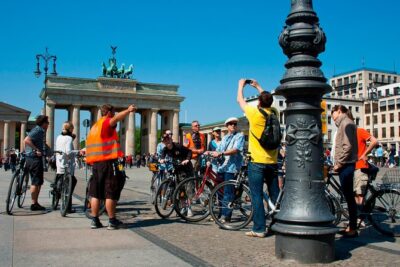
The first major stop is the Brandenburg Gate, on Pariser Platz in Mitte. This early classicist gate is one of Berlin’s best-known monuments, but its Cold War meaning is more important here than its appearance alone.
The gate stood close to the Wall and became a symbol of a divided city. Seeing it near the beginning of the route gives you a useful reference point. Berlin’s political center, the Wall, the former Soviet sector, and the former Western sectors were not distant ideas. They met in the same city streets.
The stop lasts about 10 minutes and admission is free. That short visit works well on a bike tour. You get time to look, listen, and understand the location without turning the outing into a long monument lecture.
Your guide may also help you see why Berlin cannot be reduced to a single Wall fragment. The Brandenburg Gate carries imperial, Nazi, wartime, divided-city, and reunification associations. The Cold War section of that story is the focus here, but the setting gives it weight.
Berlin Wall Memorial: The Clearest Look at the Border
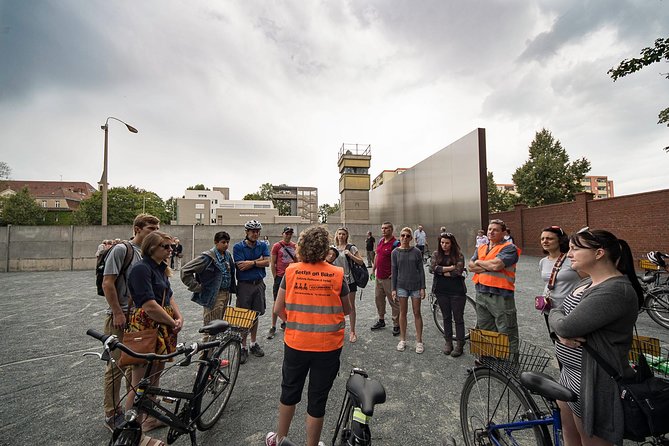
The Berlin Wall Memorial is one of the most important stops. It commemorates the division of Berlin by the Wall and the people who died at it. The route allows about 10 minutes here.
That is enough to receive the guide’s explanation, view the memorial area, and ask questions. It is not enough for a long museum visit, so you should think of this tour as an overview with selected stops rather than a complete study of every memorial site in Berlin.
This is where the Wall becomes more than a political boundary. You can think about the barriers, the surveillance, the danger of escape, and the way the border cut through homes and neighborhoods. The strongest part of this tour is likely to be the connection between physical places and personal stories.
One parent said the tour worked well for a chronically bored teenager, largely because Peter was articulate and enjoyable to listen to. That is useful advice if you are visiting with older children. The subject is serious, but a good guide can make it accessible without treating it like a dry classroom lesson.
Same roads, a different day in the saddle:
- Berlin Highlights: 3-Hour Bike Tour
★ 4.9 · 809 reviews - Berlin Highlights Sightseeing Bike Tour in Small Groups
★ 5.0 · 652 reviews - Berlin: The Wall and Third Reich Guided Bike Tour
★ 4.8 · 578 reviews - Berlin: Alternative Bike Tour of Kreuzberg & Friedrichshain
★ 4.7 · 548 reviews
Mauerpark and the Border in an Ordinary Neighborhood
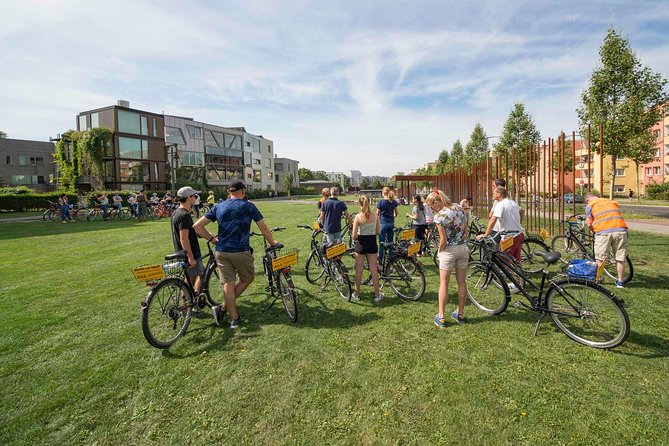
Mauerpark takes its name from the Wall that once crossed this area between the former districts of Prenzlauer Berg and Wedding. Today it is a public park, but the name keeps the old boundary visible.
The planned stop is only about five minutes. That may sound short, but the value is the explanation. You are seeing how the former border ran through a normal part of Berlin, not just through official checkpoints and famous monuments.
This is one of the reasons I prefer the bicycle format. You pass through several sections of the city and notice how quickly the setting changes. The Wall did not divide only government buildings. It affected parks, homes, transport routes, workplaces, and daily errands.
If you want long stretches of quiet time at each site, this tour may feel brisk. If you want a clear route through several different areas, the short stops make sense. The guide supplies the connection, while the cycling lets you see the distance between places.
The GDR Watch Tower at Kieler Eck
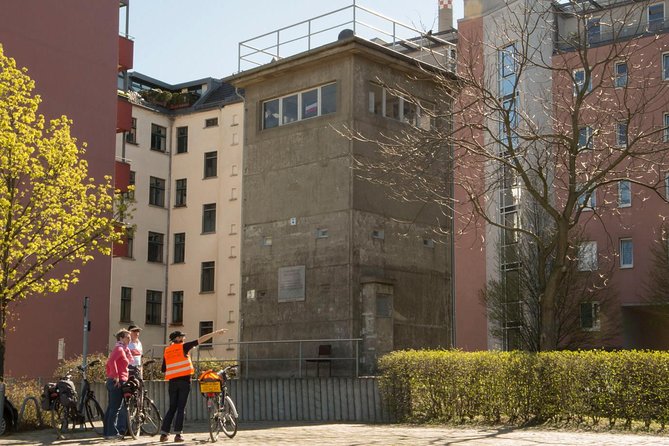
The old GDR watch tower at Kieler Eck is a smaller stop, with about five minutes planned. Unlike the more famous Brandenburg Gate or Checkpoint Charlie, it is not a major city landmark. Its value comes from its direct connection to border control.
A watch tower makes the Wall system easier to picture. This was not simply a concrete barrier. It was a controlled border supported by guards, observation points, restricted areas, and strict rules. The guide can place this tower within that larger system.
Admission to the tower is included. The supplied details do not promise a lengthy interior visit, so you should treat it as a brief historical stop rather than a full museum experience.
That short pause also shows the route’s balance. You visit symbolic places, memorials, and practical remnants of the border. Together, they offer a fuller picture than a route made only of famous photo stops.
Checkpoint Charlie and the Problem of Famous Symbols
Checkpoint Charlie was a crossing between the American and Soviet sectors from 1961 to 1990. It linked East Berlin’s Mitte district with West Berlin’s Kreuzberg area along Friedrichstraße.
This is probably the stop most familiar to first-time visitors. It is also a place where expectations need managing. Checkpoint Charlie is historically important, but the modern setting can feel more commercial and theatrical than solemn. The tour’s guide is useful here because you can separate the real Cold War function of the crossing from the present-day displays and photo opportunities.
The stop is listed without a specific time or admission detail. It is best understood as one part of the wider route, not the entire experience. You will get more from it after visiting the Wall Memorial, Mauerpark, and the watch tower, since those stops give you several ways to understand the border.
The bike route also helps put the checkpoint in context. You do not simply arrive, take a picture, and leave. You have already seen how the border affected other parts of Berlin, so this crossing becomes one chapter in a much larger story.
Palace of Tears and the Human Side of Leaving
The Palace of Tears was the exit hall for the border crossing at Bahnhof Friedrichstraße during the divided-city years. Its nickname refers to the tears shed during farewells between people who could not freely cross the border.
This is an especially useful stop for understanding the emotional side of separation. Checkpoints and watch towers explain control. The Palace of Tears points toward the families, friends, and visitors who had to say goodbye under rules they did not choose.
The information provided does not specify how long the group stops here or whether admission is included. You should therefore expect the guide to explain its role from the outside or as part of the route, rather than assume a full museum visit.
That distinction matters. This experience is a guided bike tour, not a ticketed museum program. Its strength is the connection between several places across Berlin, with the guide filling in the story as you ride.
What the Guides Add to the Experience
The guide can make or break a history tour, and this one has received especially warm praise for its staff. Giovanni has been credited with combining dates and facts with stories about the struggles of East and West Berlin. George was praised for turning the ride into a useful historical lecture while also helping record a video.
Peter, or Liverpool Pete, seems particularly suited to visitors who want both accuracy and feeling. His approach has been described as compassionate, thoughtful, and open to different viewpoints. One useful extra: he was also willing to suggest places for lunch.
Monti has received praise for a tour people would happily repeat, while Gilles was described as enthusiastic and highly familiar with the subject. These comments suggest that the company does not rely on one fixed personality. Your guide will shape the tone, but the format supports questions and conversation.
I would not book this expecting a neutral list of dates with no personal detail. The best version of the tour appears to combine facts with stories of ordinary life, border crossings, escape attempts, and the emotional effect of separation. That approach is far more memorable than memorizing a timeline.
Cost, Comfort, and Practical Value
At $43.54 per person, the tour is reasonably priced for three and a half hours when bicycle use, a helmet, and a local English-speaking guide are included. You are paying for transportation between widely separated sites as well as the guide’s route and explanations.
The value is strongest if you want to cover a lot of Berlin in one outing. A walking tour would take longer to reach the same places, while public transport would interrupt the story each time you changed lines or searched for a stop. The bicycle keeps the route connected.
Food and drinks are not included. One person suggested that more refreshment and bathroom options would improve the day, noting that the group stopped once at a fast-food-style place. I would use the toilet before starting and carry water or a small snack.
Hotel pickup and drop-off are not included. You need to reach Knaackstraße 97 yourself, but the location is near public transportation. The tour returns to the same meeting point, so you can plan the rest of your day from there.
The tour operates in all weather conditions, so dress for the forecast. At the same time, poor weather may cause cancellation, with a different date or full refund offered. You can cancel for a full refund up to 24 hours before the start time. Changes or cancellations inside that period are not accepted.
Who Will Like This Bike Tour Most
I would choose this for a first or second visit to Berlin when you want a clear introduction to the Wall and Cold War years. It suits people who prefer active sightseeing, enjoy guide-led stories, and want to see several neighborhoods in one morning or afternoon.
Families can also do well here. A 12-year-old was reported to have enjoyed the experience, and the bicycle format offers a welcome break from indoor museums and long walks. Still, every child is different, and the subject includes death, separation, and political repression.
You should be comfortable cycling for about 20 kilometers and spending the full tour outdoors. If you need frequent long breaks, dislike city cycling, or want extensive time inside museums, you may prefer a slower walking tour or a museum visit.
The tour is also a good fit for history-minded visitors who want more than the standard Berlin checklist. You will see famous places, but the route also includes Mauerpark, Kieler Eck, and the former railway border setting of the Palace of Tears.
Should You Book It?
Book this tour if you want a lively, human explanation of Berlin’s division while seeing a large section of the city by bicycle. The high rating and 98 percent recommendation match the main strengths: excellent guides, easy cycling for many people, a small group, and access to places you might not reach on your own.
Skip it if cold rain, a brisk pace, or serious historical subject matter would spoil your day. For everyone else, $43.54 buys a useful overview, a bike, a helmet, and a route that links Berlin’s famous symbols with quieter reminders of what the Wall meant to ordinary people.
FAQ
How long does the Berlin Wall bike tour last?
The tour lasts approximately 3 hours and 30 minutes.
How far does the bike tour travel?
One review describes the route as about 20 kilometers. The exact distance may vary by route or conditions.
What is the maximum group size?
The tour has a maximum of 15 participants.
Is bicycle use included?
Yes. Bicycle use and a helmet are included in the price.
Where does the tour begin?
It begins at Berlin on Bike, Kulturbrauerei, Knaackstraße 97, 10435 Berlin, Germany.
Where does the tour end?
The tour ends back at the meeting point.
Is the tour offered in English?
Yes. The experience is offered in English.
What happens if the weather is poor?
The experience requires good weather. If it is canceled because of poor weather, you can choose a different date or receive a full refund.
Just added around Berlin
- Berlin: Guided Private Bike Tour to Explore the Highlights★ 5.0 · 12 reviews
- Berlin : The best bike tour with a Berlin guide and insider tips★ 5.0 · 14 reviews
- Alternative Berlin Bike Tour – Off the Beaten Tracks in Small Groups★ 5.0 · 99 reviews
- Potsdam Bike Tour with Rail Transport from Berlin★ 4.5 · 81 reviews
- Berlin: Guided Bike tour of the Berlin Wall and Third Reich★ 5.0 · 160 reviews
- Berlin : Guided Private Sightseeing Tours with Funbikes, Teambikes★ 5.0 · 20 reviews
- Small-Group Berlin Wall Bike Tour★ 5.0 · 17 reviews
- 3-Hour Bike Tour of Tiergarten and Berlin’s Hidden Places★ 5.0 · 26 reviews
Berlin Cycling Tours, compared.
Sights and Highlights Bike Tour with a Local Guide
Read our review →
Berlin Highlights Sightseeing Bike Tour in Small Groups
Read our review →
Alternative Bike Tour of Kreuzberg & Friedrichshain
Read our review →
Browse the lists this tour appears in