
REVIEW · ROME
Appian Way Aqueducts Bike Tour (Catacombs & Lunch Option)
Rome has a quieter side. This e-bike tour takes you from the Colosseum area through the Aurelian Walls and out to the Appian Way, Caffarella Park, ancient aqueducts, catacombs, and Roman ruins. I like the mix of fresh air and serious archaeology, and I like that an electric bike makes the long route possible without turning it into a cycling endurance test. The main catch is simple: you must already know how to ride a bike well, since parts of the route use traffic, rough cobblestones, dirt paths, and tight descents.
The five-hour option adds the Catacombs of St. Callixtus, lunch, and an aperitif, making it the fuller day. The four-hour route is a better fit if you want the Appian Way and aqueducts without quite as much saddle time. Guides such as Alex, Ava, Chris, Iman, Lorenzo, and Paolo receive especially warm praise for patient riding instruction, strong history stories, and careful handling of city traffic.
Key points to know before booking
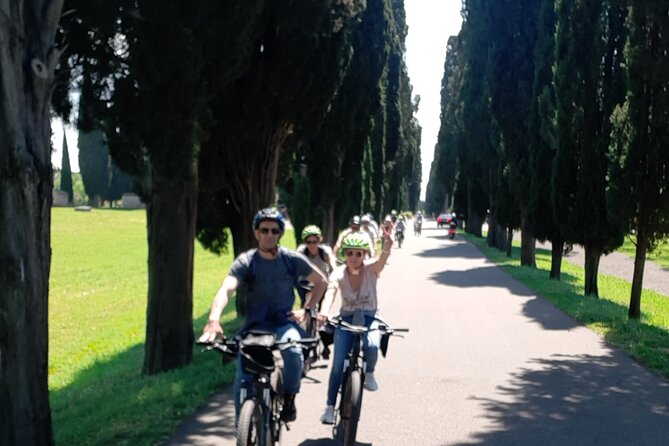
- Ancient Rome beyond the center: Ride through the Appian Way Archaeological Park, Caffarella Park, and the Aqueducts Park.
- E-bikes reduce the strain: The bikes assist on hills and longer stretches, but they do not remove the need for balance, braking, and steady riding.
- The five-hour tour adds the catacombs: St. Callixtus includes a guided underground visit of about 50 minutes.
- The route is not always smooth: Expect large Roman paving stones, deep gaps, dirt trails, and some city traffic.
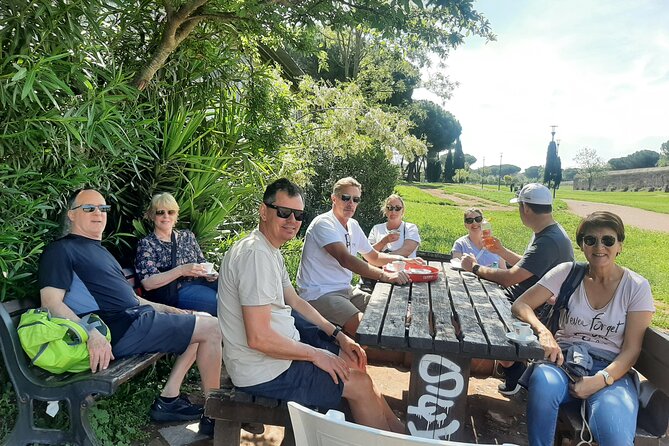
- Small groups keep things manageable: The stated maximum is 12 people, with a guide leading the group back to the bike shop.
- Price and value: At $78.60 per person, the tour includes the e-bike, helmet, phone holder, guide, and, on the longer option, the catacombs and food service.
Why this route feels different from central Rome
Most Rome sightseeing keeps you among fountains, churches, tour groups, and traffic. This ride changes the rhythm. After meeting at Roma STARBIKE on Via dei SS. Quattro, a short distance from the Colosseum, you collect your helmet and get fitted to an electric bike.
The first city streets can feel like the hardest mental part of the day. You are learning the bike while following a guide through Rome traffic. That is why the guide matters so much. Alex is praised for checking on riders often and offering calm instructions. Ava is singled out for kindness and clear route management, while Iman brings both cycling confidence and strong historical context.
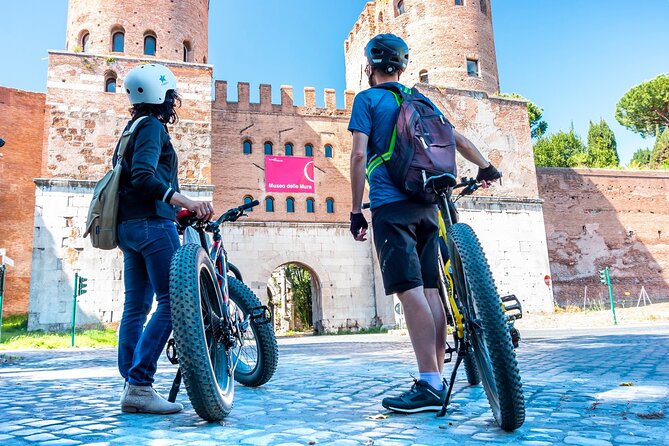
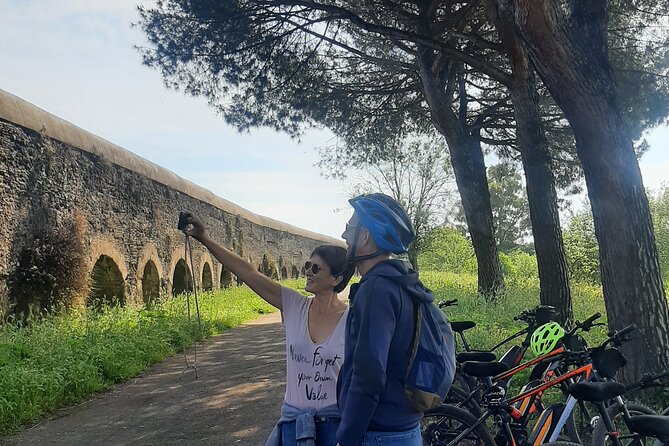
Once you pass through Porta San Sebastiano, the ride opens up. Rome begins to feel less like a crowded capital and more like an archaeological park with farms, trees, ruins, and long views. You still see the city, but you are no longer looking at it from a pavement packed with people.
The tour is limited to a maximum of 12 participants. That is a useful size for a cycling group because the guide can keep an eye on riders, give directions, and pause for photos without creating a long procession.
More Rides with Lunch in Rome:
- Rome: Appian Way Aqueducts Bike Tour (UPG Catacombs & Lunch)
★ 4.9 · 692 reviews - Rome: Appian Way Underground Catacombs Bike Tour with Lunch
★ 4.9 · 145 reviews - Rome: Full-Day Guided Tour by E-Bike with Lunch Included
★ 4.9 · 36 reviews
Porta San Sebastiano and the first Roman walls
Porta San Sebastiano is the gateway to the historic Via Appia Antica. It formed part of the Aurelian Walls, built around AD 275, and its heavy stone structure gives you an immediate sense of Rome as a defended city.
The gate also carries medieval graffiti left by pilgrims passing through over many centuries. That detail is easy to miss when you visit Rome by car or on a standard city walk. Here, the gate marks a clear change from modern streets to the old road system.
You spend about 15 minutes here. It is a short stop, but a useful one. The guide can explain how the walls protected Rome and why the Appian Way mattered as a military and trade route.
The Appian Way: Rome’s original long road
The Via Appia Antica was called Regina Viarum, or queen of roads. Construction began in the fourth century BC under the censor Appius Claudius, first linking Rome with Capua. Later, the road extended to Brindisi, the key port at the heel of Italy.
This is one of the most rewarding parts of the tour, but it is also where you need to pay attention to the surface. The ancient paving stones are large, uneven, and separated by deep gaps. At times, you can ride on dirt beside the stones. At other points, you must handle the cobbles directly.
The electric bikes help with the route’s distance and short hills. Some bikes have suspension, which makes the rough surface easier on your hands and back. Still, the saddle can become uncomfortable after several hours, especially if you do not ride often.
The route is mostly flat with a few short hills, but mostly flat does not mean effortless. You need to brake smoothly, keep both hands ready, and follow the guide’s line. One rider reported a fall after misjudging the strong brakes, so take the introduction seriously before setting off.
Caffarella Park and the Nymphaeum of Egeria
Parco della Caffarella is one of Rome’s largest green areas. It forms part of the Appian Way Regional Park and combines open paths, woods, old farm areas, and ancient remains.
This section gives the tour its breathing room. You might see goats, chickens, or turtles along the route, and the setting feels far removed from the Colosseum crowds. The park is not just a scenic shortcut. It shows how ancient Roman land outside the walls has continued to serve as open countryside.
You spend around 50 minutes in the park, followed by about 20 minutes at the Nymphaeum of Egeria. The spring is tied to the story of Egeria, a nymph who loved Rome’s second king, Numa Pompilius. After learning of his death, she wept so deeply that her tears became a spring.
The story is more legend than archaeology, but it gives the place character. A good guide can use it to connect Roman myth, water, and the old sacred sites scattered around the city.
A few more days on two wheels around Rome worth a look
- Rome EBike Tour: Appian Way, Catacombs & Roman Aqueducts
★ 5.0 · 1,766 reviews - Rome: Top Highlights & Hidden Gems Tour by Cannondale E-Bike
★ 4.9 · 1,760 reviews - Rome: Appian Way & Aqueducts E-Bike Tour (Catacombs & Food)
★ 4.9 · 1,498 reviews - Rome: Appian Way, Catacombs, & Roman Aqueducts E-bike Tour
★ 4.9 · 1,421 reviews
Cecilia Metella and the medieval fortress
The Mausoleum of Cecilia Metella is one of the best-preserved tombs on the Appian Way. It dates to the first century BC and was later incorporated into the Castrum Caetani, a medieval fortified complex.
You also see the remains of the Caetani family’s medieval residence and the perimeter walls of the church of San Nicola. The combination is what makes the stop worthwhile. Roman tombs, medieval power, and later Christian buildings all occupy the same stretch of road.
The stop lasts about 20 minutes. You will not have time for a long independent visit, but the location works well as a guided pause before the route continues toward the aqueducts.
The Catacombs of St. Callixtus on the five-hour tour
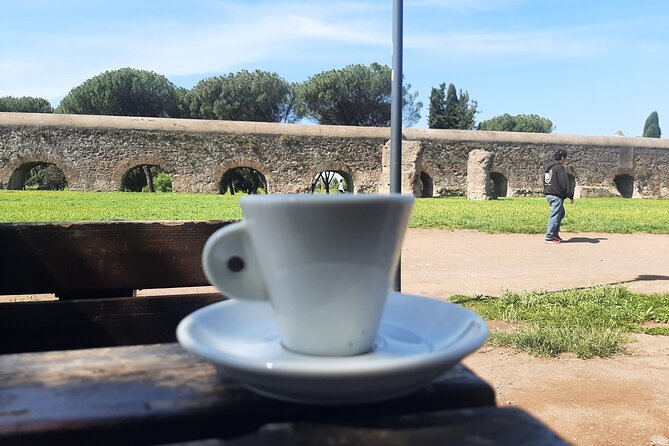
The catacombs are included only with the five-hour option. St. Callixtus is one of Rome’s largest underground cemeteries, with corridors extending about 20 kilometers. The complex is associated with the early Church of Rome and includes the burial places of more than 50 martyrs and 16 popes.
The guided visit lasts about 50 minutes. This is not a casual underground stroll. You are entering a funerary complex with narrow corridors and a serious religious setting, so it may not suit anyone uncomfortable in enclosed spaces.
For many people, the catacombs are the strongest reason to choose the longer tour. The ride supplies the open air and Roman roads, while the catacombs provide a more intimate look at early Christian Rome. The two parts feel very different, which keeps the five-hour day from becoming repetitive.
The catacombs are also a conventional timed stop, unlike the open parks and roads. That means the day includes both flexible outdoor riding and a structured underground visit.
The Aqueducts Park and the food stop
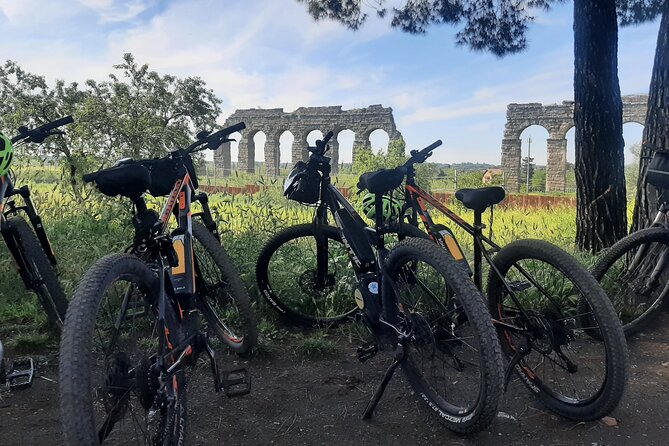
Parco degli Acquedotti is the visual payoff. The remains of the Claudio aqueduct cross the open park in long, tall lines. Other aqueducts also survive here, and some water channels remain in use.
The scale is hard to grasp from inside central Rome. In the city, you see fragments built into walls and monuments. Here, the aqueducts run across open space, allowing you to understand how Roman engineering moved water over long distances.
On the five-hour version, the plan includes food at this part of the route. The description refers to a boxed lunch in one place, while the detailed schedule describes Italian specialties at a restaurant and an afternoon aperitif replacing the brunch on the later departure. Because those details vary by departure time, confirm exactly what your selected option includes when booking.
The food is part of the five-hour value, but it also affects the pace. You are not simply cycling nonstop for five hours. There is time to sit, eat, and recover before returning to the bike.
Circus of Maxentius and the return to central Rome
The Circus of Maxentius lies along the Appian Way and is one of the best-preserved Roman circuses. Its central spina is still visible. The obelisk that once decorated it was moved during the Renaissance and now forms part of the Fountain of the Four Rivers in Piazza Navona.
This stop helps you picture the scale of Roman public entertainment. The site is quieter than the Colosseum, but its surviving layout makes the ancient venue easier to understand than a pile of isolated stones.
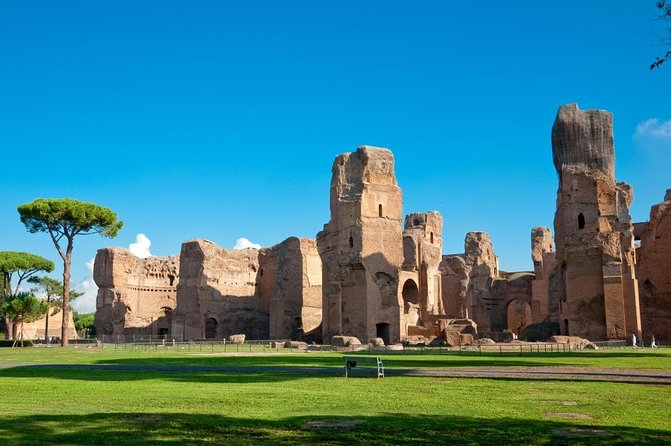
The route then reaches the Baths of Caracalla. For roughly a century, these were the largest public baths in the Roman world. The remains are still substantial, and the aqueduct connection adds another useful thread to the day: Rome’s public life depended on an enormous water system.
After about 15 minutes at the baths, you ride back to the bike shop. The return gives you a final look at the ancient walls and modern Rome before you return the bike and helmet.
How difficult is the cycling?
This tour is suitable for someone with moderate physical fitness who already rides a bike confidently. It is not a good choice if you have not cycled in years or if you feel uneasy stopping, turning, and braking on uneven ground.
You should expect:
- City streets near the beginning and end
- Dirt paths through parks
- Ancient cobbles and large paving stones
- Short hills and downhill sections
- Several hours in the saddle
- Quick stops and close attention to the guide
The e-bike assists your pedaling, but it does not steer itself. A parent riding with older children should consider the terrain and the child’s cycling ability. A child seat is available up to 25 kilograms, and children aged 6 to 10 who are under 143 centimeters use a trailer bike rather than riding a bike alone.
The maximum rider weight is 120 kilograms, or 265 pounds. Helmets, a phone holder, and the child seat are included.
Is $78.60 a fair price?
At $78.60 per person, the price is reasonable for the amount of equipment, guiding, and access included. You receive a quality e-bike, helmet, phone holder, small-group instruction, and a route that covers several areas difficult to connect on foot.
The four-hour version offers the better value for anyone mainly interested in the Appian Way, parks, and aqueducts. The five-hour version costs more only if the selected option carries an additional charge, but it adds the catacombs and food service. That longer route is a strong choice if you want one active day to cover early Christian Rome, Roman roads, aqueducts, tombs, and public baths.
The cost is less attractive if you dislike cycling or want a slow sightseeing day. You are paying for a full route and an active way of moving between sites, not simply for entrance tickets.
Practical advice for a smoother ride
Wear clothes that allow easy movement and shoes suitable for pedaling. Bring water, since the route includes sustained riding and outdoor sections. A small bag is more practical than anything bulky.
Give yourself time to get comfortable with the e-bike before leaving the shop. Test the brakes, ask how the assistance levels work, and tell the guide if you are worried about traffic or uneven ground.
Do not skip the safety instructions. The guides receive strong praise for watching the group, remembering names, giving clear commands, and stopping when someone needs help. That support is valuable, but it works best when you ride predictably and stay alert.
Weather matters. The tour requires good weather, and a cancellation caused by poor conditions results in either another date or a full refund. You can cancel for a full refund up to 24 hours before the start time, but changes made later are not accepted.
Who should book this Appian Way tour?
Book it if you want to trade central Rome’s crowds for open parks, ancient roads, and huge aqueducts. It suits active couples, families with capable older children, and anyone who likes history best when moving through the actual setting.
Choose the five-hour option if the Catacombs of St. Callixtus are high on your list or if you value having lunch built into the day. Choose four hours if you want the outdoor route but are concerned about saddle fatigue.
Skip it if you are an uncertain cyclist, dislike rough surfaces, or want a relaxed vehicle tour. The electric assistance helps, but this remains a real bike ride. For the right rider, though, it is one of the more memorable ways to see Rome’s ancient outskirts, and guides such as Chris, Alex, Ava, Iman, Lorenzo, and Paolo add the history and care that make the route work.
FAQ
Where does the bike tour begin?
It begins at Roma STARBIKE, located at Via dei SS. Quattro, 58, near the Colosseum in central Rome.
Where does the tour finish?
The tour ends back at the same bike shop where you collect the e-bike and helmet.
How long does the tour last?
The tour lasts approximately four to five hours, depending on the option you book.
Are the catacombs included?
The guided visit to the Catacombs of St. Callixtus is included only with the five-hour tour.
Is lunch included?
Lunch and an aperitif are included with the five-hour version only. The detailed food arrangement can differ by departure time, so check the specific option when booking.
Are bikes and helmets included?
Yes. The tour includes a high-quality e-bike, helmet, mobile phone holder, and handlebar holder.
Can children join the tour?
Children aged 6 to 10 can receive the child reduction only if they are under 143 centimeters tall. They use a trailer bike rather than riding a bike alone. A child seat is available for children up to 25 kilograms.
How fit do I need to be?
You need moderate physical fitness and must know how to ride a bike well. The route includes city traffic, dirt paths, hills, and uneven Appian Way cobblestones.
What happens if bad weather cancels the tour?
You will be offered a different date or a full refund if poor weather causes the tour to be canceled. You can also cancel for a full refund up to 24 hours before the start time.
Just added around Rome
- Rome: Guided eBike Evening Tour with italian Aperitif★ 5.0 · 16 reviews
- Rome: Villa Borghese, Villa Ada, and Coppedè E-Bike Tour★ 4.8 · 78 reviews
- Sunrise in Rome: Small Group E-Bike Tour & Italian breakfast★ 4.9 · 177 reviews
- Rome: Top 10 Highlights Guided Tour by Bike or E-Bike★ 4.4 · 15 reviews
- Rome: Appian Way, Aqueducts, & Catacombs E-Bike Guided Tour★ 4.9 · 54 reviews
- Rome: Villa Borghese E-Bike Tour (Small Group or Private)★ 4.9 · 92 reviews
- Rome: Taste of Rome by quality Cannondale E-Bike★ 5.0 · 12 reviews
- Rome: Panoramic Off-the-beaten-track Cannondale E-Bike tour★ 5.0 · 71 reviews
Rome Cycling Tours, compared.
Rome EBike Tour: Appian Way, Catacombs & Roman Aqueducts
Read our review →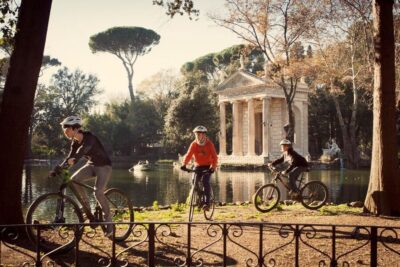
Top Highlights & Hidden Gems Tour by Cannondale E-Bike
Read our review →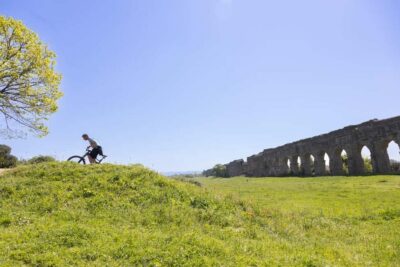
Appian Way & Aqueducts E-Bike Tour (Catacombs & Food)
Read our review →
Appian Way, Catacombs, & Roman Aqueducts E-bike Tour
Read our review →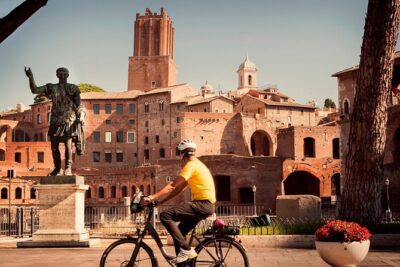
Rome City Small Group Bike Tour with quality Cannondale EBike
Read our review →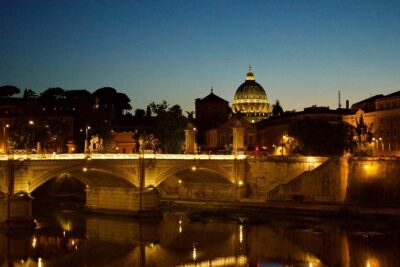
Rome by Night – Ebike Small Group Tour – Food and Wine (Option)
Read our review →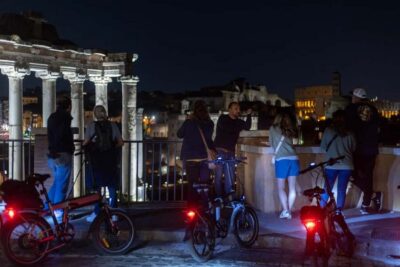
Rome by Night: E-bike Small Group Tour -Food & Wine (Option)
Read our review →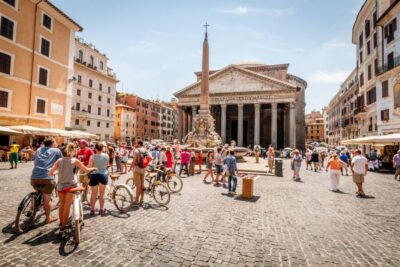
Browse the lists this tour appears in