
REVIEW · BERLIN
Berlin: Small Group Bike Tour Through City Center
Berlin’s story is best seen on two wheels. This 3.5-hour ride links the former Wall crossing at Bornholmer Straße with the Reichstag, Brandenburg Gate, Museum Island, and Alexanderplatz, while keeping the group to eight people. I especially like the mix of 20th-century history and everyday Berlin, plus the fact that a bicycle, guide, and rain poncho are included.
The main consideration is the pace. You cover a lot of ground with few planned stops, and one guest wished for another hour or two, ideally with a break. The tour is also conducted in German, so you should be comfortable following historical explanations in that language.
- Bornholmer Straße begins the story: Start where East and West Berliners first celebrated the Wall’s opening on November 9, 1989.
- A strong central Berlin route: Ride past the Reichstag, Brandenburg Gate, Holocaust Memorial, Potsdamer Platz, Gendarmenmarkt, and Museum Island.
- Small group, personal feel: The maximum of eight cyclists makes it easier to hear the guide and ask questions.
- Berlin’s contrasts are built into the route: See the Charité, Hauptbahnhof, government district, grand boulevards, socialist-era Alexanderplatz, and hip Prenzlauer Berg.
- Good value for active sightseers: At $40, the tour combines bicycle rental and a live city guide for three and a half hours.
- Bring water and travel light: Food and drinks are not included, and large bags or luggage are not allowed.
Starting at Bornholmer Straße, where the Wall opened
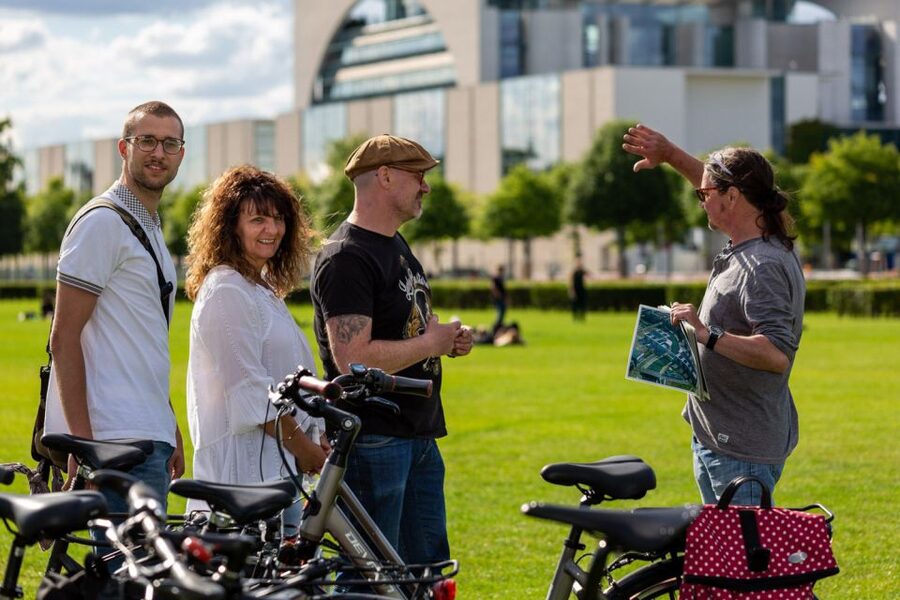
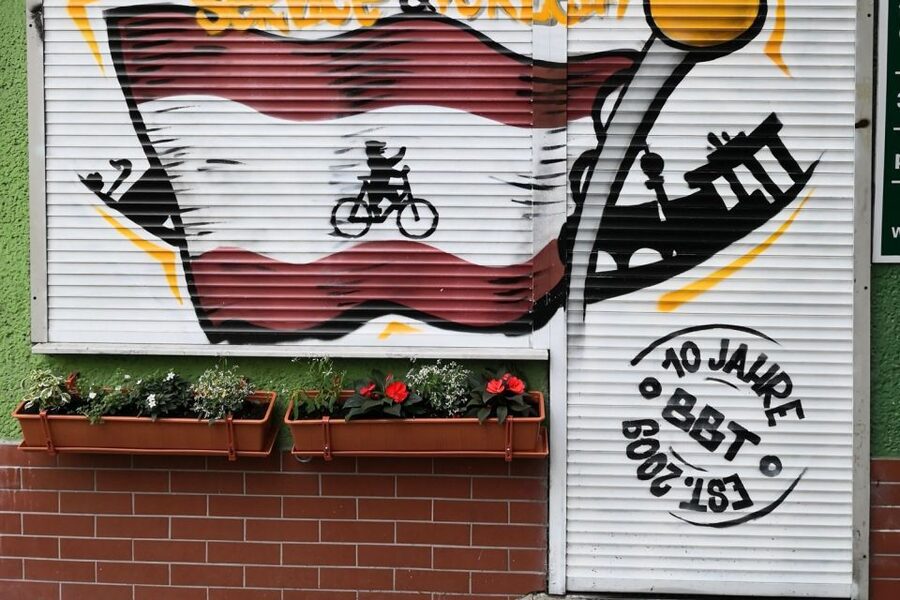
The tour begins at BBT Fahrradladen, Fahrradwerkstatt & Fahrradverleih, at 75 Bornholmer Straße. You should arrive 20 minutes early for check-in and bicycle preparation.
The location is easy to reach. Tram stops Björnsonstraße, served by M1, M13, and M50, are about a minute away. S-Bahn station Bornholmer Straße is roughly two minutes on foot, with S1, S2, S8, S25, and S85 service. Schönhauser Allee, served by the S-Bahn and U2, is about a 10-minute walk.
Starting here is more meaningful than beginning beside a famous monument. Bornholmer Straße was a former border crossing between East and West Berlin. On November 9, 1989, it became the first crossing where the barriers opened, sending Berliners from both sides into the street together.
Your guide uses this spot to frame the day. You are not simply pedaling from attraction to attraction. You begin with the event that changed modern Berlin, then follow the city’s rebuilding, reunification, and changing neighborhoods toward the center.
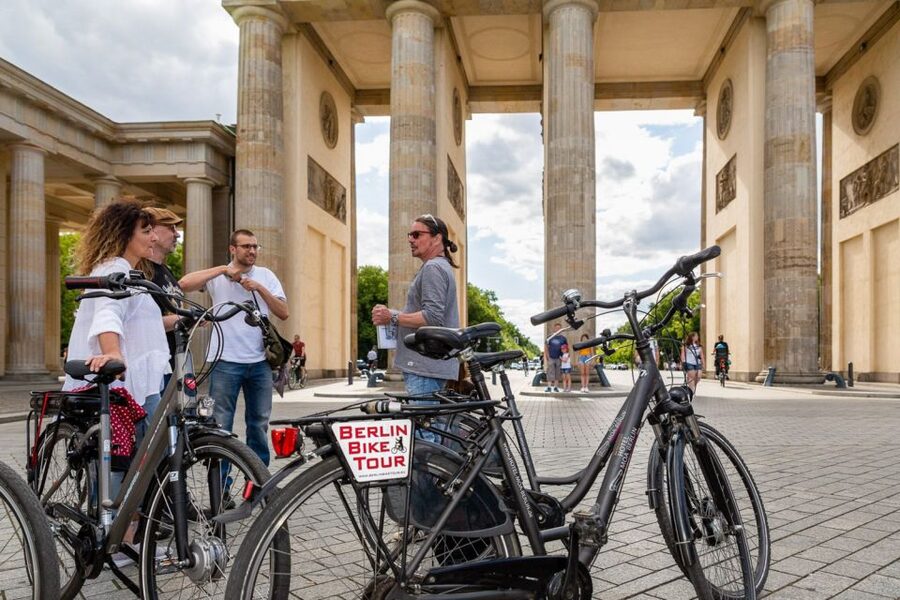
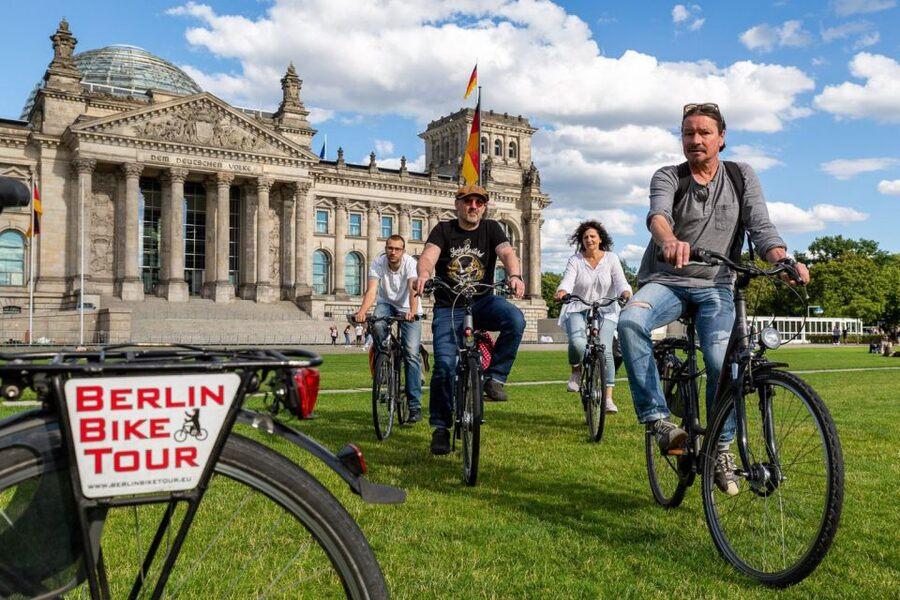
The bikes are included, and the group is limited to eight. That small size matters on city streets and at busy stops. You are less likely to lose the guide at a traffic light, and the guide can speak to the group without shouting across a large pack.
From the New Synagogue to Berlin’s cultural center
From Bornholmer Straße, the route heads toward central Berlin and the New Synagogue. Its ornate exterior and large dome make it one of the more memorable buildings along the ride. The site is now connected with Berlin’s Jewish Centre and gives the tour a chance to address the city’s Jewish history and the destruction caused by the Nazi period.
The Old Post Headquarters adds a different layer. It is a reminder that Berlin was not built only from palaces and memorials. Postal buildings, theaters, hospitals, rail stations, and government offices all helped shape the working city.
You also pass Friedrichstadt-Palast, one of Berlin’s best-known performance venues. From there, the route continues to the Charité, a major medical institution, and Berlin Hauptbahnhof, the city’s huge central railway station.
This section captures a useful Berlin contrast. The Charité represents long-established civic and medical institutions, while Hauptbahnhof is a modern transport hub built for a reunited capital. From a bicycle, you can see those changes in sequence instead of treating each building as an isolated photo stop.
The tradeoff is that many of these places are sightseeing points rather than extended visits. You should expect to look, listen, and keep moving. If you want to tour the New Synagogue or enter the Reichstag, this is not the right format. The tour gives you orientation and context from outside.
More Small-Group Bike Tours in Germany
- Berlin Wall History Small Group Cycling Tour
★ 4.9 · 152 reviews - Small-Group Historical Bike Tour in Berlin
★ 4.5 · 103 reviews - Small-Group Berlin Wall Bike Tour
★ 5.0 · 17 reviews
The Reichstag and Berlin’s reunited government quarter
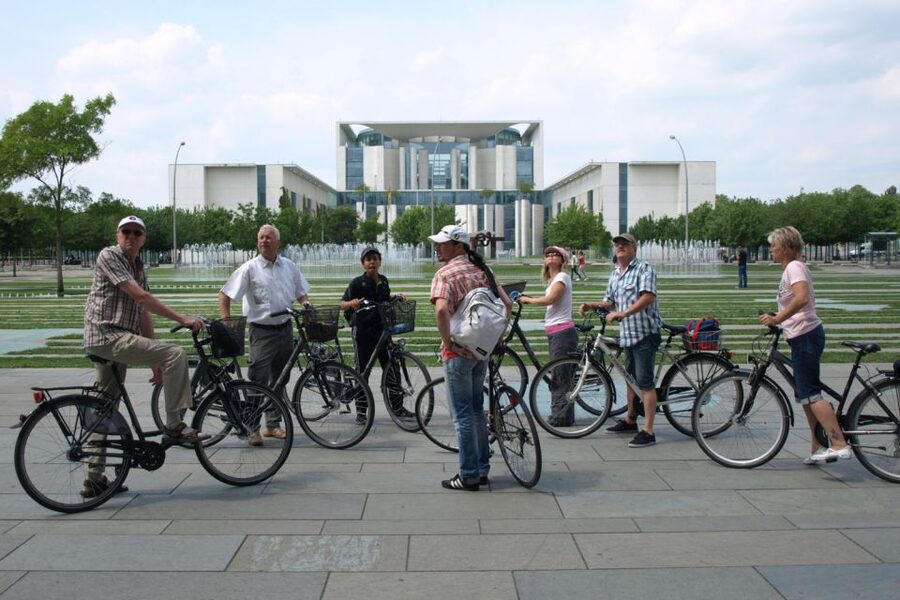
The ride then reaches the Government District, including the Marie-Elisabeth-Lüders-Haus and the Reichstag. This is one of the strongest parts of the route because Berlin’s political geography is easy to understand from a bicycle.
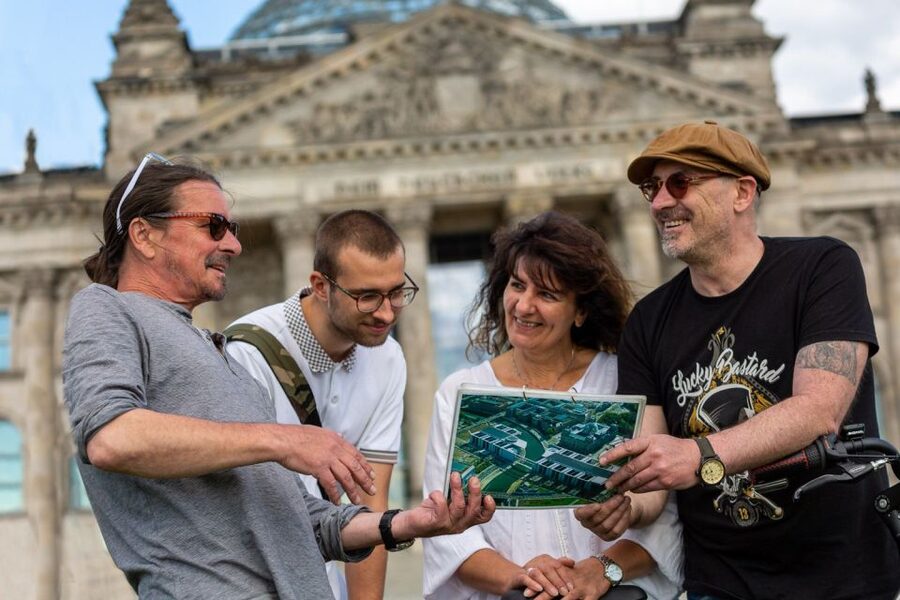
The Reichstag is a key symbol of a united Berlin. Its historic shell, modern additions, and location beside the former division line reflect the city’s complicated past. The nearby government buildings are less decorative than many older Berlin monuments, but they show how the capital functions today.
You pass along the Spree near the parliamentary buildings, then move toward the Brandenburg Gate. The bicycle gives you a practical advantage here. You can connect several sights without waiting for a train or crossing the city on foot, and you get a better sense of how close these important places actually are.
The tour does not include entry to the Reichstag. That normally requires advance planning and separate arrangements, so treat this stop as an exterior visit and photo opportunity.
Tiergarten, Brandenburg Gate, and the Holocaust Memorial
The ride through Tiergarten offers a welcome change after the formal government quarter. Berlin’s largest central park is often compared with New York’s Central Park, though the atmosphere is different. Here, the route gives you a stretch of greenery between major sights.
A bicycle makes Tiergarten especially practical. You cover more of the park than you would on a standard walking tour without spending a full afternoon on it. Still, the ride is sightseeing rather than a nature excursion, so you should expect the park to be one portion of a much longer city circuit.
The Brandenburg Gate is the obvious visual centerpiece. It once marked a city divided by political power and now represents a reunified Berlin. The tour places it in context with the Wall, the government quarter, and the old east-west boundary, which gives the monument more meaning than a quick stop for photographs.
Nearby, the Holocaust Memorial consists of rows of concrete blocks arranged across an open field. Its design is intentionally open to interpretation, and the guide can provide the historical setting. You will have time to see the memorial from the route, but do not expect a long, quiet visit inside the site.
The tour continues to Potsdamer Platz, another useful contrast. Once cut by the Wall and left in a divided city, it became a major modern development after reunification. Its glass towers and broad public spaces show Berlin’s newer commercial face, especially when set against the older monuments only a short ride away.
Gendarmenmarkt, Bebelplatz, and Unter den Linden
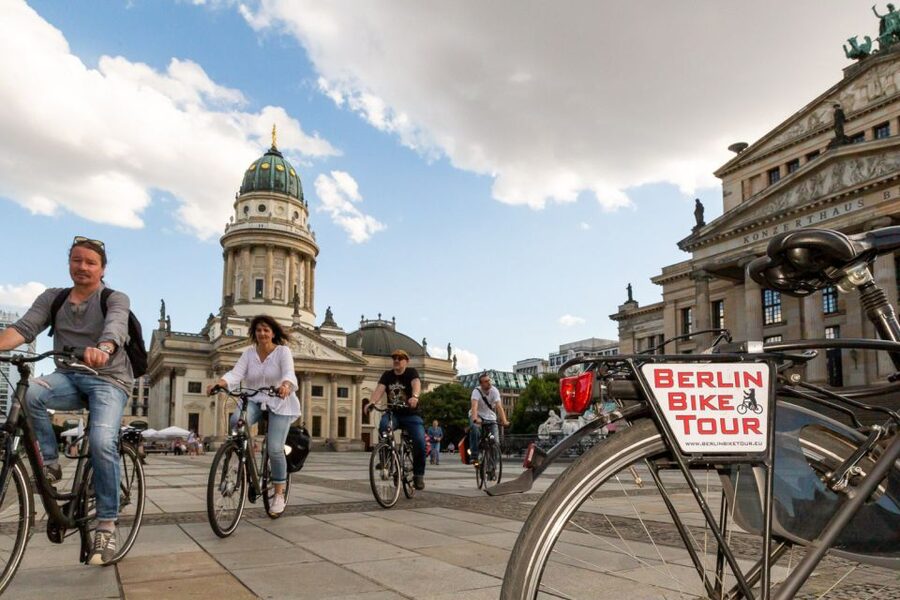
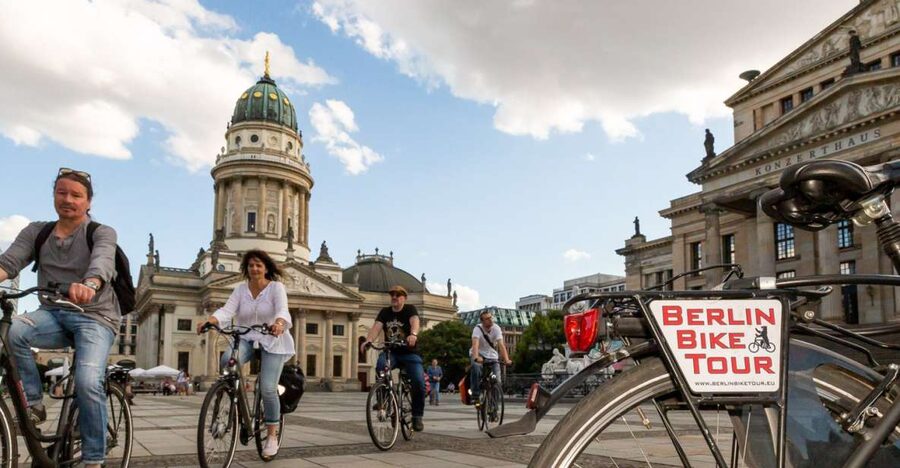
The next section moves into some of central Berlin’s most elegant streets and squares. Gendarmenmarkt is framed by the German Cathedral and French Cathedral, with the Konzerthaus between them. Even if you only pause briefly, the square helps explain the scale and ambition of historic central Berlin.
The Deutscher Dom and French Cathedral are especially useful landmarks for understanding the square’s design. Their similar forms create a balanced setting, while the buildings’ separate identities reflect Berlin’s German and French communities and traditions.
At Bebelplatz, the tour reaches one of Berlin’s most sobering memorial sites. The square is associated with the Nazi book burning of 1933. It also sits beside Humboldt University and the Catholic St. Hedwig’s Cathedral area, making it a place where architecture and difficult history meet within a few steps.
Humboldt University and Unter den Linden then lead you toward Museum Island. Unter den Linden is Berlin’s grand historic boulevard, lined with major buildings and monuments. From a bicycle, you can take in the full axis of the street without walking its entire length.
This part of the ride may feel dense. There are many names, buildings, and historical references in a short period. Pay attention to the broad connections rather than trying to memorize every date. The guide’s value here is helping you understand how the boulevard, university, palace district, and ceremonial spaces fit together.
More Small-Group Bike Tours in Berlin:
- Small Group Guided Bike Tour of Amsterdam’s Hidden Gems
★ 5.0 · 3,936 reviews - Rome City Small Group Bike Tour with quality Cannondale EBike
★ 5.0 · 1,380 reviews - Complete Cracow Bike Tour (small group of maximum 15 people!)
★ 5.0 · 1,322 reviews - Rome by Night – Ebike Small Group Tour – Food and Wine (Option)
★ 5.0 · 1,275 reviews
Museum Island, Schlossplatz, and old Berlin
Berlin Cathedral is one of the route’s most recognizable buildings. Its dome dominates the approach to Museum Island and the Spree. You will see it from outside, along with Schlossplatz, the former palace area opposite the cathedral.
Schlossplatz reflects Berlin’s repeated rebuilding. The setting has shifted from royal power to East German planning and then to post-reunification reconstruction. It is a good place to notice how the city changes its public symbols over time.
The route then reaches Nikolaiviertel, a small historic quarter near the original center of Berlin. Its tighter streets and older-looking architecture provide a sharp contrast with the broad spaces of Unter den Linden and the monumental scale of the government district.
The Old Berlin section is one reason this route is more useful than a simple monument loop. You see not just the postcard landmarks but also the changing size and texture of the city. The drawback is that the tour’s full route leaves limited time for lingering. If you want to enter Berlin Cathedral or explore Nikolaiviertel’s restaurants, plan a separate visit.
Alexanderplatz and the symbols of East Berlin
At Alexanderplatz, the tour reaches the most recognizable center of former East Berlin. The Red Town Hall, Neptune Fountain, Marienkirche, and TV Tower surround a broad urban space with a very different feel from Gendarmenmarkt or Unter den Linden.
The East German World Clock is one of the most distinctive stops. It shows the world’s time zones and remains a memorable piece of socialist-era design. It is also a practical meeting point in the square, where the TV Tower makes orientation easy.
The TV Tower itself dominates Berlin’s skyline and remains one of the city’s clearest visual markers. The tour does not include an ascent, but seeing it from Alexanderplatz helps you understand the scale of the former East German capital.
The Red Town Hall and Marienkirche add another layer, placing historic Berlin buildings beside broad postwar planning. This is a city of interruptions and replacements, and Alexanderplatz makes that especially clear.
You may find this section noisier and more crowded than the earlier stops. That is part of the point, but it can make explanations harder to hear. Staying close to the guide matters, particularly when the group is cycling through open public spaces.
Returning through Prenzlauer Berg
The final stretch heads through Prenzlauer Berg, often associated with cafés, independent shops, renovated buildings, and a younger city culture. Here, the tour shifts away from official Berlin and toward the neighborhood life that gives the capital its current character.
This makes a fitting ending. You begin at the place where the Wall opened and finish by seeing a Berlin neighborhood shaped by reunification and long-term urban change. The route is not limited to the traditional tourist center.
You return to the bicycle shop on Bornholmer Straße after about 210 minutes. The full distance is not specified, but the number of sights makes clear that this is a substantial ride. You should be comfortable cycling for several hours and moving through city traffic.
What the $40 price really includes
At $40 per person, the tour offers solid value if you want both transportation and interpretation. A bicycle rental alone would not provide the route planning or historical explanation, while a walking tour would cover fewer districts in the same time.
The small group is a major part of the value. With no more than eight people, you get a more manageable ride and a better chance to hear the German-speaking guide. Richard is specifically praised for combining personal stories with clear, interesting explanations, and other strong feedback highlights guides who are friendly, capable, and engaging.
The bicycle also saves time. Berlin’s sights are spread across a wide area, from Bornholmer Straße to Alexanderplatz and the government district. You are paying to connect them efficiently, not just to rent a bike for a few hours.
Food and drinks are not included. Bring water, since one person specifically wished they had remembered a bottle. Large bags and luggage are not allowed, so leave suitcases at your accommodation or arrange storage before arriving.
The tour runs in all weather. Rain ponchos are provided when needed, but you still need practical clothing. Sunglasses and a sun hat are listed as useful items, and an ID card or passport is required. A camera is welcome, but keep your hands free while riding.
The cancellation terms need a little care. The general policy allows cancellation up to 24 hours before the start for a full refund, but groups of three or more have a three-day cancellation deadline. If your party has at least three people, confirm the applicable rule before booking.
Who will get the most from this bike tour
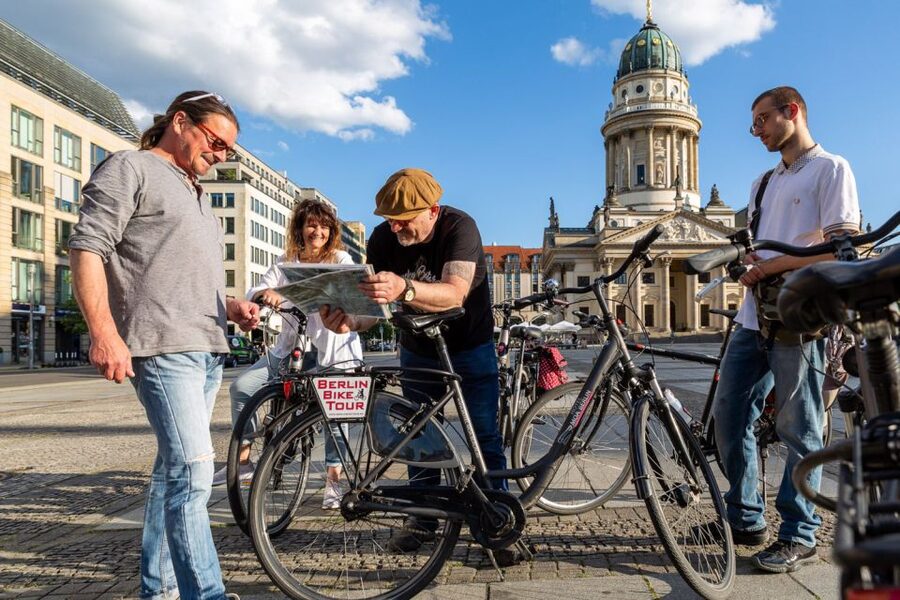
I would choose this experience if you want a fast, well-connected introduction to Berlin and enjoy learning through movement. It suits first-time visitors who want to see the major center sights while also reaching Bornholmer Straße, Alexanderplatz, and Prenzlauer Berg.
It is also a good fit if you already know a few famous Berlin landmarks but want the historical links between them. The route explains how the Wall, reunification, government quarter, East Berlin, and present-day neighborhoods relate to one another.
You should think twice if you need an English tour, prefer long interior visits, or dislike cycling in city conditions. The language is German, the schedule is full, and the tour takes place in rain as well as fair weather.
Families and older cyclists should consider the duration and pace carefully. The group is small, but the route still lasts three and a half hours. There is no planned food stop, and the available information does not specify a rest break.
Should you book this Berlin bike tour?
Book it if you want broad Berlin coverage in one outing, especially with a focus on the Wall, reunification, government district, Brandenburg Gate, Alexanderplatz, and Prenzlauer Berg. The $40 price is fair because it includes the bicycle, guide, and a carefully connected route, while the eight-person limit keeps the experience personal.
Skip it if German-language guiding will be frustrating or if you want to spend serious time inside museums and monuments. For an active visitor who wants history, modern city life, and many of Berlin’s essential sights in a single ride, this is a strong choice. Bring water, pack light, and arrive ready to pedal.
FAQ
How long does the Berlin bike tour last?
The tour lasts 210 minutes, or three and a half hours.
Where does the tour begin?
It begins at BBT Fahrradladen, Fahrradwerkstatt & Fahrradverleih, at 75 Bornholmer Straße, Berlin 10439.
How early should I arrive?
You should arrive 20 minutes before the tour begins.
Is the tour conducted in English?
No. The listed live guide language is German.
What is included in the price?
The price includes a bicycle, a city guide, and a rain poncho when necessary.
Can I bring luggage or a large bag?
No. Luggage and large bags are not allowed on the tour.
Just added around Berlin
- Berlin Wall and Cold War Bike Tour in Small Groups★ 5.0 · 114 reviews
- Berlin: Guided Private Bike Tour to Explore the Highlights★ 5.0 · 12 reviews
- Berlin : The best bike tour with a Berlin guide and insider tips★ 5.0 · 14 reviews
- Alternative Berlin Bike Tour – Off the Beaten Tracks in Small Groups★ 5.0 · 99 reviews
- Potsdam Bike Tour with Rail Transport from Berlin★ 4.5 · 81 reviews
- Berlin: Guided Bike tour of the Berlin Wall and Third Reich★ 5.0 · 160 reviews
- Berlin : Guided Private Sightseeing Tours with Funbikes, Teambikes★ 5.0 · 20 reviews
- Small-Group Berlin Wall Bike Tour★ 5.0 · 17 reviews
Small-Group Bike Tours, compared.
Rome City Small Group Bike Tour with quality Cannondale EBike
Read our review →
Complete Cracow Bike Tour (small group of maximum 15 people!)
Read our review →
Rome by Night – Ebike Small Group Tour – Food and Wine (Option)
Read our review →
Rome by Night: E-bike Small Group Tour -Food & Wine (Option)
Read our review →
Historic Athens: Small Group Electric Bike Tour
Read our review →
Browse the lists this tour appears in