
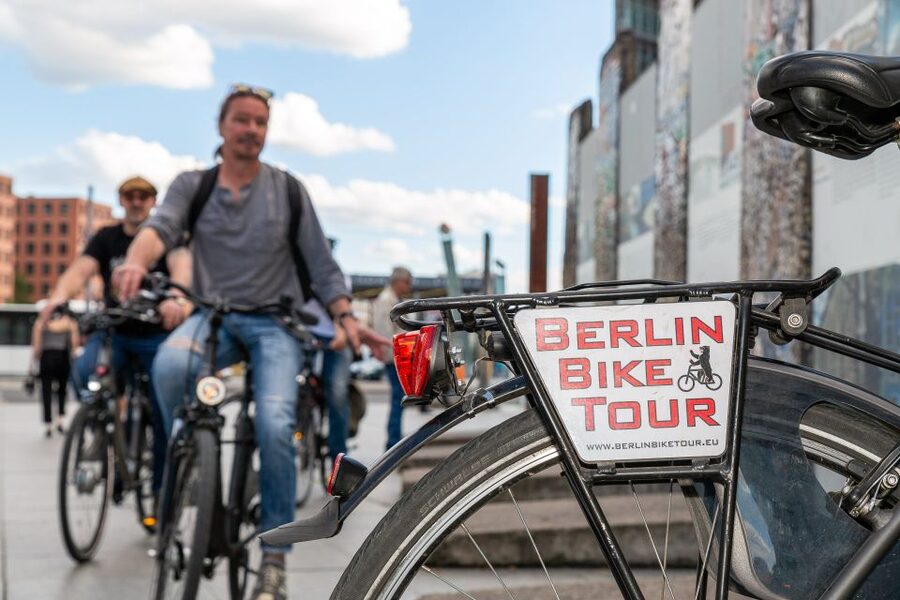
REVIEW · BERLIN
Berlin Wall History Small Group Cycling Tour
Berlin’s Wall story is best understood on two wheels. This four-hour ride follows the former border from Bornholmer Straße toward Checkpoint Charlie, linking watchtowers, memorials, escape sites, and the places where the Wall finally began to open. I like the small groups of three to eight, and I like that the route includes less obvious places such as Invaliden Cemetery and the Parliament of the Trees.
The bicycles, guide, fees, and a rain poncho when needed are included in the $40 price. The main consideration is language: the tour is conducted in German, so you will get much more from it if you understand German well. The route also runs in all weather, and Berlin rain can make a bike saddle less charming.
What makes this Wall tour worth your time
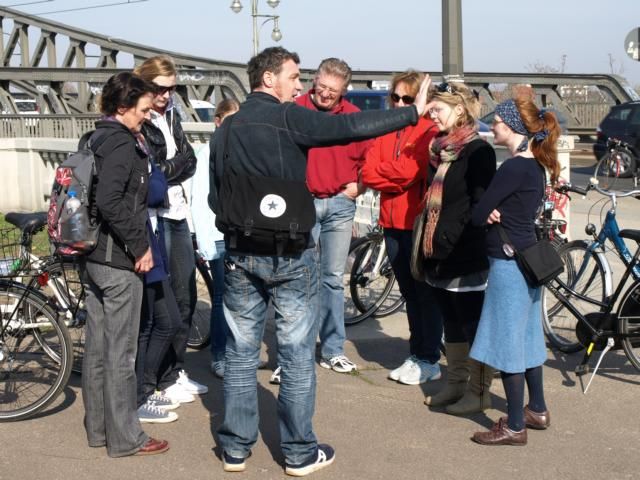
- Begin at Bornholmer Straße: Start at the border crossing where East German citizens first crossed freely on November 9, 1989.
- See surviving Wall traces: Ride past an original watchtower, parts of the former Death Strip, and memorials tied to escape attempts.
- Visit Bernauer Straße and Mauerpark: These areas show both the physical remains of the border and the modern city that grew around them.
- Follow the route through central Berlin: The ride connects Brandenburg Gate, Potsdamer Platz, Checkpoint Charlie, and the Palace of Tears.
- Hear personal context: Guide Ferenz has shared his own memories of the period around German reunification, adding a human note to the historical explanation.
- Keep the group manageable: With no more than eight participants, it is easier to hear the guide and stop at places a larger group might rush past.
Why a bicycle is the right way to see the Berlin Wall
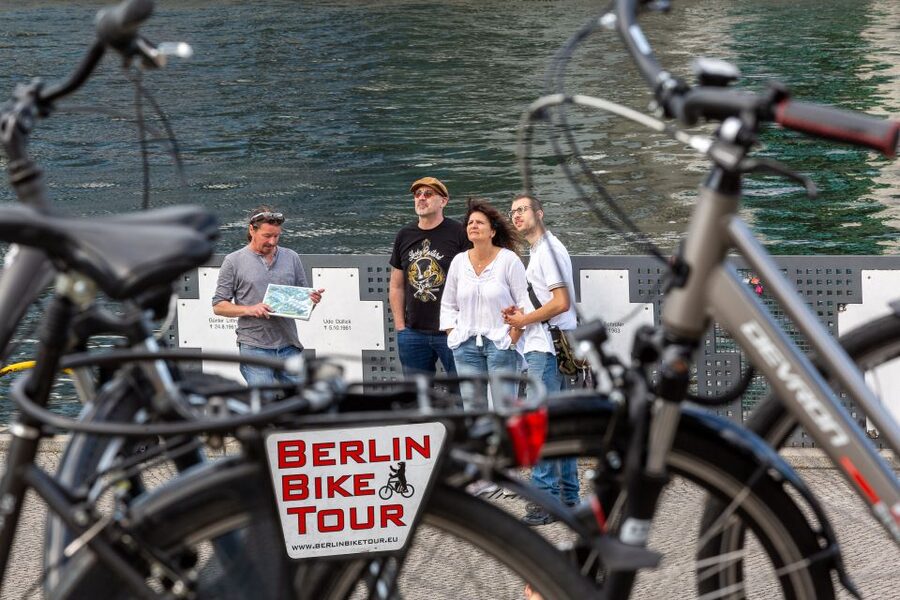
The Berlin Wall did not survive as one long monument. Its former route cuts through streets, parks, railway lines, government buildings, cemeteries, and busy public squares. On foot, you can visit a few major memorials. By bicycle, you can connect them and understand the border as a physical line running across the city.
I like this tour because it does not treat the Wall as a single slab of concrete. It shows the layered border system: barriers, watchtowers, patrol routes, open strips of ground, crossing points, and the human stories tied to each location. You are not simply cycling past sights. You are following a route that once divided neighborhoods and families.
The small group matters here. A maximum of eight people gives the guide room to explain details at stops, answer questions, and keep the ride from becoming a bicycle convoy. The tour is still a four-hour outing, so it covers a lot of ground, but the format should feel more personal than a large city excursion.
The tour begins at BERLIN BIKE TOUR, at 75 Bornholmer Straße. The meeting point is easy to reach. Björnsonstraße tram stop is about one minute away, and Bornholmer Straße S-Bahn station is about two minutes on foot. Schönhauser Allee station is roughly a ten-minute walk and serves S-Bahn and U-Bahn lines.
More Small-Group Bike Tours in Germany
- Small-Group Historical Bike Tour in Berlin
★ 4.5 · 103 reviews - Berlin: Small Group Bike Tour Through City Center
★ 4.9 · 64 reviews - Small-Group Berlin Wall Bike Tour
★ 5.0 · 17 reviews
Bornholmer Straße: where the border first opened
The starting point is the Square of November 9, 1989. This is an especially fitting place to begin because Bornholmer Straße was the first East Berlin border crossing where citizens crossed after the Wall began to open.
The guide explains how the evening unfolded and why this crossing became so important. You also hear about the cherry trees planted along Bornholmer Straße, a detail that gives the site a gentler character without hiding its political weight. It is a reminder that Berlin has repeatedly changed the meaning of its public spaces.
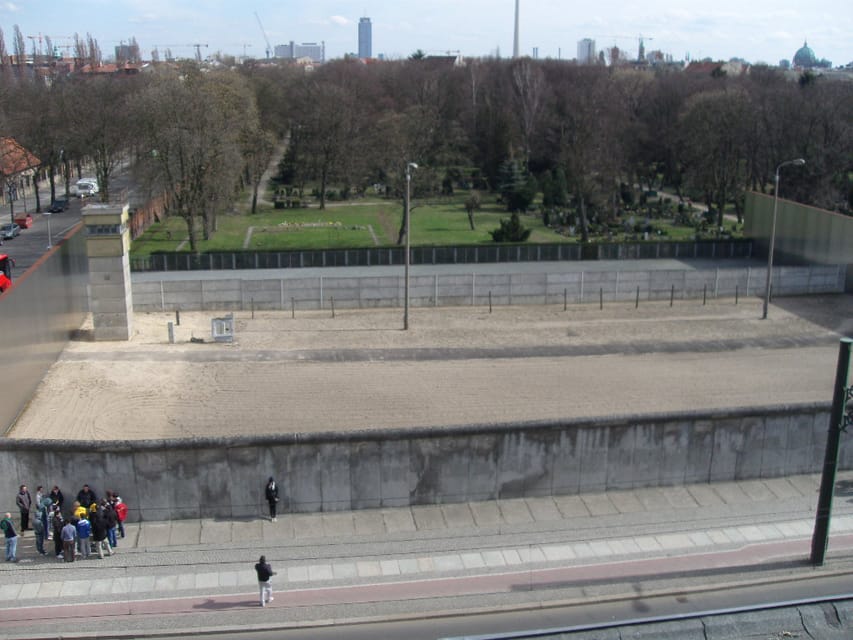
You then see an original watchtower and part of the former Death Strip. The term can sound abstract until you see the open ground and understand how closely the border was controlled. This early stop gives you the basic structure needed for the rest of the ride.
Bring your passport or ID card, sunglasses, a sun hat, and a camera. Large bags and luggage are not allowed, so pack lightly. A small personal bag is not specifically described, but you should avoid arriving with anything bulky.
Mauerpark and Bernauer Straße: a border through ordinary life
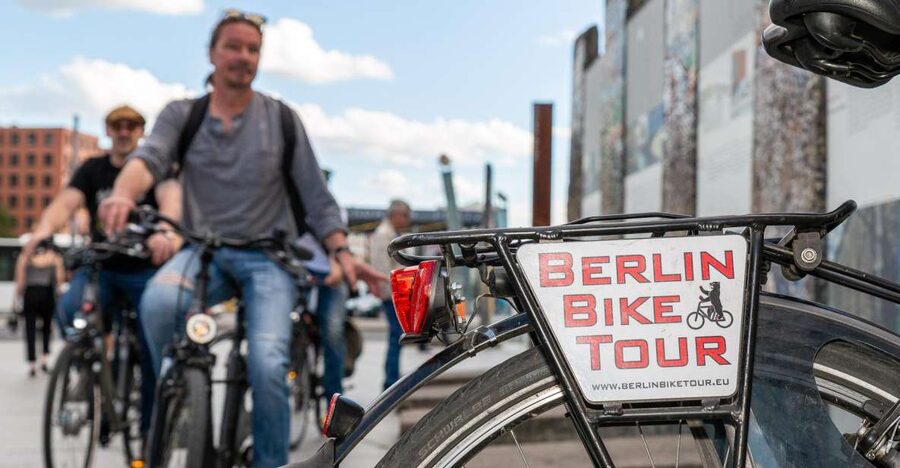
From Bornholmer Straße, the route continues through Mauerpark. Today, the park is one of the city’s well-known public spaces, but its name and position come directly from the former Wall line. Cycling through it helps you see how a once-forbidden strip became part of everyday Berlin.
Bernauer Straße gives the history a sharper focus. The Wall once cut directly along this street, separating buildings, sidewalks, and neighbors. The area now contains several important memorial features, including the Chapel of Reconciliation and preserved parts of the border area.
The Chapel of Reconciliation is one of the more reflective stops. It sits within the former border zone and offers a quiet pause during a route that otherwise keeps moving through the city. Here, the story is not only about governments and checkpoints. It is also about homes, churches, streets, and people whose daily lives were disrupted by the division.
The Bernauer Straße memorial area can be emotional, but it is also practical in the way it explains the border. You can better understand how the Wall looked and how the open strip was maintained. The guide’s job is important here, since many traces are easy to miss if you do not know what you are looking at.
Chausseestraße and Invaliden Cemetery: escape stories and border control
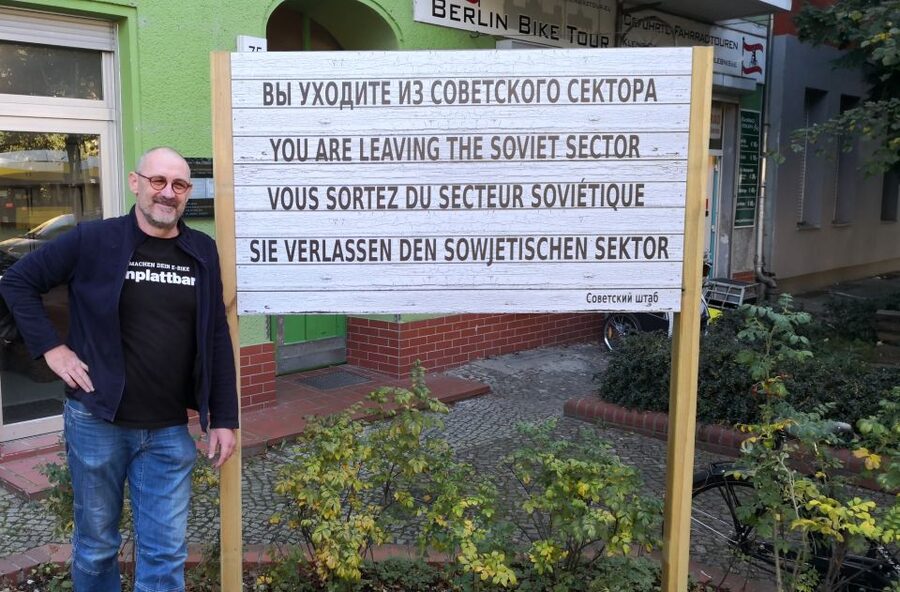
The ride continues toward the former Chausseestraße crossing. This was one of the routes through which people moved between East and West Berlin under tightly controlled conditions. The crossing helps show that the Wall was not only a barrier between two political systems. It was also a set of regulated gates, documents, searches, and decisions about who could pass.
Nearby, Invaliden Cemetery adds another unusual layer. A cemetery may seem an unexpected stop on a Wall tour, but the former border passed through this area, and the site is tied to the wider story of escape and control. The tour also visits the memorial to Günter Litfin, whose death is remembered along the former border.
These stops are valuable because they pull you away from the most familiar postcard locations. Brandenburg Gate and Checkpoint Charlie are essential, but they can also make the Wall seem like a central-city attraction. Chausseestraße and Invaliden Cemetery show how widely the border affected Berlin.
You should expect some historical explanation at each stop rather than long visits inside museums. The route is a cycling tour, not a full indoor museum program. If you want extensive exhibits, photographs, and archival material, set aside another part of your Berlin schedule for the city’s dedicated Wall museums and memorial centers.
More Small-Group Bike Tours in Berlin:
- Small Group Guided Bike Tour of Amsterdam’s Hidden Gems
★ 5.0 · 3,936 reviews - Rome City Small Group Bike Tour with quality Cannondale EBike
★ 5.0 · 1,380 reviews - Complete Cracow Bike Tour (small group of maximum 15 people!)
★ 5.0 · 1,322 reviews - Rome by Night – Ebike Small Group Tour – Food and Wine (Option)
★ 5.0 · 1,275 reviews
The Parliament of the Trees and the government district
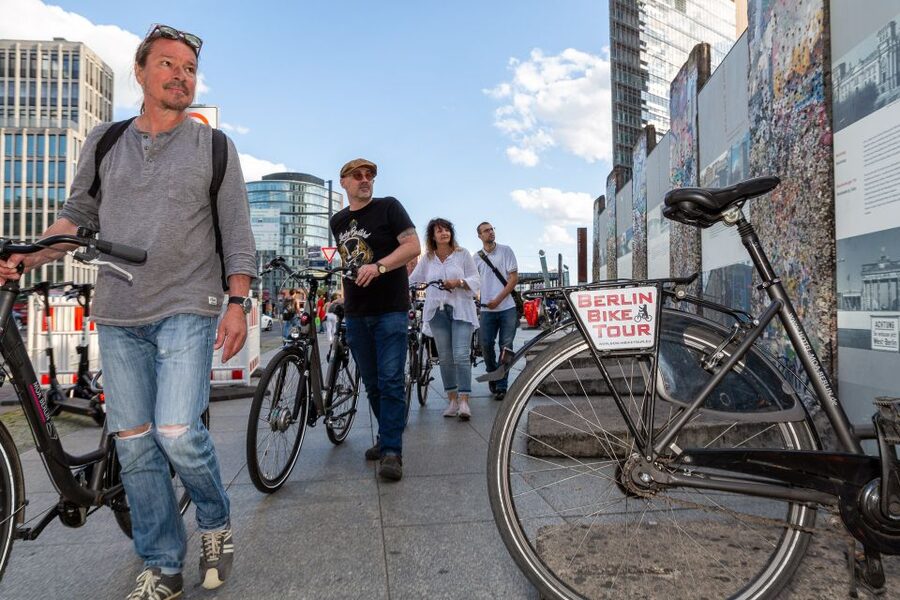
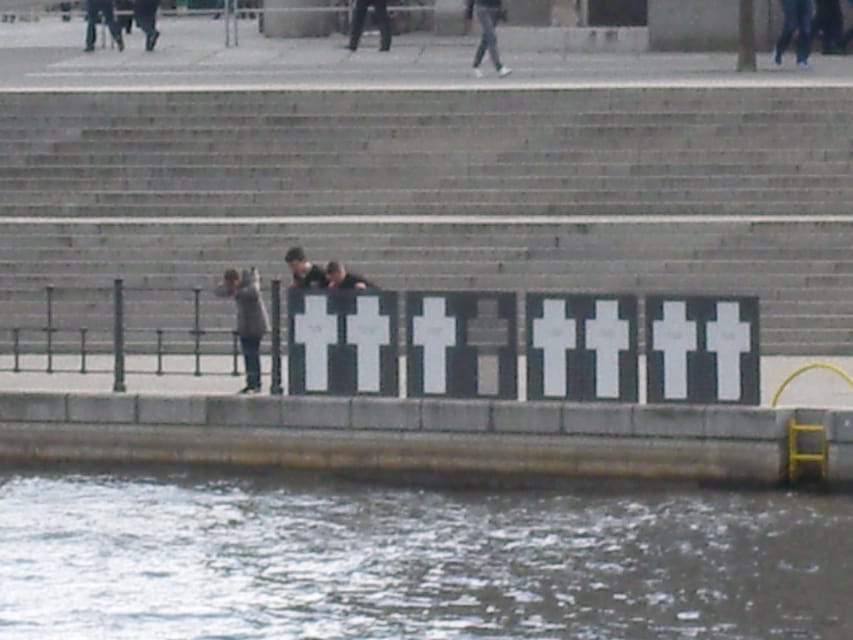
One of the more distinctive stops is the Parliament of the Trees, reached along the Government Bank. The memorial uses sections of the former Wall and commemorative elements to remember people who died at the border.
This is a good example of why the route works as a whole. You move from a former checkpoint to a cemetery, then along the government area, seeing how memorials appear in very different parts of the city. The Parliament of the Trees is not as instantly recognizable as Brandenburg Gate, but it carries serious historical meaning.
The ride also passes the rabbit pictures marked on the ground. These painted rabbits refer to the animals that once lived in the restricted border strip, where people could not freely walk. It is a small and unusual detail, but it helps make the route memorable. Look down as you cycle, since not every clue is at eye level.
The route passes central sights including Friedrichstadt Palace, Museum Island, the New Synagogue, and the Old Berlin Post Office. These are not all full sightseeing stops, but they give you a moving view of Berlin’s changing architecture and civic life. You are seeing the former border in relation to the city around it, not as an isolated historical display.
Brandenburg Gate and Potsdamer Platz
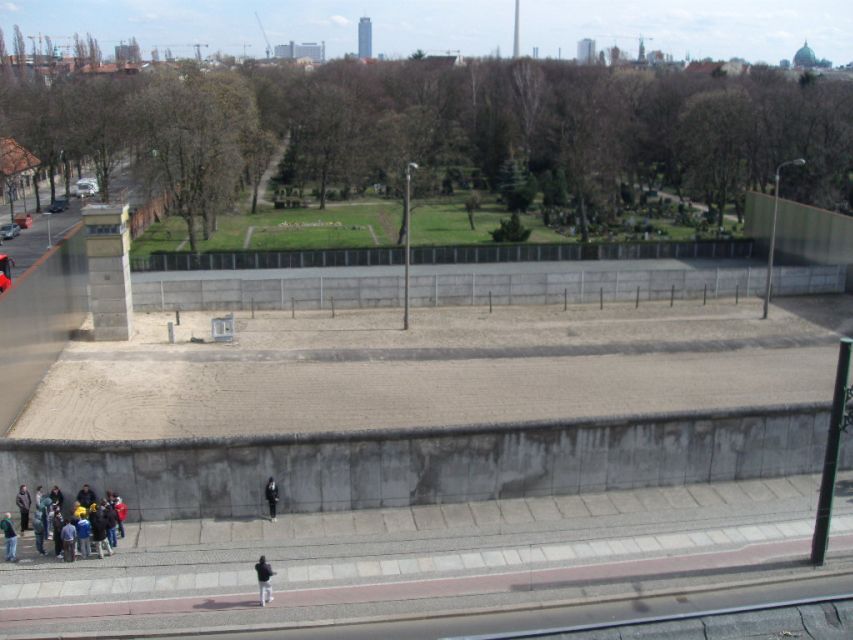
Brandenburg Gate is one of the essential stops on any first visit to Berlin, but its role in this tour is specific. The gate once sat beside the divided border and later became one of the most powerful images of reunification. Cycling toward it along the former Wall route connects the earlier memorials with the public symbol most people recognize.
You then continue toward Potsdamer Platz. Before division, this was a major city center. During the Wall years, the area became part of the border zone, and after reunification it changed again. Today, the modern buildings can make it hard to picture the empty border area that once occupied the site.
I appreciate the contrast here. The tour does not ask you to look only backward. It shows how quickly Berlin’s physical surroundings changed after 1989, while the memory of the border remained present in pavement markers, memorials, and fragments of Wall.
Potsdamer Platz is also a useful point for understanding scale. The Wall did not divide only quiet residential streets. It crossed major routes through the center of Berlin, affecting the movement of workers, families, and visitors.
Checkpoint Charlie and the Palace of Tears
Checkpoint Charlie is the best-known former crossing in Berlin. It is a quick visual shorthand for the Cold War, but the surrounding area can feel highly commercial and crowded compared with quieter memorial locations. I would not make it the sole reason for booking this tour. Its value comes from seeing it as one stop in a much larger route.
The final section includes the Tränenpalast, or Palace of Tears, on Friedrichstraße. The name refers to the farewells that took place there, especially when people from East Berlin had to say goodbye to family or friends leaving for the West. It is a powerful final piece of the story because it focuses on personal separation rather than military hardware.
The route passes Friedrichstadt Palace, Museum Island, the New Synagogue, and the Old Berlin Post Office before returning to the starting point. This last stretch places the border story within Berlin’s broader cultural and architectural center.
The finish at the original bike shop is practical. You return the bicycle where you began, rather than ending at an unrelated part of the city. The complete ride takes about four hours, so plan your next activity with some breathing room.
The guide, group size, and style of explanation
The tour is conducted in German with a live guide. That point deserves serious attention. The historical value depends on understanding the explanations, and the route includes many sites where the physical remains are partial or subtle. If your German is limited, you may see the places but miss much of the meaning.
Guide Ferenz has received particular praise for balancing friendliness, clear facts, and personal perspective. His own experience around the period of reunification has added a human dimension for people who joined the ride. Personal memories can make the history more immediate, though the quality of the experience will still depend on your German comprehension and your interest in discussion.
The group size is limited to eight participants, with a minimum of three. That gives you a better chance to hear at street-side stops and ask about the places that catch your attention. It also means the tour may not operate as a private outing if fewer people book, since the stated minimum is three.
The cycling itself is not described as a sporting challenge. Still, you are on a bicycle for four hours and covering a long route through Berlin. You should be comfortable riding in city conditions and prepared for changing weather. The operator provides a rain poncho when necessary, and the tour runs in all weather.
Is $40 a good value?
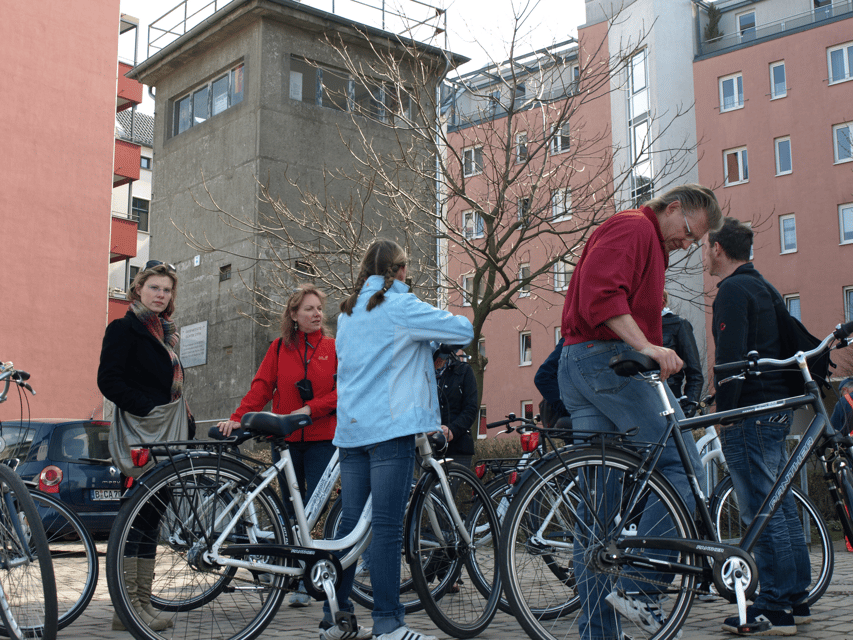
At $40 per person, the price is reasonable for a four-hour guided city ride. You receive the bicycle, tour fees, guide, and rain protection when needed. You are also paying for the route design, which links many Wall sites that would be difficult to connect efficiently on your own.
The strongest value is the combination of range and explanation. You see Bornholmer Straße, Mauerpark, Bernauer Straße, Chausseestraße, Invaliden Cemetery, the Parliament of the Trees, Brandenburg Gate, Potsdamer Platz, Checkpoint Charlie, and the Palace of Tears in one outing.
Food and drinks are not included. Plan to eat before or after the ride, or bring only what is permitted and practical for cycling. Since large bags are not allowed, do not treat the tour as a way to carry a full day’s luggage around Berlin.
Free cancellation is available up to 24 hours before departure, and you can reserve with payment later. Those terms help if your Berlin schedule is still shifting, but the main choice is still whether a German-language cycling tour fits your plans.
Who should book this experience?
I would choose this tour if you want a connected explanation of the Berlin Wall rather than a collection of separate city sights. It suits first-time Berlin visitors who want to understand how the border ran through the city, as well as repeat visitors who have already seen Brandenburg Gate and Checkpoint Charlie but want more context.
It is also a strong option for families with older children or teenagers who can cycle comfortably and follow a German explanation. One recent family experience specifically found the tour suitable for young people, with the historical stories holding attention better than a standard sightseeing route might.
You should think twice if you need an English-language guide, dislike cycling in rain, or prefer long indoor museum visits. This is a moving history lesson, with much of the learning happening outdoors at streets, memorials, parks, and former crossing points.
The high rating of 4.9 from 152 bookings fits the tour’s main strengths: clear explanations, well-maintained bicycles, a varied route, and personal historical context. I would place the greatest weight on the guide language and weather policy before booking.
Should you book the Berlin Wall cycling tour?
Book it if you want to connect Berlin’s Wall sites in one thoughtful half-day and you understand German. The small group, included bicycle, and route from Bornholmer Straße to Checkpoint Charlie make $40 good value, especially if you want places beyond the standard central sights.
Skip it if you need English commentary or prefer to explore at your own pace. For everyone else, this is a practical way to see how the Wall divided real streets, real neighborhoods, and real lives, then vanished into a city still learning how to remember it.
FAQ
Where does the Berlin Wall cycling tour start?
The tour starts at BERLIN BIKE TOUR, 75 Bornholmer Straße, Berlin 10439.
How long does the tour last?
The cycling tour lasts four hours.
What is the price?
The tour costs $40 per person.
How many people are in the group?
The small group has a minimum of three participants and a maximum of eight.
What language is the tour conducted in?
The live tour guide conducts the tour in German.
Is a bicycle included?
Yes. A bicycle is included in the tour price.
Is rain protection provided?
Yes. A rain poncho is provided when necessary, and the tour takes place in all weather.
Which major Wall sites does the route visit?
The route includes Bornholmer Straße, Mauerpark, Bernauer Straße, Chausseestraße, Invaliden Cemetery, the Parliament of the Trees, Brandenburg Gate, Potsdamer Platz, Checkpoint Charlie, and the Palace of Tears.
What should I bring?
Bring a passport or ID card, sunglasses, a sun hat, and a camera.
Can I bring luggage or a large bag?
No. Luggage and large bags are not allowed.
Is food included?
No. Food and drinks are not included.
Where can I reach the meeting point by public transport?
Björnsonstraße tram stop is about one minute away on foot. Bornholmer Straße S-Bahn station is about two minutes away, and Schönhauser Allee S-Bahn and U-Bahn station is about ten minutes away.
Just added around Berlin
- Berlin Wall and Cold War Bike Tour in Small Groups★ 5.0 · 114 reviews
- Berlin: Guided Private Bike Tour to Explore the Highlights★ 5.0 · 12 reviews
- Berlin : The best bike tour with a Berlin guide and insider tips★ 5.0 · 14 reviews
- Alternative Berlin Bike Tour – Off the Beaten Tracks in Small Groups★ 5.0 · 99 reviews
- Potsdam Bike Tour with Rail Transport from Berlin★ 4.5 · 81 reviews
- Berlin: Guided Bike tour of the Berlin Wall and Third Reich★ 5.0 · 160 reviews
- Berlin : Guided Private Sightseeing Tours with Funbikes, Teambikes★ 5.0 · 20 reviews
- 3-Hour Bike Tour of Tiergarten and Berlin’s Hidden Places★ 5.0 · 26 reviews
Small-Group Bike Tours, compared.
Rome City Small Group Bike Tour with quality Cannondale EBike
Read our review →
Complete Cracow Bike Tour (small group of maximum 15 people!)
Read our review →
Rome by Night – Ebike Small Group Tour – Food and Wine (Option)
Read our review →
Rome by Night: E-bike Small Group Tour -Food & Wine (Option)
Read our review →
Historic Athens: Small Group Electric Bike Tour
Read our review →
Browse the lists this tour appears in