
REVIEW · BERLIN
Small-Group Historical Bike Tour in Berlin
Berlin tells its story in layers. This 3 to 4-hour bike tour links the city’s Prussian, Jewish, Nazi, Cold War, and reunification landmarks in one steady ride. I like the broad route and the chance to cover far more ground than you could on foot.
I also like the small-group feel and the guides’ personal approach. Jerry, Pablo, and Demetrios are praised for clear storytelling, old photographs, humor, and patience with questions. The main drawback is that the bikes may not suit everyone. One bike used a back-pedal brake system, and another booking began late after problems with bike condition and finding the correct meeting point.
Five things to know before you book
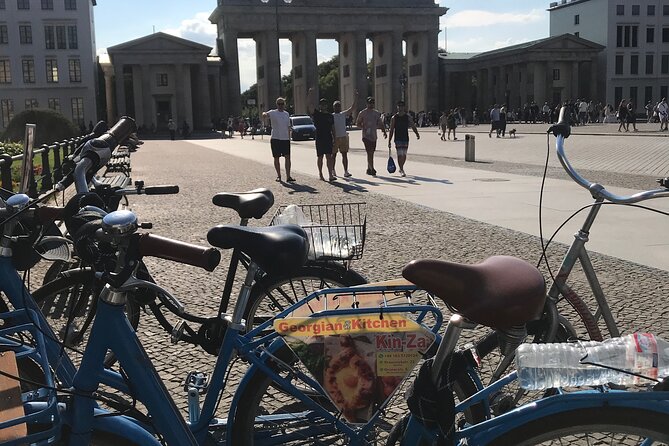
- The route covers major Berlin history in one morning: You visit the Berlin Wall Memorial, Reichstag, Brandenburg Gate, Holocaust Memorial, Topography of Terror, Checkpoint Charlie, Gendarmenmarkt, Bebelplatz, Museum Island, and more.
- Berlin is easy to cycle: The city is flat, and several riders describe the pace as gentle and safe.
- Guides are a major strength: Jerry, Pablo, and Demetrios are praised for lively explanations, old photos, humor, and a willingness to answer questions.
- The tour is personal rather than anonymous: It is listed as a private activity, with only your group participating, although the exact group size can vary.
- Check the meeting point carefully: Start at Panoramastraße 1 by the TV Tower at 11 a.m. The tower has two sides, and some people have waited at the wrong entrance.
Why a bike is a smart way to see Berlin
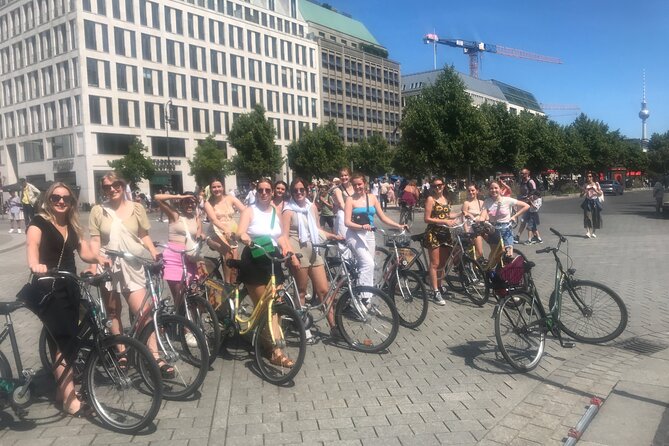
Berlin is spread out. Its key sights are not all gathered around one compact old town, so walking between them can eat up much of your day. On a bicycle, you can move from Museum Island to Bernauer Strasse, then across the former East-West divide and down toward the old Nazi government district.
The appeal here is not speed. The ride includes frequent stops, and the guide pauses to explain what you are seeing. That makes the bicycle a practical bridge between walking tours and bus tours. You cover more ground than on foot, but you still get out, look around, take pictures, and ask questions.
Several people found the cycling easy because Berlin is flat. The route is described as leisurely, and riders who felt nervous at first generally found the experience safe and relaxed. Still, you should be comfortable handling a bicycle in an urban setting.
The equipment is included, but bike quality can vary. Most comments describe the bikes as usable or decent. One detailed complaint described older bikes, delayed repairs, and a back-pedal brake that was difficult for a rider unfamiliar with the system. The provider explained that back-pedal brakes are common on Berlin’s three-speed bicycles. Ask for a quick explanation before setting off, especially if you normally use hand brakes.
More Small-Group Bike Tours in Germany
- Berlin Wall History Small Group Cycling Tour
★ 4.9 · 152 reviews - Berlin: Small Group Bike Tour Through City Center
★ 4.9 · 64 reviews - Small-Group Berlin Wall Bike Tour
★ 5.0 · 17 reviews
Starting beneath the TV Tower at Alexanderplatz
The meeting point is Panoramastraße 1, near Berlin’s famous TV Tower. This is a lively central location with strong public transport links, but it can be confusing because the tower area has two sides and more than one approach.
I would arrive early and use the full address rather than simply searching for the TV Tower. The main entrance and the nearby train station are useful reference points. The tour begins at 11 a.m. and returns to the same meeting point, which makes it easy to continue sightseeing afterward.
The opening stop gives you a short introduction to Alexanderplatz and the Fernsehturm. The tower is more than a city landmark. Its presence reflects the former East German capital, and the square has its own political and architectural story. The planned stop is about ten minutes, so expect an orientation rather than a visit inside the tower.
From there, the route includes St. Nicholas Church, one of the oldest landmarks in central Berlin. The church is tied to the beginnings of Berlin as a city, giving you an early chapter before the tour moves into the city’s darker modern history.
Oranienburgerstrasse and Berlin’s Jewish past
Oranienburgerstrasse brings the tour into Berlin’s Jewish history, with a view of the New Synagogue and the surrounding district. The stop lasts about fifteen minutes, enough for an explanation and photographs.
This is an important part of the route because Berlin’s past is not limited to the Wall and the Second World War. The synagogue and the street help place Jewish life within the wider story of the city. You get a reminder that Berlin was a major cultural and religious center before the destruction of the Nazi period.
The quality of this stop will depend heavily on your guide. Jerry is praised for bringing extra stories and answering questions, while Pablo is credited with using photographs and visual material to make the past easier to picture. If you want a long, detailed museum-style treatment, this short stop may feel limited. If you want a city orientation with useful context, it works well.
The Berlin Wall Memorial on Bernauer Strasse
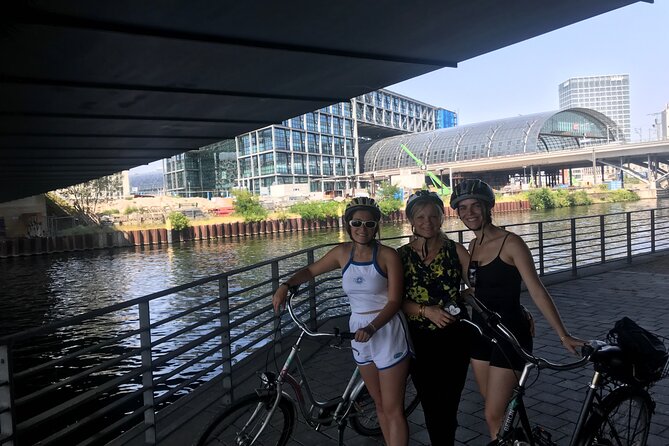
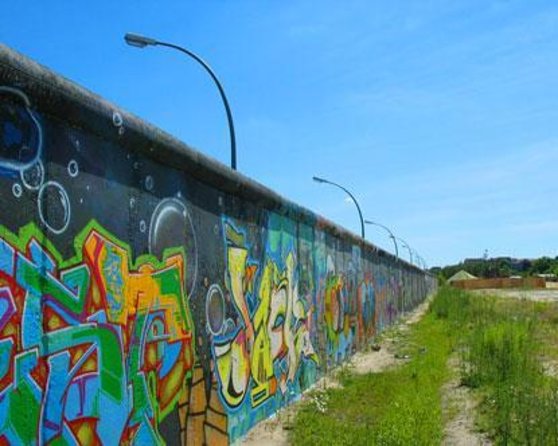
The Berlin Wall Memorial is one of the most valuable stops on the ride. The site stretches for about 1.4 kilometers along the former border strip on Bernauer Strasse. It includes a preserved section of Wall, traces of the border defenses, and the grounds behind the barrier.
You will spend roughly 25 minutes here. That is enough to understand the basic layout and hear about the human cost of the division, but not enough to explore the entire memorial at length. The memorial is also connected with the Berlin Wall Foundation and the history of escape and emigration from divided Germany.
This stop helps correct a common misunderstanding. The Wall was not simply one concrete barrier. It developed into a wider border system with fences, open areas, watch structures, and controlled crossings. Seeing the remaining pieces in their original setting makes the division easier to understand than a photograph alone.
I would pay close attention here and save questions for the guide. The route gives you a useful overview, but anyone wanting a full study of the Wall should return independently with more time.
More Heritage and Temple Bike Tours in Berlin:
- Berlin (E)Bike Tour Historical Highlights in Small groups
★ 4.5 · 24 reviews - Bangkok: Temples, Canals & Local Life Bike Tour
★ 4.9 · 3,511 reviews - Historical Singapore Bike Tour on Full-Sized Bicycles
★ 5.0 · 1,421 reviews - Barcelona: 2.5-Hour Bike or E-Bike Historical Tour
★ 4.5 · 1,262 reviews
Reichstag, Brandenburg Gate, and the city’s divided center
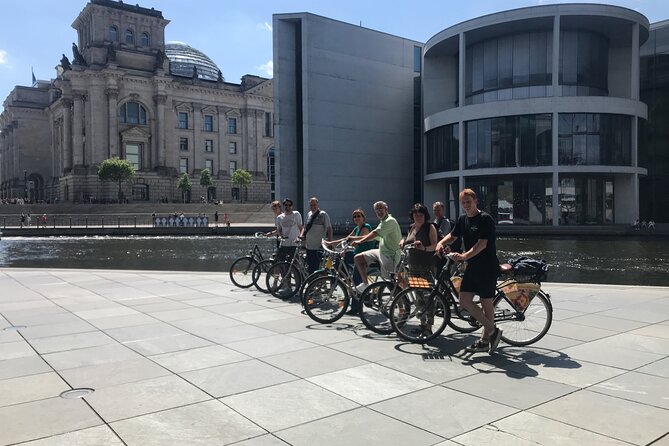
The ride then reaches the Reichstag Building, home of the German Parliament. The guide explains its role before the Nazi takeover, the 1933 fire, and the building’s place in Germany’s political story.
The stop is short, about ten minutes, so you should not expect to go inside. You will see the building from outside and hear the main points about the Weimar Republic and the Nazi seizure of power. The value is in connecting the building to the wider route, rather than treating it as just another grand facade.
Nearby, the Brandenburg Gate provides one of Berlin’s clearest symbols. Built during the reign of Friedrich Wilhelm II in the 18th century, it later sat in the restricted area between East and West Berlin. The same monument became a symbol of division during the Cold War and reunification after the Wall fell.
This is one of the places where a guide adds real value. A photograph shows the columns and horses on top. A good explanation shows why the gate became such a powerful political image. The stop is also practical for first-time visitors because you can return later for better photographs and a longer look.
The Holocaust Memorial and Topography of Terror
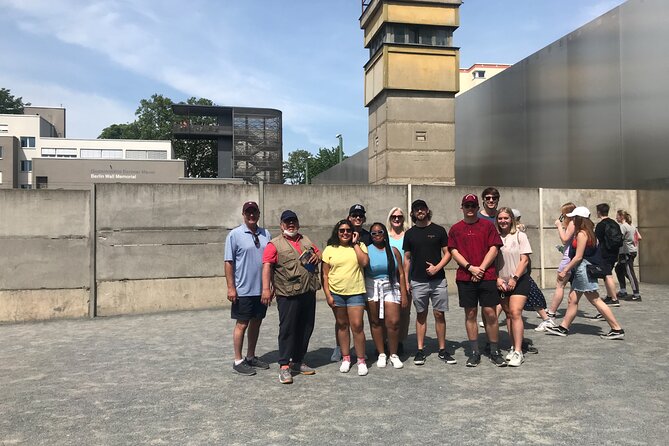
The Memorial to the Murdered Jews of Europe is made up of concrete slabs arranged across an open field near the Brandenburg Gate. You can walk among the slabs and take photographs while the guide explains the purpose and meaning of the site.
The planned stop lasts about fifteen minutes. That is enough to see the memorial and talk through its basic design, but the nearby underground information center is not listed as part of the tour. I would treat this as an introduction, not a complete visit.
The memorial can prompt strong reactions, and the guide’s tone matters. The best approach is quiet, direct, and respectful. You will have time to walk through the space, but the tour is still moving on a schedule.
A short ride brings you to the Topography of Terror, located on the former site of the Gestapo headquarters. The stop lasts about ten minutes and focuses on the location and photographs. This is another place where the site itself is powerful because very little of the original headquarters remains.
The stop gives you the setting for the Nazi police system and its crimes. If you want the full exhibition, plan a separate visit. The bicycle tour provides the geographic link between the government district, Nazi institutions, and the city center.
Checkpoint Charlie and Gendarmenmarkt
Checkpoint Charlie receives only about five minutes, so think of it as a quick orientation and photo stop. The famous crossing point became one of the best-known symbols of Cold War Berlin, but the modern setting is busy and commercial.
The short visit is sensible. You get the location and its place in the East-West story without spending too much of the tour at a reconstructed checkpoint. If this is a major interest, return later and spend more time reading about the actual border crossing and the people who used it.
At Gendarmenmarkt, the bicycle passes through the square while the guide explains its buildings and history. You have about ten minutes for photographs and discussion. It is a welcome change of pace after the heavier memorial sites.
The square also shows why a bike route works well in Berlin. You are not only moving between war and division landmarks. You are also seeing the city’s older civic architecture and central public spaces.
Bebelplatz and the book-burning memorial
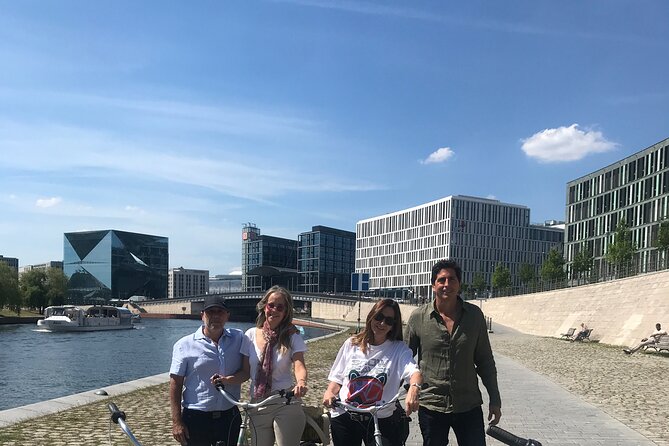
The next stop is Bebelplatz, where a memorial marks the Nazi book burning of 1933. The tour allows about fifteen minutes for an explanation and photographs.
This is a small memorial with a large subject. Its location beside major historic buildings makes the event easier to place within the city. The stop also shows how Berlin remembers crimes through quiet, easily missed markers rather than only through huge monuments.
You should listen closely here because the memorial can be easy to overlook when passing by on your own. This is one of the tour’s strongest arguments: a guide helps you notice places that do not announce themselves with a large sign.
Museum Island and the ride back to Alexanderplatz
Museum Island is covered from the bicycle, with the guide pointing out the museums and explaining the island’s place in Berlin. The stop lasts about fifteen minutes.
The tour does not include museum admission, and the itinerary does not promise entry into any museum. You will see the buildings from outside and get useful background. If you want to visit the museums, return on another day with a timed entry and several hours to spare.
The final ride returns to the TV Tower and the original meeting point. By then, you will have crossed several major chapters of Berlin’s story: the city’s medieval beginnings, Jewish life, Prussian architecture, Nazi rule, the Holocaust, Cold War division, and reunification.
That range is the tour’s real strength. It does not focus only on one period. It gives you a framework for the city, which is especially useful early in a Berlin visit.
Guide style and what to expect from the service
The guides are central to the experience. Jerry is repeatedly praised for warmth, humor, patience, and strong command of Berlin’s past. Pablo is praised for storytelling, photographs, and an easy way with groups. Demetrios is described as especially clear and well informed.
The tone appears personal rather than formal. Guides have adjusted the route for individual interests, including one private ride that sought out a memorial plaque connected with a rider’s family. That kind of flexibility is valuable if your group has a particular historical question or family connection.
The service is not perfectly uniform. One booking had trouble finding the guide and started about 30 minutes late. Another person felt the historical explanations were too light. That tells me you should view this as a lively overview, not a university lecture.
The tour is offered in English. Children must be accompanied by an adult, the minimum age is listed as two, and service animals are allowed. Most people can participate, but young children still need to be suitable for the bicycle arrangements provided.
Is $54.42 good value?
At $54.42 per person, this is a fair price for a 3 to 4-hour guided ride if you want both transport and historical interpretation. You are paying for the bicycle, a local guide, and a route that links many major sights without separate public transport trips between them.
The value is strongest on a first visit. You can use the tour to decide which places deserve a longer return visit. It is also useful if you have only a few days in Berlin and want a broad first look.
The price does not include food, drinks, hotel pickup, or admission to museums. Those exclusions are reasonable, but you should budget for your own refreshments. Since the route has many stops and can last four hours, bring water and dress for changing weather. Casual clothing is suitable.
Free cancellation is available up to 24 hours before the start time. Changes or cancellations made inside that window are not refundable. The activity also requires a minimum number of participants, and a cancellation for that reason comes with the choice of another date or a full refund.
Who should book this Berlin bike tour?
I would choose this ride if you want:
- A first-day overview of central Berlin
- A mix of Nazi, Jewish, Prussian, Cold War, and reunification history
- Gentle cycling instead of a long walking route
- Frequent stops for photographs and questions
- A guide who can adapt explanations to your interests
- A small or private group setting
I would think twice if you want long visits inside museums, highly polished bicycles, or a tightly timed professional operation at every step. The route is broad, and some stops are brief. Bike condition and guide style may vary.
Should you book it?
Yes, if your main goal is to get your bearings and understand how Berlin’s major historic sites connect. The flat streets, gentle pace, and wide-ranging route make this a strong introduction, especially early in your stay.
Book with realistic expectations. You are getting a lively outdoor overview, not a full museum tour or a specialist seminar. Confirm the TV Tower meeting point, arrive early, ask about the braking system, and tell the guide what interests you most. With those precautions, $54.42 buys a useful and memorable way to see the city.
FAQ
Where does the bike tour start?
The tour starts at Panoramastraße 1, 10178 Berlin, Germany, near the Berlin TV Tower at Alexanderplatz.
What time does the tour begin?
The scheduled start time is 11 a.m.
How long does the tour last?
The tour lasts approximately 3 to 4 hours.
Where does the tour finish?
The activity ends back at the original meeting point.
Is the tour offered in English?
Yes. The experience is offered in English.
Is bicycle use included?
Yes. Use of a bicycle is included in the tour price.
Are food and drinks included?
No. Food and drinks are not included.
Does the tour include hotel pickup and drop-off?
No. Hotel pickup and drop-off are not included.
What is the minimum age?
The minimum age is two years. Children must be accompanied by an adult.
Can I cancel for a full refund?
Yes, if you cancel at least 24 hours before the experience start time. Cancellations made less than 24 hours before the start time are not refundable.
More Small-Group Bike Tours in Berlin
- Small Group Guided Bike Tour of Amsterdam’s Hidden Gems
★ 5.0 · 3,936 reviews - Rome City Small Group Bike Tour with quality Cannondale EBike
★ 5.0 · 1,380 reviews - Complete Cracow Bike Tour (small group of maximum 15 people!)
★ 5.0 · 1,322 reviews - Rome by Night – Ebike Small Group Tour – Food and Wine (Option)
★ 5.0 · 1,275 reviews
Just added around Berlin
- Berlin Wall and Cold War Bike Tour in Small Groups★ 5.0 · 114 reviews
- Berlin: Guided Private Bike Tour to Explore the Highlights★ 5.0 · 12 reviews
- Berlin : The best bike tour with a Berlin guide and insider tips★ 5.0 · 14 reviews
- Alternative Berlin Bike Tour – Off the Beaten Tracks in Small Groups★ 5.0 · 99 reviews
- Berlin: Guided Bike tour of the Berlin Wall and Third Reich★ 5.0 · 160 reviews
- Berlin : Guided Private Sightseeing Tours with Funbikes, Teambikes★ 5.0 · 20 reviews
- Potsdam Bike Tour with Rail Transport from Berlin★ 4.5 · 81 reviews
- Small-Group Berlin Wall Bike Tour★ 5.0 · 17 reviews
Heritage and Temple Bike Tours, compared.
Historical Singapore Bike Tour on Full-Sized Bicycles
Read our review →
Night Bike Tour with Temples & Flower Market Visit
Read our review →
Intramuros, Manila: Historical Bamboo Bike Tour
Read our review →
Historical Bike Tour of Savannah and Keep Bikes After Tour
Read our review →Browse the lists this tour appears in